Introduction
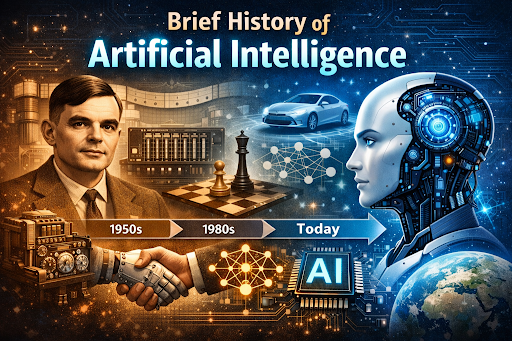
Today, artificial intelligence is everywhere. It helps us search the internet, unlock our phones, watch recommended videos, and even talk to virtual assistants. For many people, AI feels like a modern invention. But in reality, the story of artificial intelligence began long before smartphones or even personal computers existed, and it is closely connected to the history of computer development.
The idea that machines could think like humans once sounded impossible. It was more of a dream than a real technology. Over time, however, scientists and researchers slowly turned that dream into reality. The brief history of artificial intelligence is not just about machines — it is about human curiosity, experimentation, and persistence.
To understand modern AI, we first need to look back at how it all started.
The Early Thinking: Before AI Was Real
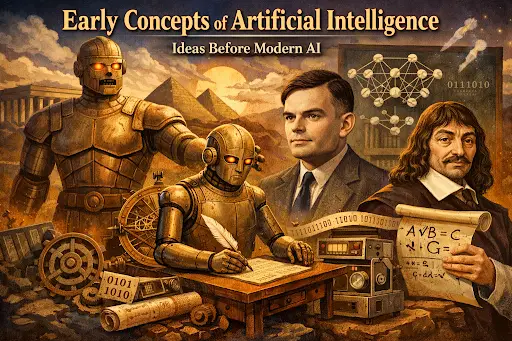
Long before computers were invented, people were already imagining intelligent machines. Philosophers used to ask questions like: Can a machine think? Can logic be turned into a mechanical process?
These questions remained theoretical for centuries because the technology simply did not exist yet.
In the 1800s, an important step was taken when Charles Babbage designed a mechanical calculating machine. His design showed that machines could follow instructions and perform tasks. Although his machine was not intelligent, it introduced an important concept — that thinking processes could be broken into steps.
This idea would later become essential for artificial intelligence.
Alan Turing: The Man Who Changed Everything
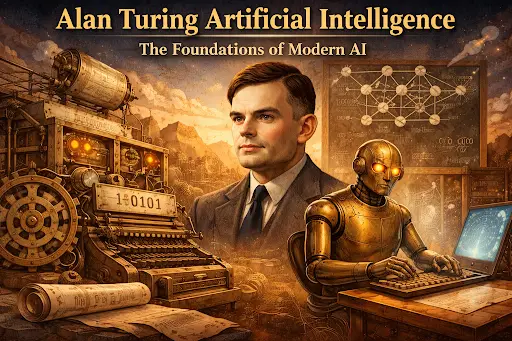
The real turning point came in 1950, when a British mathematician named Alan Turing asked a powerful question: Can machines think?
Instead of leaving it as a philosophical debate, he proposed a practical way to test it. He introduced what is now called the Turing Test. The idea was simple: if a person talks to a machine and cannot tell whether it is human or not, then the machine can be considered intelligent.
This idea was revolutionary. It gave scientists a clear goal and helped establish artificial intelligence as a serious scientific field.
Even today, Alan Turing’s work is considered the foundation of AI.
1956: Artificial Intelligence Gets Its Name
A few years later, in 1956, a group of researchers met at Dartmouth College in the United States. This meeting became a historic moment because it was here that the term “Artificial Intelligence” was officially introduced.
The researchers believed that machines could be built to simulate human intelligence. They started developing programs that could solve problems and perform logical tasks.
This was the beginning of artificial intelligence as an academic discipline.
At the time, many scientists were very optimistic. Some even believed intelligent machines would be created within their lifetime.
Early Success and Rising Expectations
In the years that followed, researchers made impressive progress. Computers were able to solve mathematical problems and play simple games.
These early achievements created excitement. Governments and universities began investing in AI research.
However, there was one major problem: computers were still very limited.
They were slow, expensive, and lacked the power needed for advanced intelligence.
As a result, progress did not move as quickly as people had hoped.
The Difficult Period Known as the AI Winter
By the 1970s, disappointment began to grow. Many promises had been made, but the results were not meeting expectations.
Funding was reduced, and interest in artificial intelligence declined.
This period became known as the AI Winter.
For several years, AI research slowed down. Some people even believed artificial intelligence would never succeed.
But behind the scenes, researchers continued their work. They improved methods and waited for technology to catch up.
Their patience would eventually pay off.
Artificial Intelligence Makes a Comeback
In the 1990s, artificial intelligence started gaining attention again. Computers had become faster and more affordable. This allowed researchers to work with larger amounts of data.
One of the most famous moments happened in 1997, when an AI system defeated the world chess champion Garry Kasparov.
This event showed the world that machines could handle highly complex tasks.
It restored confidence in artificial intelligence.
The Modern AI Revolution
The biggest growth in artificial intelligence has happened in the last decade.
Thanks to powerful computers, massive data, and improved algorithms, AI has reached a new level.
Today, artificial intelligence is used in many real-world applications:
Voice assistants that answer questions
Apps that recognize faces
Systems that detect fraud
Tools that help doctors analyze medical data
AI is no longer experimental — it is part of everyday life.
What once seemed like science fiction has become reality.
Why Artificial Intelligence Matters Today
Artificial intelligence has changed the way the world works.
Businesses use it to make better decisions. Hospitals use it to improve patient care. Technology companies use it to create smarter products.
Even simple daily tasks, like getting directions or receiving recommendations, depend on AI.
Many people use artificial intelligence without even realizing it.
Its influence continues to grow every year.
The Future of Artificial Intelligence
Looking ahead, artificial intelligence is expected to become even more advanced.
Researchers are exploring new possibilities, including machines that can learn more efficiently and solve complex problems.
While there are still challenges, one thing is clear: artificial intelligence will continue to shape the future.
Just as it evolved in the past, it will keep evolving in the years to come.
FAQ
Who is known as the father of artificial intelligence?
Alan Turing is widely considered the father of artificial intelligence because of his early ideas and contributions.
When did artificial intelligence officially begin?
Artificial intelligence became an official field of study in 1956 during the Dartmouth conference.
Why did artificial intelligence slow down in the past?
Progress slowed because computers were not powerful enough, and research funding was reduced.
Is artificial intelligence still developing?
Yes, artificial intelligence continues to grow and improve as technology advances.
Conclusion
The history of computer and the brief history of artificial intelligence is a story of ideas turning into reality. What began as a simple question about machine intelligence has become one of the most powerful technologies ever created.
Artificial intelligence did not develop overnight. It took decades of research, failures, and breakthroughs.
Today, AI is shaping the modern world, and its journey is far from over.
Understanding its history reminds us that every major innovation begins with a simple idea.