Introduction
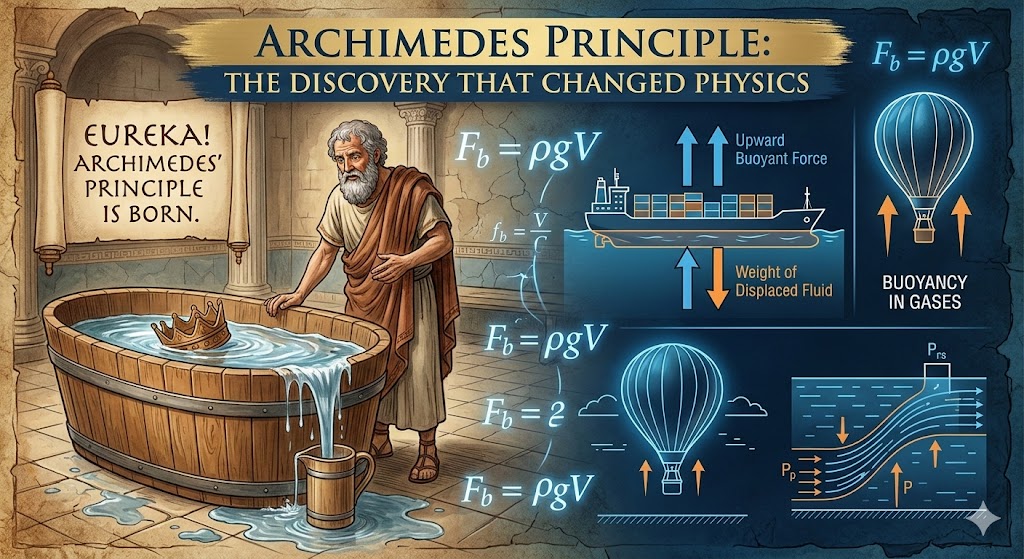
The Archimedes Eureka moment is one of the most famous stories in the history of science. It describes the exciting moment when Archimedes discovered an important scientific principle while taking a bath.
This discovery later became known as the Archimedes Principle, which explains why objects float or sink in water. The story of the “Eureka” moment shows how observation, curiosity, and simple thinking can lead to groundbreaking discoveries.
Even more than two thousand years later, the Archimedes Eureka moment remains one of the most inspiring events in scientific history.
The Problem Given by the King
The story begins in the ancient Greek city of Syracuse, where Archimedes lived and worked.
The ruler of the city, Hiero II, ordered a crown made from pure gold. However, he suspected that the goldsmith might have secretly mixed silver into the crown.
The king wanted Archimedes to solve the problem:
- Determine whether the crown was pure gold
- Do it without damaging the crown
This was a difficult challenge because traditional methods required melting the object.
Archimedes began thinking deeply about the problem but could not find an immediate solution.
The Famous Bath Discovery
One day, while taking a bath, Archimedes noticed something interesting.
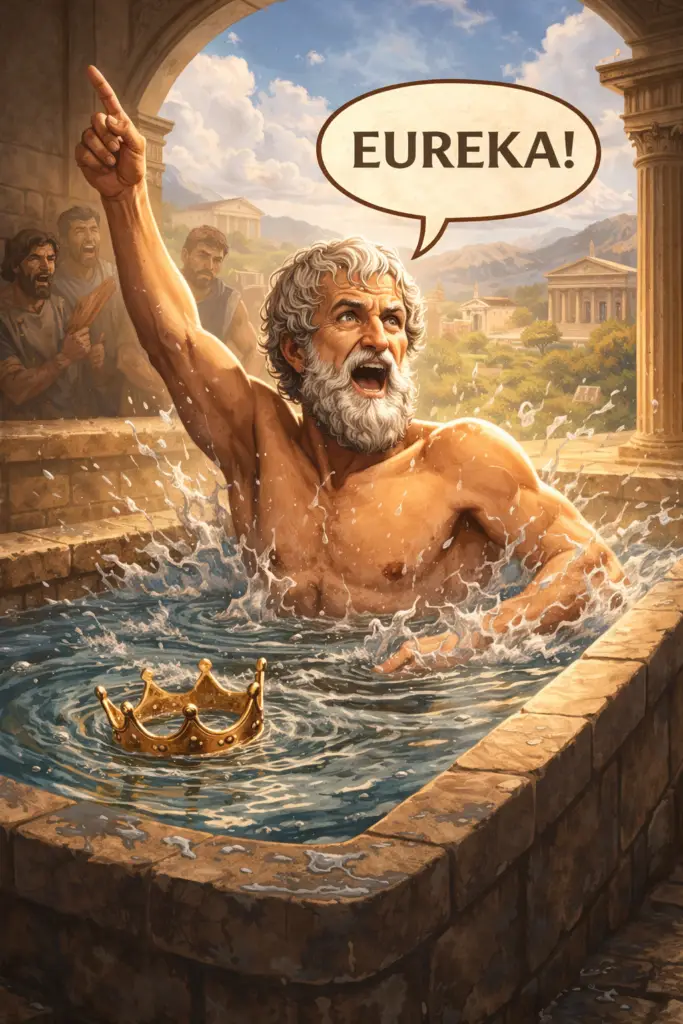
As he stepped into the bathtub, the water level rose and some water spilled out. At that moment, he realized something important:
The amount of water displaced depends on the volume of the object placed in it.
This simple observation gave him the idea he needed to test the crown.
According to legend, Archimedes became so excited about his discovery that he ran through the streets shouting:
“Eureka! Eureka!”
The Greek word Eureka means “I have found it.”
Understanding the Scientific Idea
The Archimedes Eureka moment led to the discovery of a key principle in physics.
The idea states:
When an object is placed in water, it pushes water aside.
The amount of water displaced is equal to the volume of the object.
Using this method, Archimedes could compare the crown with pure gold. If the crown displaced more water than a gold block of the same weight, it meant silver had been mixed into it.
This principle later became known as Archimedes’ Principle, which explains buoyancy.
Why the Eureka Moment Was Important
The discovery made by Archimedes had a huge impact on science and engineering.
The principle is still used today in many fields, including:
- Ship and submarine design
- Fluid mechanics
- Density calculations
- Engineering and physics research
The Archimedes Eureka moment also shows how great discoveries often come from simple observations of everyday events.
Archimedes’ Legacy in Science
Archimedes is remembered as one of the greatest scientists of ancient history. His work influenced mathematics, engineering, and physics for centuries.
Many inventions and discoveries are linked to him, including:
- The Archimedes Principle
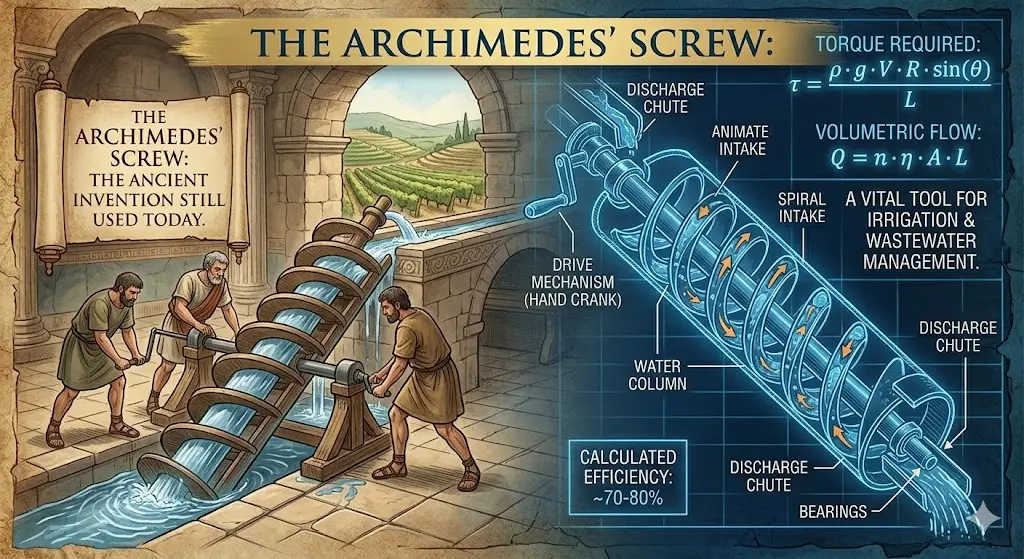
- The Archimedes Screw for lifting water
- Advanced mathematical formulas
- Mechanical war machines used to defend Syracuse
His ideas later inspired scientists such as Isaac Newton and Galileo Galilei, who helped shape modern science.
Conclusion
The Archimedes Eureka moment remains one of the most fascinating stories in scientific history. It demonstrates how curiosity and careful observation can lead to revolutionary discoveries.
From a simple bath experiment came a principle that still helps scientists understand the behavior of objects in fluids.
More than 2,000 years later, the story of Archimedes shouting “Eureka!” continues to inspire scientists, students, and innovators around the world.