Introduction
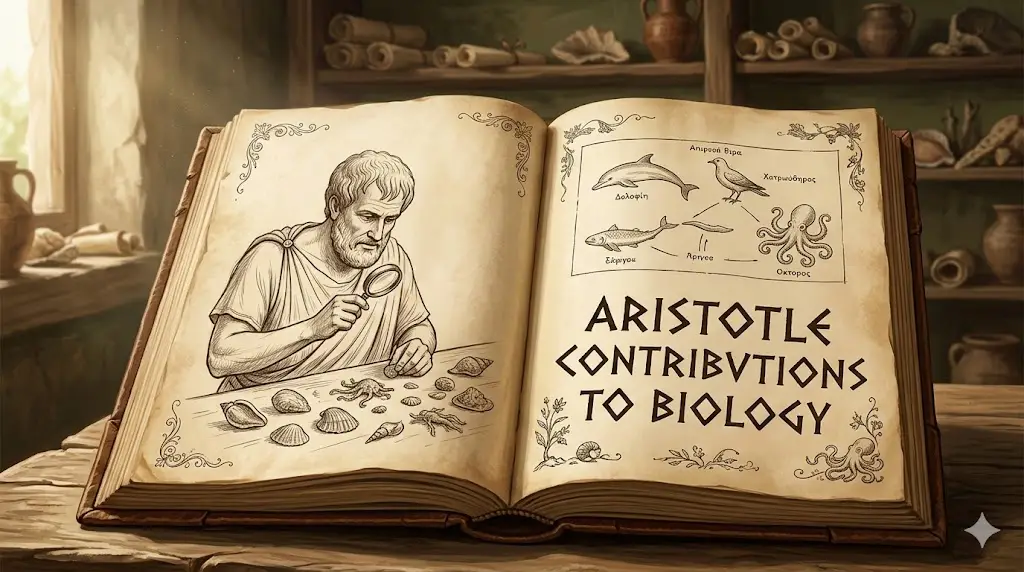
Long before the invention of the microscope or the discovery of DNA, one man sought to categorize the natural world through pure observation and logic. Aristotle contributions to biology are so foundational that he is frequently referred to as the “Father of Biology” or the “Father of Zoology.” While he is widely known for his philosophical works, his dedication to studying living organisms laid the groundwork for the life sciences as we know them today.
Aristotle Contributions to Biology
Aristotle’s work in biology was not merely a hobby; it was a systematic attempt to understand the “soul” or the animating principle of life. His biological treatises, such as History of Animals, Parts of Animals, and Generation of Animals, constitute about a quarter of his surviving writings. He moved science away from pure speculation and toward empirical evidence, asserting that to understand life, one must examine it closely.
Aristotle’s Method of Scientific Observation
Unlike many of his predecessors who relied on myths, Aristotle championed a hands-on approach. He believed that knowledge began with the senses. This Aristotle scientific method involved:
- Direct Observation: Spending years observing marine life on the island of Lesbos.
- Data Collection: Gathering detailed accounts of over 500 species.
- Inductive Reasoning: Drawing general conclusions from specific biological observations.
While he didn’t have modern lab equipment, his insistence on “observation first, theory second” remains a pillar of modern biology.
Classification of Living Organisms
One of the most significant Aristotle contributions to biology was his “Scala Naturae” or the “Great Chain of Being.” He was the first to organize creatures into a structured hierarchy based on their complexity and “perfection.”
| Category | Characteristics | Examples |
| Enaima (With Blood) | Vertebrates; mostly viviparous | Humans, mammals, birds, fish |
| Anaima (Without Blood) | Invertebrates | Insects, shelled animals, mollusks |
He further subdivided these groups by habitat (air, land, water) and reproduction methods. Though his “bloodless” category was technically incorrect (they have hemolymph), the distinction between vertebrates and invertebrates was a brilliant early insight.
Study of Animal Anatomy and Behavior
Aristotle was a pioneer in comparative anatomy. Through dissection (primarily of animals), he identified that dolphins were mammals rather than fish because they possessed lungs and gave birth to live young.
He also made remarkably accurate observations regarding:
- Embryology: He studied the growth of chick embryos inside eggs to see how organs formed over time.
- Marine Biology: He described the social behavior of whales and the unique anatomy of octopuses.
- Ruminant Stomachs: He was the first to describe the multi-chambered stomachs of cattle.
Influence on Later Biological Research
The impact of Aristotle’s work lasted for nearly 2,000 years. During the Islamic Golden Age and the European Renaissance, his texts were the standard curriculum for any aspiring physician or naturalist. Scholars like Al-Jahiz and later Darwin looked back at his work with immense respect. When examining the broader Aristotle contributions to science, it is clear that his biological studies provided the template for all systematic inquiry. Darwin once remarked that while contemporary biologists were great, they were “mere schoolboys” compared to old Aristotle.
Aristotle as a Teacher and Scholar
Aristotle’s role as a teacher at the Lyceum ensured that his biological inquiries were collaborative. He encouraged his students, such as Theophrastus (the Father of Botany), to apply his observational methods to plants. This culture of inquiry turned biology from a series of random notes into a formal academic discipline.
Lasting Legacy in Biology
Even though modern science has corrected many of his errors—such as his belief that the heart, not the brain, was the seat of intelligence—the core of his work remains relevant. His focus on Aristotle contributions to science through the lens of teleology (the study of purpose in nature) helped future scientists ask why an organ is shaped the way it is, leading to the study of adaptation and function.
Frequently Asked Questions (FAQs)
Why is Aristotle called the Father of Biology?
He was the first person to systematically study, classify, and record the anatomy and behavior of living organisms using empirical observation rather than mythology.
What was Aristotle’s classification system called?
It was known as the Scala Naturae (Ladder of Nature), which organized life from the simplest organisms to the most complex.
Did Aristotle practice dissection?
Yes, he performed numerous dissections on animals to understand their internal structures, though he did not perform dissections on humans due to Greek cultural taboos.
Conclusion
The Aristotle contributions to biology represent the first great synthesis of zoological knowledge. By combining rigorous observation with a systematic classification system, he provided the framework that would eventually evolve into modern biology. His legacy is a reminder that science begins with the simple, profound act of looking closely at the world around us