Introduction: The Man Who Asked a Revolutionary Question
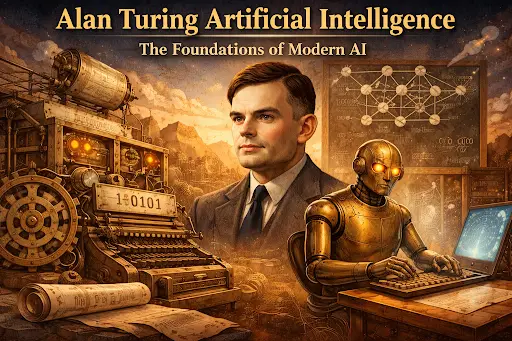
When we talk about Alan Turing artificial intelligence, we are talking about the intellectual beginning of modern AI.
Before artificial intelligence became a scientific field, one mathematician dared to ask a bold question:
Can machines think?
That question changed history.
In this article, we explore Alan Turing’s AI contribution, his famous Turing Test, and how his ideas built the foundations of artificial intelligence.
Who Was Alan Turing?
Alan Turing was a British mathematician, logician, and computer scientist. He is widely considered one of the fathers of computer science and artificial intelligence.
In the 1930s, Turing introduced the concept of the Turing machine — a theoretical model that explained how machines could perform calculations through logical steps. This idea became the foundation of modern computing.
Without this breakthrough, digital computers — and later AI systems — would not exist.
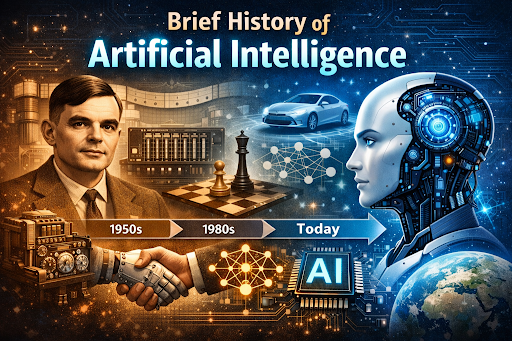
If you have already read our article on the brief history of Artificial Intelligence, you know that AI officially became a field in 1956. But Turing’s ideas came even earlier.
He prepared the ground.
The 1950 Paper That Changed Everything
In 1950, Alan Turing published a groundbreaking paper titled Computing Machinery and Intelligence.
In that paper, he did not try to define intelligence in a philosophical way. Instead, he proposed a practical experiment to test it.
This experiment later became known as the Turing Test.
Turing suggested that if a machine could communicate with a human in such a way that the human could not tell whether they were talking to a machine or another person, the machine could be considered intelligent.
This was revolutionary.
Instead of debating what “thinking” means, Turing focused on observable behavior.
What Is the Turing Test?
The Turing Test is simple in concept:
- A human judge communicates with two unseen participants.
- One is a human.
- One is a machine.
- If the judge cannot reliably tell which is which, the machine passes the test.
This idea connected machine intelligence directly with communication and reasoning.
Today, many AI chatbots are often compared to the Turing Test standard — even if the original test is rarely applied formally.
The Turing Test remains one of the most important ideas in the history of artificial intelligence.
Alan Turing’s AI Contribution Beyond the Test
When discussing Alan Turing artificial intelligence, many people only mention the Turing Test. But his contribution was much deeper.
1. Mathematical Logic and Computation
Turing proved that machines could follow logical rules to solve complex problems.
2. The Universal Machine Concept
His theoretical machine showed that one device could simulate any other machine’s logic process — a key idea behind modern computers.
3. Early Thoughts on Machine Learning
Turing even suggested that instead of programming machines with full adult intelligence, scientists should simulate a child’s mind and let it learn.
This idea sounds very similar to modern machine learning systems.
How Turing Built the Foundations of Artificial Intelligence
Artificial intelligence did not appear suddenly.
It evolved step by step.
Turing connected several essential ideas:
- Logic
- Mathematics
- Computation
- Human reasoning
His work bridged philosophy and engineering.
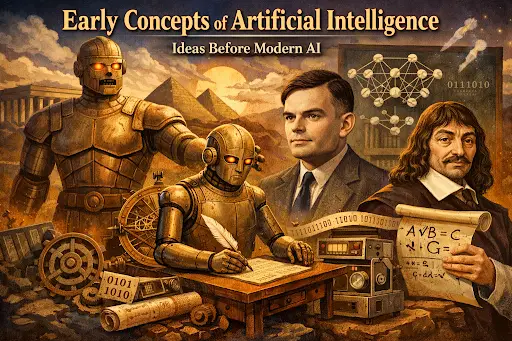
The concepts discussed in our article on early concepts of artificial intelligence show that AI began as imagination and philosophy. Turing transformed those ideas into scientific possibility.
Later, at the 1956 Dartmouth Conference, AI officially became a research field. But without Turing’s theoretical foundation, that event might never have happened.
Is Modern AI What Turing Imagined?
Modern AI systems can generate text, recognize images, and analyze massive datasets.
But would Turing consider today’s systems truly intelligent?
That question is still debated.
Some experts argue that passing the Turing Test does not guarantee real understanding. Others believe Turing’s behavioral approach was practical and still relevant.
What is clear is this:
The foundations of artificial intelligence were deeply shaped by Turing’s vision.
Why Alan Turing Still Matters Today
Understanding Alan Turing artificial intelligence helps us see that AI is not just a modern invention.
It is the result of decades of thinking about logic, machines, and human cognition.
Turing did not build today’s AI tools.
But he gave us the framework to imagine them.
And sometimes, imagination is the most powerful starting point.
Frequently Asked Questions (FAQs)
1. What is Alan Turing’s role in artificial intelligence?
Alan Turing laid the foundations of artificial intelligence by proposing that machines could simulate human thinking and by creating the Turing Test to evaluate machine intelligence.
2. What is the Turing Test in AI?
The Turing Test is a method proposed in 1950 to determine whether a machine can exhibit behavior indistinguishable from a human during conversation.
3. Did Alan Turing invent artificial intelligence?
Turing did not invent AI systems, but he established the theoretical and logical foundation that made AI research possible.
4. Why is Alan Turing important in the history of artificial intelligence?
He connected computation with intelligence and proved that machines could follow logical rules, which became the basis of AI development.
5. Is the Turing Test still relevant today?
Yes, although modern AI evaluation methods are more advanced, the Turing Test remains an important philosophical and historical benchmark.
Conclusion
The story of Alan Turing artificial intelligence is the story of a question:
Can machines think?
That single question transformed philosophy into science and theory into technology.
From the Turing machine to the Turing Test, his ideas built the foundations of artificial intelligence — long before AI became a global industry.
Modern AI may look different from what Turing imagined, but its roots still trace back to his vision.
And that is why Alan Turing remains one of the most important figures in the history of artificial intelligence.