Introduction: The Event That Started It All
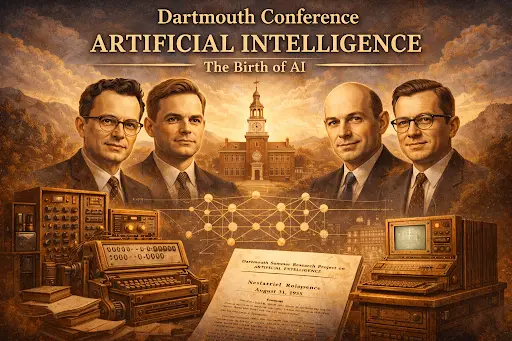
The Dartmouth Conference artificial intelligence event of 1956 is widely recognized as the official birth of AI research.
Before this conference, ideas about intelligent machines existed mainly in theory, from early concepts of artificial intelligence to Alan Turing artificial intelligence foundations.
At Dartmouth College, a small group of brilliant minds gathered to explore a revolutionary question: Can machines simulate human intelligence?
This meeting laid the groundwork for decades of AI research and innovation.
What Was the Dartmouth Conference?
The Dartmouth Conference, formally called the Dartmouth Summer Research Project on Artificial Intelligence, took place in the summer of 1956 at Dartmouth College, Hanover, New Hampshire.
It was organized by AI pioneers:
- John McCarthy – who coined the term “artificial intelligence”
- Marvin Minsky – later a leading AI researcher
- Claude Shannon – father of information theory
- Nathaniel Rochester – IBM engineer
Their goal was ambitious:
“Every aspect of learning or any other feature of intelligence can in principle be so precisely described that a machine can be made to simulate it.”
This statement became the guiding vision for AI research.
Why the Dartmouth Conference Matters
The conference is considered the birth of artificial intelligence because it:
- Introduced AI as a formal scientific field
- United leading researchers under a single vision
- Proposed early AI projects, including symbolic reasoning and problem-solving machines
- Inspired future AI milestones like expert systems, machine learning, and neural networks
Without this event, modern AI would likely have developed much later and in a less coordinated way.
Key People and Contributions
John McCarthy
Coined “artificial intelligence” and advocated for structured AI research.
Marvin Minsky
Focused on symbolic reasoning and knowledge representation — ideas that influenced AI programming languages.
Claude Shannon
Brought insights from information theory to machine intelligence.
Nathaniel Rochester
Helped design early computing systems that could run AI experiments.
The Outcomes of the Conference
Although no AI machine was created immediately, the Dartmouth Conference:
- Set the research agenda for the coming decades
- Encouraged collaborative efforts across universities and industry
- Created the first proposals for early AI projects
It also connected to the broader evolution of AI from Alan Turing artificial intelligence and early concepts of artificial intelligence to practical research experiments.
How Dartmouth Conference Influenced Modern AI
The Dartmouth Conference inspired AI research that eventually led to:
- Expert systems
- Machine learning
- Robotics
- Neural networks
It bridged theory and practice, linking the history of computers and programming languages to the practical development of intelligent machines.
Frequently Asked Questions (FAQs)
1. What is the Dartmouth Conference in AI?
The Dartmouth Conference artificial intelligence event of 1956 was the first formal gathering of scientists to define and explore AI as a research field.
2. Who organized the Dartmouth Conference?
John McCarthy, Marvin Minsky, Claude Shannon, and Nathaniel Rochester organized it.
3. Why is the Dartmouth Conference important?
It officially launched AI research, united top minds, and proposed early projects that shaped modern AI.
4. How did the Dartmouth Conference connect to Alan Turing’s ideas?
It built upon the foundations of Alan Turing artificial intelligence, moving from theoretical questions to practical research.
5. Did the Dartmouth Conference create AI immediately?
No, it set the research agenda. Actual AI programs came later, inspired by this event.
Conclusion
The Dartmouth Conference artificial intelligence event of 1956 was more than a meeting — it was the spark that ignited modern AI.
By formalizing AI research, bringing together pioneering minds, and proposing early projects, it created a roadmap that connected imagination, theory, and computation.
Without this historic conference, the AI systems we see today would not exist. It remains a milestone in the ongoing story of artificial intelligence.