Introduction
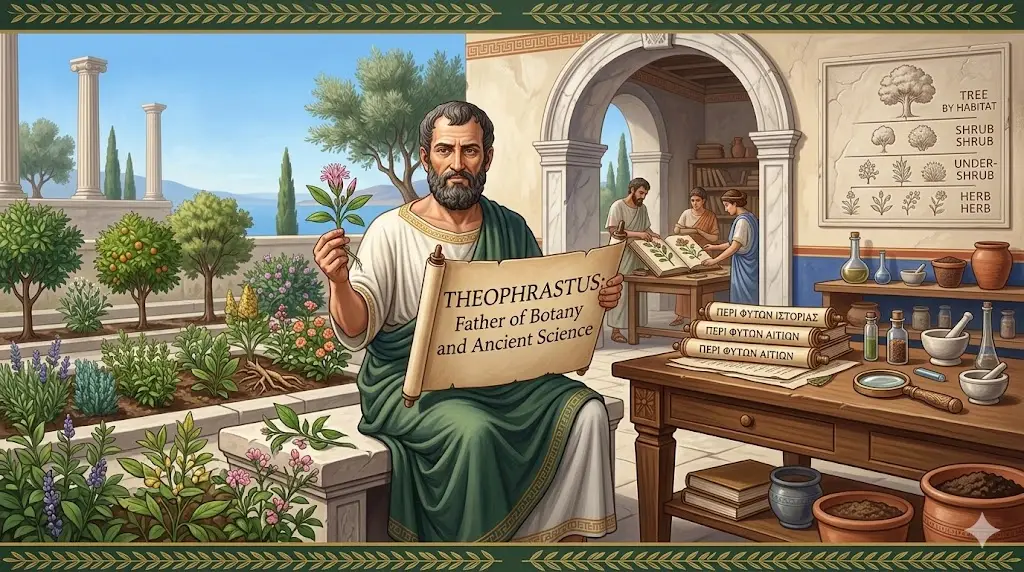
Theophrastus Father of Botany was one of the most influential thinkers of ancient Greece. Born around 371 BC in Eresos, Lesbos, he became a student of Aristotle and later succeeded him at the Lyceum in Athens. While Aristotle explored philosophy, physics, and zoology, Theophrastus dedicated much of his life to studying plants and the natural world, earning the title Father of Botany.
His work represents the earliest systematic attempt to understand the natural world in a scientific way. Theophrastus combined careful observation, logical reasoning, and detailed recording of plant features to create an early framework for botanical science.
Through his life and works, Theophrastus laid the foundation for centuries of biological and botanical research. Today, his contributions remain a cornerstone in the history of science.
Early Life and Education
Theophrastus grew up in a well-educated environment and quickly showed an interest in nature and philosophy. He became a disciple of Aristotle and was heavily influenced by Aristotle’s method of observation and logical reasoning.
Under Aristotle’s mentorship, Theophrastus developed a scientific approach to studying the natural world. He believed that careful observation and classification could reveal patterns in nature, a philosophy that would guide his future work.
Contributions to Science
While Theophrastus made contributions to philosophy and ethics, his most significant impact was in botany and the study of plants. His work can be summarized in three main areas, which will later become individual detailed articles:
- The First Scientific Study of Plants
Theophrastus meticulously observed plants in their natural habitats, recording their features, growth habits, and medicinal properties. He created detailed descriptions of trees, shrubs, and herbs, noting their uses in medicine, food, and construction. - Theophrastus’ Plant Classification System
To make sense of the variety of plants, Theophrastus developed one of the earliest classification systems. He categorized plants into trees, shrubs, and herbs, based on their structure and life cycle. This systematic approach became a model for later botanists. - Theophrastus’ Botanical Treatises
He authored seminal works, including Enquiry into Plants and On the Causes of Plants. These treatises provided detailed accounts of plant anatomy, reproduction, and environmental factors affecting growth. They were studied for over a thousand years and influenced medieval scholars and Renaissance scientists.
Scientific Approach
Theophrastus’ approach was revolutionary for his time. Unlike myth-based explanations common in ancient Greece, he relied on:
- Observation – studying plants directly in nature
- Classification – organizing plants systematically
- Recording – detailed notes on structure, growth, and utility
- Cause and Effect – identifying factors affecting plant growth
This methodology became a template for scientific inquiry and inspired future naturalists, including Carl Linnaeus, who formalized modern taxonomy.
Legacy of Theophrastus
Theophrastus Father of Botany is remembered as one of the most important figures in early science. His work created a bridge between Aristotelian philosophy and modern biological science, showing that the natural world could be studied systematically rather than philosophically.
His methods and observations influenced scholars in the Islamic world, medieval Europe, and the Renaissance. Theophrastus’ careful documentation of plants not only advanced botany but also laid the groundwork for agriculture, medicine, and ecology.
Frequently Asked Questions (FAQs)
1. Who was Theophrastus?
Theophrastus was an ancient Greek philosopher and scientist who lived from 371 BC to 287 BC. He was a student of Aristotle and later became the leader of Aristotle’s school in Athens. Theophrastus is best known for his scientific studies of plants.
2. Why is Theophrastus called the Father of Botany?
Theophrastus is called the Father of Botany because he conducted the first systematic and scientific study of plants. He carefully observed plant structure, growth, and classification, laying the foundation for modern botanical science.
3. What were the most famous works of Theophrastus?
Theophrastus wrote several important works on plant science. His most famous books are “Historia Plantarum” (Enquiry into Plants) and “De Causis Plantarum” (Causes of Plants), which describe plant characteristics, growth, and classification.
4. What did Theophrastus discover about plants?
Theophrastus discovered that plants could be studied scientifically through observation and classification. He identified different plant types such as trees, shrubs, and herbs and described their structures, reproduction, and environmental influences.
5. How did Theophrastus influence modern biology?
Theophrastus introduced systematic observation and classification of plants. His work inspired later scientists and helped establish botany as a scientific discipline, influencing biological studies for centuries.
6. When did Theophrastus live?
Theophrastus lived between 371 BC and 287 BC in ancient Greece during the classical period of Greek philosophy and science.
7. Who taught Theophrastus?
Theophrastus was taught by the famous philosopher Aristotle. After Aristotle’s death, Theophrastus became the head of the Lyceum school in Athens.
8. Why is Theophrastus important in the history of science?
Theophrastus is important because he introduced scientific observation into the study of plants. His research helped transform plant knowledge from traditional beliefs into a structured scientific field.
Conclusion
Theophrastus Father of Botany represents a pivotal moment in the history of science. By observing, classifying, and recording plants, he became the first to approach the natural world in a systematic, scientific manner.
His discoveries, including The First Scientific Study of Plants, Theophrastus’ Plant Classification System, and Theophrastus’ Botanical Treatises, will later be explored in detail in separate articles.
Studying Theophrastus reminds us that scientific observation and curiosity are timeless principles, guiding human understanding of the natural world for over two thousand years.