Introduction
Artificial intelligence has developed through several important phases, each introducing new techniques that allow machines to simulate aspects of human intelligence. One of the most significant milestones in this journey was the emergence of expert systems in artificial intelligence. During the late 1970s and throughout the 1980s, expert systems became one of the earliest practical applications of AI in real-world industries.
Before the rise of modern machine learning algorithms, many researchers believed that intelligent computers could be created by capturing human expertise in the form of logical rules. Expert systems were designed to replicate the decision-making ability of specialists such as doctors, engineers, and financial analysts.
This approach allowed computers to assist with complex problems that normally required years of professional experience. Although expert systems eventually revealed certain limitations, they played a crucial role in the history of expert systems and proved that artificial intelligence could deliver meaningful value in practical settings.
The Origins of Expert Systems
The concept of expert systems grew out of earlier symbolic AI research. During the early decades of artificial intelligence development, scientists believed that intelligence could be represented through structured knowledge and logical reasoning.
Early AI programs demonstrated that computers could perform tasks such as solving mathematical problems or playing strategic games. However, these systems were designed for very narrow environments and could not easily adapt to new situations.
Researchers soon began asking whether computers could replicate the knowledge of highly trained professionals within specific domains. Instead of attempting to build general intelligence, they focused on creating knowledge-based systems capable of storing specialized expertise.
This shift in thinking occurred soon after the optimism that followed the Dartmouth Conference, where many scientists predicted rapid advancements in AI research.
By the late 1960s and early 1970s, scientists were experimenting with systems capable of applying expert knowledge to real-world problems. These early experiments marked the beginning of expert system development.
What Are Expert Systems in Artificial Intelligence?
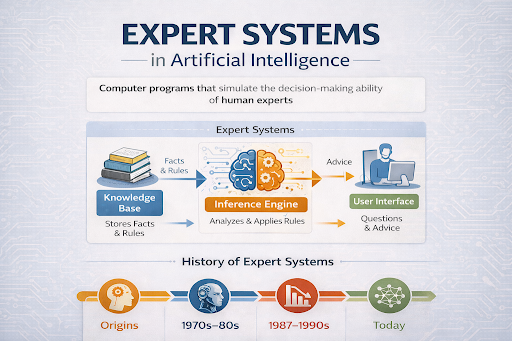
Expert systems in artificial intelligence are computer programs designed to imitate the reasoning and decision-making abilities of human experts. They achieve this by storing expert knowledge in structured rules and applying logical reasoning to analyze problems.
Unlike modern machine learning systems that learn patterns from data, rule-based expert systems rely on predefined knowledge provided by specialists.
For example, a medical expert system may contain hundreds or even thousands of rules describing symptoms, diseases, and possible treatments. When a user enters information about a patient, the system evaluates the rules and suggests possible diagnoses.
Through this method, computers were able to deliver advice that resembled the recommendations of trained professionals.
Although expert systems do not possess true understanding, they can perform logical reasoning tasks that are extremely useful in specialized fields.
How Expert Systems Work
Expert systems operate through several core components that enable them to process knowledge and generate conclusions.
Knowledge Base
The knowledge base contains the facts, rules, and expertise collected from human specialists. This information forms the foundation of the expert system.
For example, a rule might state:
If symptom A and symptom B appear together, the likely diagnosis is disease X.
Thousands of such rules can be stored within the system, allowing it to analyze complex problems.
Inference Engine
The inference engine acts as the reasoning mechanism of the system. It evaluates the rules stored in the knowledge base and determines which rules apply to the problem being analyzed.
By following logical rule chains, the inference engine can reach conclusions, provide recommendations, or suggest possible solutions.
Together, the knowledge base and inference engine enable AI expert systems to simulate the reasoning process used by human professionals.
Early Examples of Expert Systems
Several early expert systems demonstrated how this technology could solve complex problems.
One of the earliest successful systems was DENDRAL, developed in the 1960s. It helped chemists identify molecular structures by analyzing chemical data and applying expert knowledge.
Another well-known example is MYCIN, created in the 1970s at Stanford University. MYCIN assisted doctors in diagnosing bacterial infections and recommending antibiotic treatments. Even though it was primarily a research project, it showed that AI could assist medical professionals.
Later, the XCON expert system was used by Digital Equipment Corporation to configure computer systems for customers. This system significantly reduced errors and saved companies millions of dollars.
These early applications demonstrated that AI expert systems examples could solve specialized problems that required deep technical expertise.
The Commercial Boom of Expert Systems
During the 1980s, expert systems became one of the most widely adopted technologies in artificial intelligence.
Businesses realized that capturing expert knowledge inside computer systems could improve productivity, reduce costs, and support decision-making.
Industries began implementing expert systems for tasks such as:
Medical Diagnosis
Financial Analysis
Industrial Troubleshooting
Engineering Design
Large technology companies invested heavily in expert systems technology, and programming languages such as LISP and Prolog were commonly used to develop these systems.
For several years, expert systems represented the most commercially successful application of artificial intelligence.
However, as organizations deployed larger systems, new challenges began to appear.
Limitations of Expert Systems
Despite their early success, expert systems faced several significant limitations.
One of the biggest challenges was knowledge acquisition. Extracting expert knowledge and converting it into thousands of logical rules required extensive collaboration between domain experts and software developers.
Maintaining these knowledge bases also became difficult. As systems expanded, updating and managing large collections of rules required continuous human oversight.
Expert systems also struggled when confronted with unfamiliar situations that were not covered by existing rules.
These limitations eventually contributed to declining enthusiasm for rule-based AI systems and played a role in the second AI winter.
The Role of Expert Systems in AI History
Even though expert systems lost popularity over time, their impact on the development of artificial intelligence remains significant.
They demonstrated that AI could provide real value in practical business environments. For the first time, intelligent systems were used to support professional decision-making across multiple industries.
Expert systems also revealed the limitations of purely rule-based reasoning. This realization encouraged researchers to explore new approaches such as machine learning and data-driven algorithms.
Many of the ideas that later influenced early machine learning research emerged from attempts to overcome the limitations of expert systems.
This transition marked an important turning point in the evolution of machine learning algorithms.
Modern Impact of Expert Systems
Although traditional expert systems are less common today, their influence continues to shape modern artificial intelligence technologies.
Many decision-support systems still rely on structured knowledge and rule-based reasoning. Fields such as healthcare, finance, cybersecurity, and engineering continue to benefit from knowledge-based AI systems.
In addition, the concepts of knowledge representation and logical reasoning remain essential topics in AI research.
Modern AI applications often combine machine learning techniques with rule-based systems to improve accuracy and interpretability.
This hybrid approach demonstrates how the legacy of expert systems continues to influence modern intelligent systems.
Future Outlook
Artificial intelligence is evolving rapidly, but the fundamental ideas behind expert systems remain valuable.
Future AI systems may integrate structured knowledge with advanced machine learning models to create systems that are both powerful and interpretable.
For example, research in explainable AI focuses on making machine learning systems easier for humans to understand. Rule-based reasoning, which originated from expert systems, can help improve transparency.
Expert knowledge will also remain essential in specialized fields such as medicine, engineering, and scientific research.
Rather than disappearing, the principles of expert systems are likely to remain an important part of the AI ecosystem for years to come.
Frequently Asked Questions (FAQs)
What are expert systems in artificial intelligence?
Expert systems in artificial intelligence are computer programs that simulate the decision-making ability of human experts using structured knowledge bases and logical rules.
How do expert systems work?
Expert systems analyze problems by applying rules stored in a knowledge base through an inference engine that performs logical reasoning.
What are examples of expert systems?
Some well-known examples include DENDRAL for chemical analysis, MYCIN for medical diagnosis, and XCON for computer system configuration.
Why were expert systems important in AI development?
They represented one of the first successful commercial uses of artificial intelligence and demonstrated how computers could assist human decision-making.
Are expert systems still used today?
Yes. Although machine learning dominates modern AI, rule-based systems are still used in specialized decision-support applications.
Conclusion
The development of expert systems in artificial intelligence marked an important chapter in the history of AI. These systems proved that computers could capture specialized human knowledge and apply it to complex decision-making tasks.
Although their limitations eventually led researchers to pursue new approaches, expert systems played a vital role in demonstrating the practical potential of artificial intelligence.
Today, their influence continues to shape modern AI technologies, and the ideas they introduced remain essential to the design of intelligent systems.