Artificial Intelligence (AI) has evolved significantly over the years, with one of the most pivotal breakthroughs being neural networks. In simple terms, a neural network is a system inspired by the way the human brain works, allowing machines to learn from data, make decisions, and improve over time. While the idea of neural networks has been around since the 1940s, their true rise and potential only began to materialize in the last few decades.
In this article, we’ll explore the rise of neural networks, uncovering their origins, breakthroughs, and the revolutionary impact they have had on modern AI. From the early days of rudimentary models to today’s sophisticated deep learning architectures, neural networks have shaped AI as we know it.
Early Origins: From Brain Models to Perceptrons
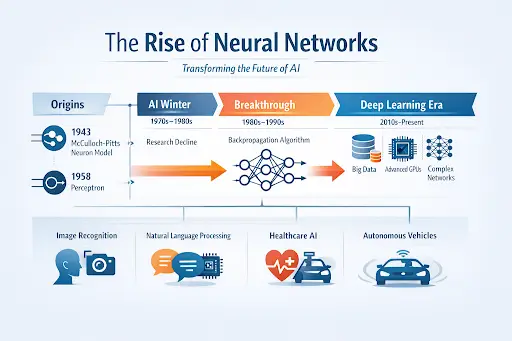
The journey of neural networks began in the mid-20th century, when researchers sought to replicate the function of the human brain. In 1943, Warren McCulloch and Walter Pitts proposed a simple mathematical model of the brain, known as the McCulloch-Pitts neuron. This model laid the foundation for artificial neurons, which are the building blocks of neural networks.
However, it was Frank Rosenblatt’s development of the Perceptron in 1958 that truly marked the beginning of neural networks in the realm of AI. The Perceptron was designed as a binary classifier — essentially a model that could learn from examples and categorize inputs. It was an exciting step forward, but the Perceptron had limitations that slowed its progress in the 1960s. Despite its limitations, it sparked interest in the potential of neural networks and inspired further research.
For more about early challenges in AI, you can explore the history of AI Winter and its impact.
Challenges and AI Winter(s)
As promising as the early neural network models seemed, they faced significant challenges. In the 1960s and 1970s, the limitations of the Perceptron, particularly its inability to solve more complex problems, led to disappointment in the AI community. Researchers began to question the feasibility of neural networks, and funding for AI research started to dry up. This period, known as the AI Winter, was marked by reduced interest and investment in AI, particularly neural networks.
However, despite these setbacks, neural network research never truly ceased. While interest waned for a while, the groundwork laid during this time would later prove invaluable as technology advanced. To understand more about this period, check out our article on the history of AI Winter.
Breakthrough: Deep Learning Emerges
The real resurgence of neural networks came in the 1980s and 1990s, with the development of backpropagation — an algorithm that allowed networks to learn more efficiently. This breakthrough, introduced by Geoffrey Hinton and others, enabled neural networks to be trained on much larger datasets. For the first time, networks could adjust their weights to minimize error and improve accuracy, revolutionizing the field.
At the same time, the development of more sophisticated hardware and the availability of big data allowed neural networks to scale to new heights. This culminated in the rise of deep learning, a subset of neural networks with multiple layers that could process vast amounts of information and perform tasks that were previously impossible. Deep learning models, like Convolutional Neural Networks (CNNs) and Recurrent Neural Networks (RNNs), became the backbone of modern AI.
Key Milestones in Neural Network Evolution
The evolution of neural networks can be traced through several key milestones. One of the most notable moments came in 2012, when a deep neural network known as AlexNet won the ImageNet competition by a wide margin. AlexNet, developed by Geoffrey Hinton and his students, demonstrated the power of deep learning to recognize images with exceptional accuracy. This victory marked the dawn of deep learning as a dominant force in AI.
Following AlexNet, other models such as ResNet, LSTMs, and the Transformer architecture further pushed the boundaries of what neural networks could achieve. These models excelled in a wide range of applications, from image recognition and natural language processing (NLP) to autonomous vehicles and medical diagnostics.
For a deeper dive into how machine learning evolved, read about the Evolution of Machine Learning Algorithms.
Why the Rise of Neural Networks Matters, Real-World Impact
The rise of neural networks has had a profound impact on various industries. One of the most visible effects is in image recognition, where neural networks have revolutionized the ability to identify objects, people, and scenes. This has applications in everything from self-driving cars to facial recognition systems.
In natural language processing (NLP), neural networks are behind the success of systems like Google Translate and virtual assistants like Siri and Alexa. These systems can understand and generate human language in ways that were once unimaginable.
Furthermore, neural networks have contributed to breakthroughs in fields such as healthcare, where they are used to predict diseases, analyze medical images, and even discover new drugs. The ability of neural networks to identify patterns in vast datasets has proven invaluable across various domains.
Future of Neural Networks in AI
Looking ahead, the future of neural networks seems boundless. Researchers are now exploring neuromorphic computing, which aims to design artificial neurons and networks that more closely resemble the human brain. This could lead to more efficient, brain-like AI systems that are capable of reasoning, problem-solving, and even creativity.
Energy efficiency is another key area of focus. As deep learning models continue to grow in size and complexity, the energy consumption of training these models has become a concern. Researchers are developing new techniques to make neural networks more energy-efficient, which could help scale AI in a more sustainable way.
Moreover, the rise of quantum computing may open new frontiers for neural networks, offering faster computations and more complex models that could further revolutionize AI.
Frequently Asked Questions (FAQs)
1. What are neural networks in AI?
Neural networks are computational models inspired by the human brain’s structure, designed to recognize patterns and learn from data. They form the backbone of modern AI, powering technologies like image recognition and natural language processing.
2. When did neural networks first emerge?
Neural networks first emerged in the 1940s, with the McCulloch-Pitts neuron model, and were further developed in the 1950s with the creation of the Perceptron by Frank Rosenblatt.
3. What is deep learning?
Deep learning is a subset of neural networks that involves multiple layers of processing. It enables neural networks to handle vast amounts of data and perform complex tasks, such as image recognition and natural language processing.
4. How have neural networks impacted industries?
Neural networks have transformed industries like healthcare, automotive, and finance. In healthcare, they help with medical imaging and disease prediction; in automotive, they power self-driving cars; and in finance, they assist in fraud detection and algorithmic trading.
Conclusion
The rise of neural networks has been nothing short of revolutionary. From humble beginnings in the 1940s to their modern applications in deep learning and AI, neural networks have reshaped industries, advanced technology, and opened the doors to a new era of intelligent machines. As we look to the future, the potential of neural networks remains vast, with developments in energy efficiency, neuromorphic computing, and quantum computing paving the way for even greater breakthroughs. The legacy of neural networks is one of continuous innovation — and we’re just getting started.