Introduction
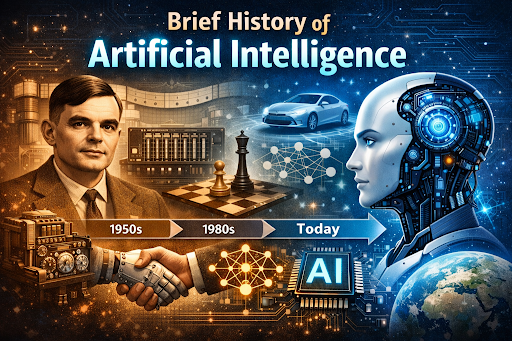
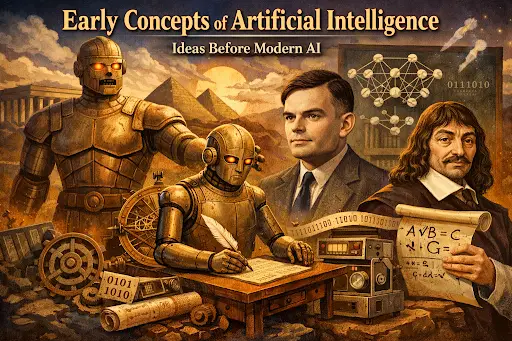
The revival of artificial intelligence in the 1990s stands as one of the most critical turning points in the history of computer science. To truly understand this pivotal era, we must look back at the broader history of artificial intelligence. The initial dream of creating thinking machines was heavily inspired by early concepts of Alan Turing Artificial Intelligence in the 1950s. The field gained its official title and boundless optimism during the legendary 1956 Dartmouth Conference, where researchers confidently predicted that human-level machine intelligence was just around the corner.
Unfortunately, that initial optimism did not last. While the 1950s and 1960s saw exciting foundational work, the reality of hardware limitations soon set in. By the 1970s and 1980s, AI lost funding at a dramatic rate. Many ambitious projects failed to deliver on their lofty promises, and the technology industry largely turned its back on the concept. However, this period of stagnation was not the end of the story. In the 1990s, AI began to recover. This remarkable AI comeback was fueled by new approaches, better hardware, and a shift toward data, setting the stage for the technological marvels we rely on today.
What Was the AI Winter?
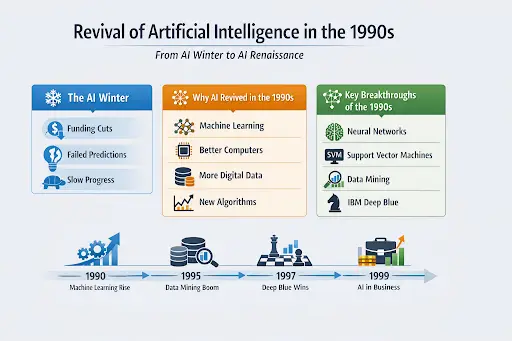
Before we can appreciate the AI renaissance of the 90s, we must understand the dark age that preceded it. The AI winter refers to prolonged periods of severely reduced funding and widespread loss of interest in artificial intelligence research.
During this time, the collapse of expert systems—rule-based AI programs that were once highly profitable—caused a massive industry-wide disillusionment. Corporations that had invested millions into these systems found them too rigid and difficult to update. As a result, government agencies and private investors pulled their grants, leading to a steep decline in funding. The term itself became a cautionary tale among computer scientists, representing the dangers of over-promising and under-delivering.
Causes of the AI Winter
Several compounding factors contributed to these infamous AI Winters, effectively freezing progress in the field for years:
- Overhyped expectations: Researchers and the media made grandiose claims about machines matching human intelligence within a decade, which was practically impossible at the time.
- Lack of computing power: The processors of the 1970s and 80s were simply too slow to handle the complex calculations required for advanced artificial intelligence.
- Limited datasets: AI systems need information to learn, but before the digital age, gathering and storing massive amounts of data was incredibly difficult.
- Failure of early AI systems: Many of the First AI Programs worked well in tightly controlled laboratory environments but completely failed when exposed to the unpredictable nuances of the real world.
Why Artificial Intelligence Revived in the 1990s
The revival of artificial intelligence in the 1990s was not a sudden miracle; it was the result of several technological and methodological shifts converging at exactly the right time.
Growth of Machine Learning
The most significant shift in AI development in the 1990s was the transition from strict, rule-based logic to data-driven learning. Instead of trying to manually program every single rule a computer needed to know, researchers focused on the Evolution of Machine Learning Algorithms. This allowed computers to ingest data and identify patterns on their own, a fundamental shift that redefined machine learning history.
Increase in Computing Power
Moore’s Law was in full effect during this decade. The 1990s saw the introduction of vastly faster processors and significantly improved storage capacities. This hardware leap meant that algorithms which previously took months to run could now be executed in days or hours, allowing for rapid experimentation and iteration.
Availability of Digital Data
The 1990s marked the dawn of the public Internet. As businesses and consumers moved online, the digital world experienced exponential growth. This explosion of digital activity created large datasets for training AI models. Without this foundational wave of data, the AI resurgence would have been impossible.
New Statistical AI Methods
Moving away from rigid symbolic logic, researchers adopted probabilistic and statistical approaches. Statistical AI allowed systems to handle uncertainty and make highly educated guesses based on probabilities, which proved much more effective in real-world applications like language translation and speech recognition.
Major Breakthroughs in AI During the 1990s
The combination of new data, better hardware, and smarter algorithms led to several massive AI breakthroughs during this transformative decade.
Support Vector Machines (SVM)
Introduced as a highly effective new machine learning algorithm, support vector machines revolutionized classification tasks. SVMs were exceptional at drawing complex mathematical boundaries between different categories of data, making them the gold standard for pattern recognition tasks throughout the decade.
Neural Network Improvements
While neural networks had been theorized for decades, they saw crucial backpropagation progress in the 1990s. Backpropagation is the method by which a neural network updates its internal weights to correct errors. Refining this mathematical process allowed researchers to train multi-layered networks much more effectively.
Data Mining
As corporate databases grew, data mining became a massive trend. Companies began using early AI and statistical tools to analyze large datasets, discovering hidden consumer trends, optimizing supply chains, and identifying fraudulent financial transactions.
IBM Deep Blue (1997)
Perhaps the most famous public event of artificial intelligence in the 1990s occurred in 1997 when IBM Deep Blue defeated world chess champion Garry Kasparov. This highly publicized event proved to the general public that a machine could outmaneuver the greatest human mind in a strictly logical, highly complex game.
Impact of the 1990s AI Revival
The impact of this decade cannot be overstated; it laid the unshakeable foundation for machine learning as we know it. The concepts proven during this era heavily influenced Early Machine Learning applications that began trickling into consumer technology.
This period saw the birth of early speech recognition software, which eventually evolved into the voice assistants we use on our phones today. Furthermore, the 1990s pushed computer vision research forward, allowing machines to begin accurately identifying objects in digital images. E-commerce platforms also began utilizing the early versions of recommendation systems, using AI to suggest products to users based on their past behavior.
How the 1990s AI Revival Led to Modern AI
The revival of artificial intelligence in the 1990s acts as the direct bridge between theoretical computer science and modern, ubiquitous AI.
- Big Data: The data mining trends of the 90s directly birthed the modern big data industry. Algorithms need massive amounts of information to thrive, and the infrastructure built during this era made collecting that data possible.
- Deep Learning: The slow but steady neural network improvements of the 1990s eventually scaled up into modern deep learning. By stacking more layers and using modern GPUs, today’s deep neural networks are just highly advanced descendants of 1990s architecture.
- Generative AI: The statistical and probabilistic models developed during the AI comeback are the direct ancestors of the massive large language models that currently power today’s generative AI tools.
Key Timeline of AI Revival (1990–2000)
To visualize how rapidly the field recovered, here is a brief timeline of the decade’s milestones:
- 1990 – AI research aggressively shifts away from rule-based expert systems and toward statistical machine learning.
- 1995 – Data mining becomes highly popular in the corporate sector, proving AI’s commercial viability.
- 1997 – IBM Deep Blue defeats world chess champion Garry Kasparov, making global headlines.
- 1999 – Early AI applications become embedded in standard business software, from logistics planning to basic web search algorithms.
Frequently Asked Questions (FAQs)
What exactly triggered the AI winter before the 1990s?
The AI winter was primarily triggered by a failure to meet drastically overhyped expectations. When early rule-based systems (expert systems) failed to scale and handle the complexities of the real world, investors and governments abruptly pulled their funding.
Why is IBM Deep Blue historically important?
IBM Deep Blue is important because it was a major public relations victory for AI. Defeating Garry Kasparov in 1997 proved that computers could process complex, strategic variables fast enough to defeat peak human intelligence in a specific domain.
What is the difference between AI in the 1980s and the 1990s?
In the 1980s, AI was largely focused on “symbolic AI” and rigid, human-programmed logic rules. In the 1990s, the focus shifted to statistical methods and machine learning, where the computer was fed data and allowed to find its own patterns.
Conclusion
The AI winter heavily slowed progress and tested the resilience of computer scientists worldwide. However, the revival of artificial intelligence in the 1990s changed AI research forever. By abandoning rigid rules in favor of statistical methods, embracing the internet’s wave of digital data, and leveraging faster processors, the 1990s transformed AI from a failing academic experiment into a practical, powerful tool. This remarkable era of recovery laid the vital foundation for today’s AI revolution, ensuring that the dream of intelligent machines would finally become a reality