The night sky has always been a source of wonder, but for the ancient Greeks, it was also a complex puzzle waiting to be solved. At the heart of this solution lies Hipparchus’ Star Catalog, a monumental achievement that transformed the “unchanging” heavens into a measurable, scientific map. Before this work, stars were often discussed in the context of myths and constellations, but Hipparchus sought a more permanent truth. By recording the positions and brightness of hundreds of celestial bodies, he provided future generations with a baseline to detect changes in the universe—a feat that solidifies his reputation as the Hipparchus Father of Astronomy.
Who Was Hipparchus?
Hipparchus of Nicaea was a Greek astronomer, geographer, and mathematician who lived during the second century BCE. Working primarily from the island of Rhodes, he combined the arithmetic traditions of the Babylonians with the geometric precision of the Greeks. His life was dedicated to the pursuit of accuracy, leading to the Development of Trigonometry as a means to calculate the vast distances of space.
While much of his personal history is shrouded in the mists of time, his intellectual footprint is massive. He was not content with qualitative descriptions; he wanted numbers. This drive for quantification is what led to the creation of the first comprehensive ancient star catalog in Western history.
Why the Star Catalog Was Important
Before Hipparchus’ Star Catalog, there was no systematic way to track if a star had moved, appeared, or disappeared over centuries. The catalog served as a celestial “census.” By assigning numerical coordinates to each star, Hipparchus turned astronomy into a predictive science.
This mapping the heavens Hipparchus project was essential for navigation and timekeeping. It allowed sailors to determine their position with greater confidence and helped farmers predict the changing seasons. More importantly, it established the idea that the universe followed mathematical laws, a concept that would later influence the History of computers and digital data processing.
How Hipparchus Observed the Stars
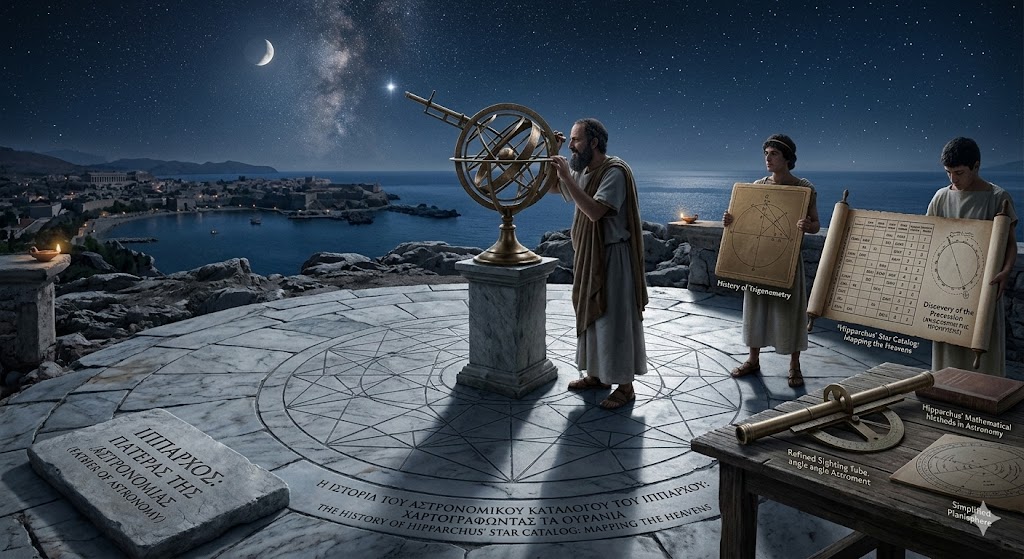
Hipparchus did not have the luxury of a telescope. Instead, he relied on his sharp eyes and a variety of mechanical instruments, such as the dioptra and the armillary sphere. These ancient astronomy observations required incredible patience. He would spend years measuring the angles between stars and their distance from the celestial equator.
To ensure his map was accurate, he used Hipparchus’ Mathematical Methods in Astronomy to account for the spherical nature of the sky. By treating the heavens as a globe, he could project the positions of stars onto a flat plane without losing precision. This early celestial mapping was the precursor to modern cartography and spherical geometry.
The Magnitude System: Measuring Star Brightness
One of the most enduring legacies of the Hipparchus stellar catalog is the magnitude system. Hipparchus realized that stars were not all the same brightness, so he classified them into six categories. The brightest stars were designated as “first magnitude,” while the dimmest stars visible to the naked eye were “sixth magnitude.”
This Hipparchus magnitude system was so logical and effective that it is still used by modern astronomers today, albeit with more precise digital sensors. It was the first time in Greek astronomy history that a standardized scale was applied to a natural phenomenon, allowing for a shared language among scientists across different eras.
The Discovery That Inspired the Catalog
Tradition suggests that Hipparchus was inspired to create his catalog after witnessing a “new star” (likely a supernova) in the constellation of Scorpius. This event challenged the Aristotelian view that the heavens were perfect and unchanging.
If a star could appear out of nowhere, Hipparchus reasoned that other stars might be moving or changing as well. This realization led directly to the Discovery of the Precession, where he noticed that the positions of the stars had shifted slightly compared to records from 150 years prior. Without a detailed ancient star catalog to compare against, this groundbreaking discovery would have been impossible.
Mapping the Heavens with Geometry
The technical brilliance of the catalog lay in its use of coordinates. Hipparchus likely used ecliptic coordinates, measuring the longitude and latitude of stars relative to the sun’s path. This required a deep understanding of circles and triangles, which spurred the Development of Trigonometry.
By applying these Hipparchus astronomy discoveries to the night sky, he created a 3D model of the universe in his mind. This was not just a list of names; it was a mathematical grid that proved the heavens were a structured, orderly environment.
Influence on Later Astronomers
The Influence on Later Astronomer figures, most notably Claudius Ptolemy, cannot be overstated. Ptolemy’s Almagest, which dominated scientific thought for over a millennium, was built upon the foundation of Hipparchus’ data. Ptolemy expanded the catalog to 1,022 stars, but the core methodology and the magnitude system remained those of Hipparchus.
During the Islamic Golden Age, scholars in the Middle East preserved and refined these records, ensuring that the history of star catalogs remained unbroken through the Dark Ages. Even during the Renaissance, astronomers like Tycho Brahe looked back at Hipparchus’ precision as a standard to beat.
The Legacy of the Hipparchus Star Catalog
Today, the legacy of this work lives on in modern space missions. The European Space Agency’s Hipparcos satellite, launched to measure the positions of over 100,000 stars, was named in direct tribute to the man who first mapped the heavens.
His Lunar and Solar Observations and his stellar records proved that science is a cumulative effort. By recording the sky in 130 BCE, Hipparchus allowed astronomers in 2026 to understand how our galaxy has evolved over thousands of years. He taught us that to understand the future of the cosmos, we must first have an accurate record of its past.
Frequently Asked Questions (FAQs)
1. What is the Hipparchus Star Catalog?
It is the first systematic list of stars created by the Greek astronomer Hipparchus around the 2nd century BCE.
2. How many stars were in Hipparchus’ catalog?
Historians estimate that it contained around 850–1000 stars.
3. Why was the catalog important?
It introduced a scientific way to record star positions and brightness, forming the foundation of modern astronomy.
4. Did Hipparchus invent the magnitude system?
Yes. He created the first system for classifying stars based on brightness.
5. Is the original catalog still preserved?
The original text has been lost, but much of its data survives through later works such as Ptolemy’s Almagest.
Conclusion
The story of Hipparchus’ Star Catalog is the story of the birth of data science in the ancient world. It shows us that with simple tools and a brilliant mind, one person can change our entire perspective on the universe. Hipparchus didn’t just look at the stars; he organized them, measured them, and handed them to us as a map. As we continue to explore the deep reaches of space, we are still following the coordinate system and the logic of the Hipparchus Father of Astronomy, whose ancient work remains a guiding light in the modern age of science.