The night sky appears to be a dome of fixed, unchanging lights, but for those with the patience of centuries, the stars are actually in a slow, rhythmic dance. The Discovery of the Precession of the equinoxes remains one of the most sophisticated achievements of the ancient world. It is a phenomenon that reveals the Earth is not a perfectly stable sphere, but a celestial body that “wobbles” as it spins. This revelation was not found through a telescope, but through the rigorous application of logic and data comparison by the man known as the Hipparchus Father of Astronomy. By identifying this minute shift in the heavens, Hipparchus proved that the universe was far more dynamic than previously imagined.
Understanding the Equinoxes
To grasp the magnitude of the precession of the equinoxes discovery, one must first understand the equinox itself. Twice a year, the sun crosses the celestial equator, resulting in a day where day and night are of approximately equal length. For ancient civilizations, the spring (vernal) equinox was a vital marker for calendars and agriculture.
The equinoxes are defined by the intersection of the Earth’s equatorial plane and its orbital plane around the sun. In Greek astronomy, these points were thought to be fixed against the background of the “permanent” stars. However, Hipparchus’ work on Lunar and Solar Observations began to suggest that the sun’s path was not as static as his predecessors believed.
What Is the Precession of the Equinoxes?
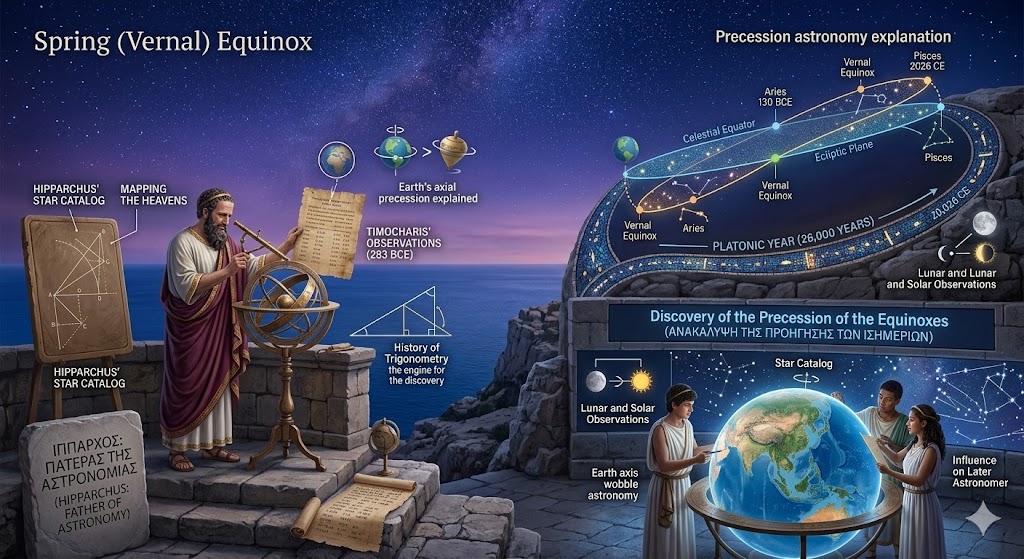
In modern terms, precession astronomy explanation is often compared to a spinning toy top. As the top begins to slow down, its axis describes a slow circle in the air while the top continues to spin rapidly. This earth axis wobble astronomy is caused by the gravitational pull of the sun and the moon on the Earth’s equatorial bulge.
This movement is incredibly slow, taking approximately 26,000 years to complete a single circuit. It causes the positions of the stars to shift by about one degree every 72 years. While this seems negligible in a single human lifetime, it creates massive discrepancies over centuries—discrepancies that Hipparchus was the first to detect.
How Hipparchus Made the Discovery
The hipparchus precession discovery was not a “Eureka” moment in a lab, but the result of a brilliant comparison of historical data. Around 129 BCE, Hipparchus compared his own measurements of the positions of certain stars, such as Spica, with observations made by astronomers Timocharis and Aristyllus about 150 years earlier.
He noticed that the stars had shifted their positions relative to the equinoxes. Specifically, their “celestial longitude” had increased. Because the shift was consistent across all stars he measured, he concluded that it wasn’t the stars that were moving, but the reference frame of the equinoxes themselves. This conclusion required the use of his Star Catalog, which acted as a precise data bank for the heavens.
Observational Methods Used by Hipparchus
Hipparchus relied on Hipparchus’ Mathematical Methods in Astronomy to ensure his measurements were beyond reproach. He used the dioptra and the armillary sphere to calculate the coordinates of stars with extreme precision. Because he lacked modern clocks, he often used lunar eclipses to determine the exact time and position of the sun and stars simultaneously.
His discovery was only possible because he had spent years on the Development of Trigonometry. By calculating the chords of angles, he could translate his raw sightings into a geometric map of the sky. This allowed him to prove that the “wobble” was a mathematical certainty rather than a mere error in his instruments.
Why the Discovery Was Revolutionary
Before this celestial motion discovery, most philosophers believed the Earth was the immovable center of a perfect, unchanging universe. Hipparchus’ discovery of the precession of equinoxes shattered this illusion. It proved that even the most fundamental markers of time—the equinoxes—were moving.
It was a revolutionary moment in ancient astronomy discoveries because it introduced the concept of “long-term” change. It forced astronomers to realize that a map of the sky made today would be inaccurate in a thousand years. This led to a more sophisticated understanding of the Influence on Later Astronomer figures, who realized they had to constantly update their records to account for this cosmic drift.
Impact on Ancient Astronomy
The impact of this discovery was immediate and profound. It allowed for the creation of more accurate calendars and helped explain why ancient star charts no longer aligned with the visible sky. Hipparchus’ astronomy contributions gave later scientists a tool to calculate the exact length of the “Platonic Year” (the 26,000-year cycle).
This work also influenced the History of Operating Systems and early navigational software in the sense that it established the need for “dynamic” data rather than static tables. It taught ancient scholars that the Earth was a dynamic part of a larger, moving system.
Long-Term Effects on Astronomy
The history of precession of equinoxes continued to evolve long after Hipparchus. During the 17th century, Isaac Newton finally provided the physical explanation for the discovery, proving that it was caused by gravity. However, without Hipparchus’ initial data, Newton would have had no phenomenon to explain.
Today, we use this knowledge for everything from deep-space navigation to understanding past climate changes (Milankovitch cycles). The Earth’s orientation in space affects how much sunlight different latitudes receive over thousands of years, making this ancient discovery a cornerstone of modern Earth science.
Legacy of the Discovery
The legacy of the Hipparchus precession discovery is found in every modern star chart. We now use “Epochs” (like J2000) to define exactly when a star map was made, because we know the coordinates are constantly changing.
Hipparchus proved that science is a bridge between the past and the future. By respecting the data of the astronomers who came before him and documenting his own findings with extreme care, he provided a gift to all humanity. He showed us that while we may feel still on the ground, we are actually part of a magnificent, swaying journey through the stars.
Frequently Asked Questions (FAQs)
1. What is the precession of the equinoxes?
It is the slow, circular “wobble” of the Earth’s axis, which causes the positions of the equinoxes to shift westward along the ecliptic over a 26,000-year cycle.
2. How did Hipparchus discover it without a telescope?
He compared his own data with observations recorded 150 years earlier by Timocharis. He noticed a consistent 2-degree shift in the stars’ positions, which he correctly identified as a movement of the equinoxes.
3. Why does the Earth’s axis wobble?
The wobble is caused by the gravitational pull of the sun and moon on the Earth’s “equatorial bulge” (the fact that Earth is slightly wider at the equator).
4. Does precession affect our star signs?
Yes. Because of precession, the sun is no longer in the same zodiac constellation on the equinox as it was 2,000 years ago. This is why “astrological” signs and “astronomical” positions are often different.
5. How long does one full cycle of precession take?
One complete cycle, often called a Great Year or Platonic Year, takes approximately 25,772 years.
Conclusion
The Discovery of the Precession of the equinoxes is a monument to the power of human observation. Hipparchus didn’t just find a shift in the stars; he found a shift in our understanding of our place in the universe. By combining the Star Catalog with the Development of Trigonometry, he reached across time to speak with the astronomers of the past and the scientists of the future. As the Hipparchus Father of Astronomy, his work remains the ultimate reminder that in science, no detail is too small to be significant, and even the “fixed” stars have a story to tell.