The history of science is rarely a straight line, but rather a relay race where one giant passes the torch to the next. In the realm of the stars, that torch was first lit with mathematical precision by Hipparchus of Nicaea. Hipparchus’ Influence on Later Astronomers is the foundation upon which the entire structure of Western and Islamic astronomy was built. Often referred to as the Hipparchus Father of Astronomy, his work shifted the focus of human inquiry from philosophical myths to data-driven science. By establishing a culture of rigorous measurement and long-term observation, he ensured that his name would be whispered in observatories for over two millennia.
Hipparchus as a Pioneer of Scientific Astronomy
Before the era of Hipparchus, ancient greek astronomy influence was largely dominated by qualitative models. While the Greeks had long been interested in the cosmos, they often prioritized “perfect” geometric shapes over raw data. Hipparchus changed this by insisting on Hipparchus’ Mathematical Methods in Astronomy. He realized that to understand the universe, one must first record it with absolute fidelity.
His scientific contributions were not just limited to what he saw, but how he saw it. He developed tools and techniques that allowed for the systematic tracking of celestial bodies. This transition toward empirical evidence is the primary reason hipparchus astronomy legacy remains so potent. He taught the world that the sky was a laboratory, not just a canvas for the gods.
Influence on Claudius Ptolemy
The most direct and famous example of hipparchus and ptolemy astronomy is found in the Almagest. Written nearly 300 years after Hipparchus’ death, Ptolemy’s work is the most significant astronomical text of antiquity, yet it is essentially a massive expansion of Hipparchus’ earlier findings.
Ptolemy utilized Hipparchus’ Lunar and Solar Observations to build his own geocentric model of the universe. In many sections of the Almagest, Ptolemy openly credits Hipparchus as his “greatest predecessor,” particularly regarding the motion of the planets and the sun. Without the data gathered by Hipparchus in Rhodes, the Almagest—and by extension, the next 1,400 years of European science—would have lacked its mathematical backbone.
Contribution to Star Catalog Development
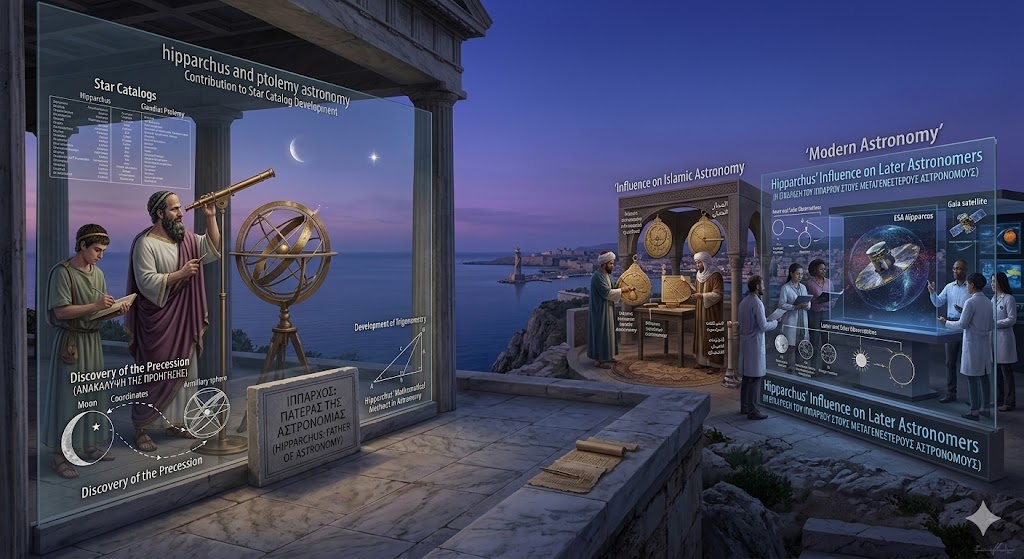
Perhaps the most tangible hipparchus discoveries impact was the creation of the first comprehensive Star Catalog. By recording the positions and brightness of approximately 850 stars, Hipparchus provided a “snapshot” of the heavens. This was a revolutionary act in the development of astronomy history.
Later astronomers, from the Romans to the Renaissance giants, used this catalog as a baseline. When they looked at the sky and saw a star in a slightly different place than Hipparchus had recorded, they didn’t assume he was wrong; they realized the sky itself was changing. This realization led directly to the Discovery of the Precession, a concept that became a fundamental requirement for any future astronomer attempting to map the heavens.
Impact on Trigonometry and Mathematical Astronomy
The history of astronomy hipparchus is inseparable from the history of mathematics. Hipparchus realized that flat geometry was insufficient for a curved sky, leading to the Development of Trigonometry. By creating the first table of chords, he gave future scientists the “software” needed to calculate distances and angles in three-dimensional space.
This impact on astronomy was profound. It allowed later scholars to move beyond mere observation and into the realm of prediction. Because of Hipparchus, astronomers could now calculate the timing of an eclipse or the distance to the moon with a pen and paper. This mathematical bridge is a cornerstone of hipparchus scientific contributions, providing a universal language for scientists across different cultures and eras.
Influence on Islamic Astronomy
During the Islamic Golden Age, the works of the Greeks were translated, preserved, and refined. Scholars like Al-Battani and Al-Sufi were deeply influenced by the hipparchus astronomy legacy. They took his Star Catalog and updated it, noting that the “fixed” stars had shifted even further due to precession.
Islamic astronomers were particularly impressed by Hipparchus’ focus on accuracy. They adopted his instruments and improved upon them, leading to the creation of more sophisticated astrolabes and quadrants. This cross-cultural transfer of knowledge highlights how Hipparchus’ Influence on Later Astronomers crossed borders and religions, eventually making its way back to Europe during the Renaissance.
Establishing the Importance of Accurate Observation
One of the most subtle yet powerful ways Hipparchus impacted science was by establishing the “Standard of Precision.” He was the first to realize that small errors in measurement could lead to massive errors in prediction over time.
By comparing his own data to Babylonian records, he showcased the value of long-term history of astronomy hipparchus research. This influenced later astronomers like Tycho Brahe, who, nearly 1,700 years later, would mirror Hipparchus’ obsession with precision. Brahe’s data, in turn, allowed Johannes Kepler to discover the laws of planetary motion. The chain of discovery remains unbroken from the shores of Rhodes to the modern computer-guided observatory.
Legacy in Modern Astronomy
Even in the age of the James Webb Space Telescope, we still use the magnitude system for star brightness that Hipparchus invented. The European Space Agency (ESA) honored this hipparchus astronomy legacy by naming their star-mapping satellite mission Hipparcos.
Modern scientists still rely on the coordinate systems and trigonometric foundations that he pioneered. Every time a scientist calculates a “parallax” to find the distance of a nearby star, they are using a method that was first refined during the Lunar and Solar Observations of an ancient Greek genius.
Why Hipparchus Remains Important
Hipparchus remains important because he represents the birth of the “Scientific Method” in astronomy. He was willing to be proven wrong by the data. When he saw that the stars had shifted from the records of Timocharis, he didn’t ignore the discrepancy; he investigated it until he found the Discovery of the Precession.
This intellectual honesty is the hallmark of great science. His hipparchus discoveries impact is not just found in numbers and tables, but in the very spirit of inquiry that drives us to explore the stars today. He turned the sky from a mystery of the gods into a map for humanity.
Frequently Asked Questions (FAQs)
How did Hipparchus influence Ptolemy?
Ptolemy used Hipparchus’ star coordinates, his magnitude system, and his models for solar and lunar motion as the primary foundation for the Almagest, the most influential astronomy book of the ancient world.
Why is Hipparchus called the Father of Astronomy?
He earned this title by creating the first star catalog, discovering the precession of the equinoxes, and inventing trigonometry, effectively turning astronomy into a mathematical science.
Did Islamic astronomers use Hipparchus’ work?
Yes, Islamic scholars in the Middle Ages translated his findings and used them to refine their own star charts and instruments, ensuring his work survived through the Dark Ages.
What is the “Hipparcos” satellite?
It was a mission launched by the European Space Agency in 1989 to measure the positions and distances of stars with extreme accuracy, named in honor of Hipparchus.
How did Hipparchus change the way stars were measured?
He introduced a coordinate system and a magnitude scale (1 to 6) for brightness, both of which are still used in modified forms by modern astronomers today.
Conclusion
Hipparchus’ Influence on Later Astronomers is a testament to the power of a single mind to illuminate the path for thousands of years. From the foundational Development of Trigonometry to the meticulous construction of his Star Catalog, he provided the tools that allowed humanity to finally measure the infinite. As the Hipparchus Father of Astronomy, his legacy is written in the very light of the stars he mapped. Whether we are looking at an ancient astrolabe or a modern satellite, we are seeing the world through the lens of accuracy and wonder that Hipparchus first polished under the clear night skies of Rhodes.