The transition of astronomy from a mystical observation of the heavens to a rigorous physical science was not an overnight occurrence. It required a unique mind capable of marrying the abstract world of numbers with the visible world of the stars. Hipparchus’ Mathematical Methods in Astronomy provided this bridge. By applying the principles of Greek geometry and Babylonian arithmetic to the night sky, Hipparchus transformed how humanity perceived the cosmos. Often celebrated as the Hipparchus Father of Astronomy, his legacy is defined not just by what he found, but by the mathematical precision he used to find it.
The Role of Mathematics in Ancient Astronomy
In the era before the telescope, ancient astronomy mathematics was the only tool powerful enough to peer into the distances of space. While earlier civilizations like the Babylonians were excellent record-keepers, their approach was largely arithmetic and based on identifying recurring cycles. Hipparchus, however, introduced a geometric framework that sought to explain the “why” behind these cycles.
By utilizing Hipparchus’ Mathematical Methods in Astronomy, he was able to create models that did more than just list dates; they predicted positions. This was a radical shift in ancient greek astronomy mathematics. He treated the celestial sphere as a geometric object that could be dissected using chords and angles, a method that would eventually lead to his monumental Star Catalog.
Use of Geometry in Celestial Measurements
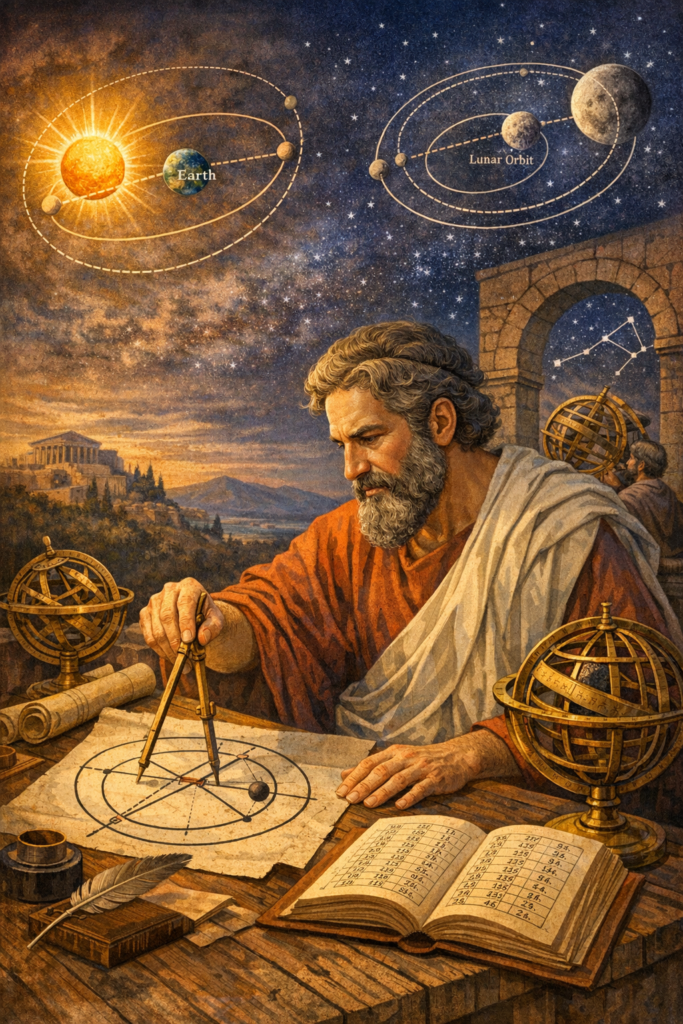
Geometry in ancient astronomy served as the “ruler” for the universe. Hipparchus viewed the sky as a series of concentric spheres. To measure the movement of a planet or the sun, he had to calculate the properties of circles. He was particularly skilled in using the “eccentric” and “epicycle” models.
An eccentric model placed the Earth slightly away from the center of a circular orbit, which explained why the seasons were of unequal length. An epicycle involved a small circle moving along the circumference of a larger one. These celestial calculations were purely geometric solutions to complex observational problems. Through these methods, he was able to refine his Lunar and Solar Observations to a degree of accuracy that remained unsurpassed for centuries.
Development of Trigonometric Techniques
Perhaps the most famous aspect of mathematical astronomy hipparchus is known for is the Development of Trigonometry. In order to solve the triangles formed by the positions of stars, Hipparchus needed a way to relate the length of a side to the size of an angle.
He achieved this by creating the first “table of chords.” By dividing a circle into 360 degrees and calculating the lengths of chords for specific angles, he provided a functional precursor to the modern sine table. This hipparchus trigonometry astronomy was the engine that powered his entire scientific output. It allowed him to move beyond simple visual sightings and into the realm of three-dimensional spatial analysis, which was essential for the Discovery of the Precession.
Mathematical Models of Lunar Motion
The Moon presents one of the most difficult challenges for any astronomer because its speed and path are highly irregular. To tackle this, Hipparchus developed sophisticated mathematical models of lunar motion. He combined the Babylonian periods of the moon’s cycles with his own geometric models of epicycles.
By applying these hipparchus scientific methods, he was able to account for the moon’s “anomaly”—the fact that it appears to move faster at some times and slower at others. His ability to fit these irregularities into a consistent geometric framework was a triumph of ancient astronomy mathematics. It allowed him to calculate the moon’s position with such accuracy that he could predict eclipses to within a few hours.
Mathematical Analysis of Solar Motion
Just as with the moon, Hipparchus applied a rigorous mathematical analysis to the sun’s path through the sky. He observed the exact timing of the equinoxes and solstices to determine the length of the solar year.
His hipparchus celestial calculations revealed that the year was not exactly 365.25 days, but slightly less. He used this data to calibrate his solar models, ensuring that his calendar remained in sync with the actual position of the sun. This meticulous attention to numerical detail is why the Influence on Later Astronomers such as Ptolemy was so significant; they inherited a body of work that was mathematically sound.
Calculating Distances in Space
One of the most awe-inspiring feats of history of mathematical astronomy was Hipparchus’ attempt to measure the distance to the moon. He utilized the concept of parallax—the shift in an object’s position when viewed from two different points.
By observing a solar eclipse that was total in one location and only partial in another, he used his Development of Trigonometry to calculate the distance. He estimated the moon to be between 60 and 63 Earth radii away. This use of triangles to measure the “unmeasurable” is the quintessential example of Hipparchus’ Mathematical Methods in Astronomy.
Influence on Later Astronomical Models
The Influence on Later Astronomers was profound because Hipparchus provided a template for how science should be conducted. He didn’t just provide answers; he provided the math used to reach them. Claudius Ptolemy’s Almagest is essentially a massive expansion of the mathematical groundwork laid by Hipparchus.
During the Islamic Golden Age and the European Renaissance, astronomers continued to use his chord-based trigonometry until it evolved into the sine and cosine functions we use today. The very structure of our coordinate systems in space—latitude and longitude—traces its mathematical lineage back to the methods refined by Hipparchus in ancient Greece.
Establishing a Scientific Approach to Astronomy
Beyond the numbers, Hipparchus established a permanent scientific approach to the field. He insisted on the comparison of new data with old records. By comparing his own Star Catalog with observations made 150 years prior, he mathematically identified a tiny discrepancy that led to the Discovery of the Precession.
This willingness to follow the math, even when it led to unexpected conclusions, is the hallmark of modern science. He moved astronomy away from being a subset of philosophy and into the realm of physics and mathematics.
Legacy of Hipparchus’ Mathematical Astronomy
The legacy of hipparchus mathematical methods in astronomy is visible in every corner of modern science. From the GPS in our phones to the flight paths of rockets, the use of trigonometry to navigate space is a direct descendant of the chord tables of Rhodes.
He showed us that the universe is not a chaotic place, but a structured one that speaks the language of geometry. As the Hipparchus Father of Astronomy, his greatest gift to humanity was the realization that the mind, armed with mathematics, can reach out and measure the stars.
Frequently Asked Questions (FAQs)
What exactly were Hipparchus’ mathematical methods?
He primarily used chord-based trigonometry and spherical geometry to calculate the positions and distances of celestial bodies, moving away from purely arithmetic Babylonian methods.
How did he use math to find the distance to the Moon?
He used the parallax method, which involves creating a giant triangle between two points on Earth and the Moon, then using trigonometric ratios to solve for the missing distance.
Did Hipparchus invent trigonometry?
Yes, he is widely credited with inventing the first systematic trigonometric table (a table of chords), which allowed astronomers to relate angles to side lengths in a circle.
Why was his use of geometry so important?
Geometry allowed him to create visual and mathematical models (like epicycles) that could explain the irregular speeds of the sun and moon within a system of perfect circles.
What is a Table of Chords?
It is a mathematical table that lists the lengths of chords for various angles in a circle. It served the same purpose in ancient times that sine and cosine tables serve for modern students.
Conclusion
The story of Hipparchus’ Mathematical Methods in Astronomy is the story of how we learned to measure the infinite. By combining the Star Catalog with the Development of Trigonometry, Hipparchus gave us the eyes to see the universe as a mathematical masterpiece. His Lunar and Solar Observations were not just lucky guesses; they were the results of a rigorous, scientific process that prioritized data and logic above all else. Today, we continue to look at the sky using the same geometric spirit that the Hipparchus Father of Astronomy first ignited over two thousand years ago.