Introduction
The story of ptolemy contributions to astronomy is one of the most important chapters in the history of science. Claudius Ptolemy was a brilliant scholar who lived in Alexandria during the second century CE. His research combined observation, mathematics, and earlier Greek knowledge to create a scientific system that shaped humanity’s understanding of the universe for more than a thousand years.
When historians discuss ancient astronomy, the ptolemy contributions to astronomy stand out as a turning point in scientific thinking. Ptolemy did not simply observe the sky; he built mathematical models that explained how celestial bodies move. These ideas influenced scholars throughout the medieval period and remained central to astronomy until the Renaissance.
Many of the claudius ptolemy discoveries came from his ability to organize knowledge from earlier astronomers such as Hipparchus while adding his own observations. Through this work, the history of ptolemy astronomy became deeply connected to the development of astronomy itself.
Ptolemy’s Life and Scientific Background
Claudius Ptolemy worked in the famous intellectual center of Alexandria, where scholars studied mathematics, astronomy, and philosophy. His scientific work reflects the tradition of ancient astronomy ptolemy helped preserve and expand.
Although little is known about his personal life, his writings demonstrate a remarkable understanding of mathematics and observation. The ptolemy contributions to astronomy were built on careful measurements and logical reasoning.
Ptolemy’s research covered multiple disciplines, including astronomy, geography, optics, and mathematics. However, the greatest impact of his work came from his astronomical studies. The ptolemy scientific achievements in this field helped establish a structured understanding of celestial motion.
Almagest: Mapping the Heavens
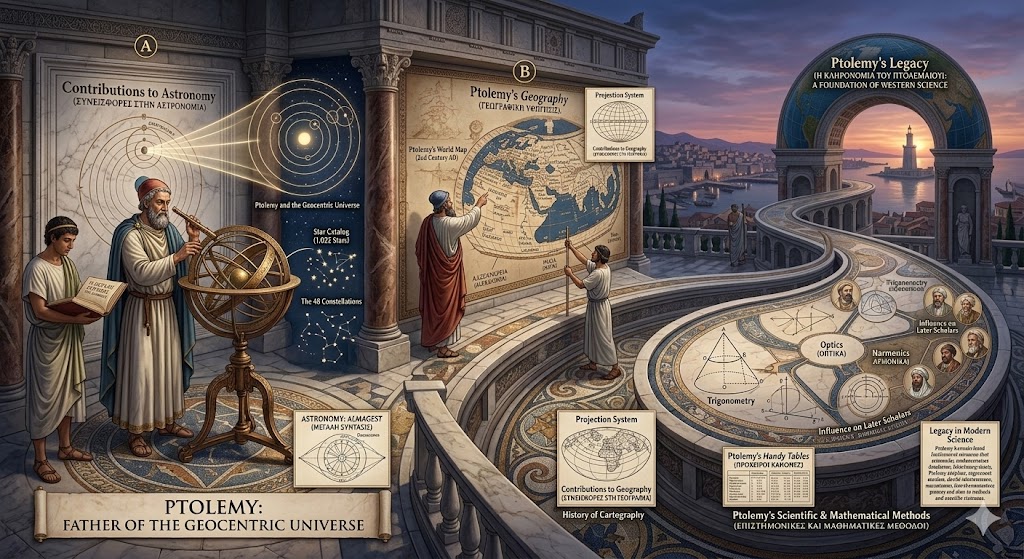
One of the most famous works connected to ptolemy contributions to astronomy is the Almagest. This massive astronomical treatise became the most influential scientific book of the ancient world.
The field of ptolemy almagest astronomy describes how this book organized centuries of astronomical observations into a clear and systematic model of the universe.
The Almagest includes:
- A detailed explanation of planetary motion
- A catalog of more than 1,000 stars
- Mathematical tools for predicting eclipses
- Methods for calculating celestial positions
Through the Almagest, the ptolemy contributions to astronomy became widely accepted across the ancient and medieval worlds. Scholars in both Europe and the Islamic world studied this book for centuries.
Geocentric Model Explained
Another major part of ptolemy contributions to astronomy was the development of the geocentric model of the universe.
The ptolemy geocentric model explained a system in which Earth sits at the center of the universe while the Sun, Moon, planets, and stars revolve around it. To explain irregular planetary motion, Ptolemy introduced complex circular paths called epicycles.
Although modern astronomy has proven that the Sun is the center of the solar system, Ptolemy’s model successfully predicted planetary positions for many centuries. Because of this predictive accuracy, the ptolemy contributions to astronomy remained dominant until the 16th century.
The geocentric system became one of the most famous examples of ptolemy scientific achievements in mathematical astronomy.
Star Catalog and Its Impact
Another important part of ptolemy contributions to astronomy is his famous star catalog. The ptolemy star catalog history includes detailed information about more than one thousand stars and their positions in the sky.
These stars were organized into forty-eight constellations, many of which are still recognized today. The catalog also recorded the brightness of stars and their approximate locations.
The ptolemy contributions to astronomy in star mapping allowed astronomers to track celestial objects more accurately. This catalog became the most reliable reference for astronomers for more than a millennium.
Many historians believe that Ptolemy used earlier observations from Hipparchus while expanding and refining them. Regardless of its sources, the ptolemy star catalog history remains one of the most important documents in the history of astronomy.
Influence on Medieval Astronomy
The ptolemy influence on science extended far beyond the ancient world. During the Middle Ages, scholars in the Islamic world translated the Almagest into Arabic and studied it extensively.
Through these translations, the ptolemy contributions to astronomy spread across different cultures. Muslim astronomers improved observational instruments and refined mathematical calculations while still relying on Ptolemy’s models.
Later, European scholars rediscovered these texts and studied them in medieval universities. The history of ptolemy astronomy therefore became a bridge connecting ancient Greek science with medieval and Renaissance astronomy.
Even when new discoveries began challenging the geocentric model, the ptolemy contributions to astronomy continued to influence scientific thinking.
Contributions to Geography
While the ptolemy contributions to astronomy are widely recognized, Ptolemy also made remarkable advances in geography. His book Geographia introduced a coordinate system for mapping the Earth.
The ptolemy geography contributions included the use of latitude and longitude to describe geographic locations. This method allowed mapmakers to represent the world more systematically than before.
Ptolemy also attempted to create a world map that included hundreds of cities and regions. Although some of these measurements were inaccurate, his approach helped establish scientific cartography.
The ptolemy geography contributions influenced mapmaking for centuries and helped shape the way scholars understood the physical world.
Why Ptolemy’s Work Lasted for Centuries
One of the most remarkable aspects of ptolemy contributions to astronomy is how long they remained influential. His models and theories dominated scientific thought for more than 1,400 years.
Several factors explain this lasting impact:
First, the ptolemy contributions to astronomy were mathematically structured, allowing astronomers to calculate planetary motion.
Second, his works preserved earlier Greek discoveries while presenting them in a systematic way.
Third, the ptolemy influence on science spread across multiple civilizations, including the Islamic world and medieval Europe.
Because of these reasons, the ancient astronomy ptolemy studied remained the foundation of astronomical education for many generations.
Ptolemy’s Legacy in Science
Even though modern astronomy has replaced many of his theories, the ptolemy contributions to astronomy remain historically important. His work demonstrated how mathematical models could explain natural phenomena.
The claudius ptolemy discoveries show the power of combining observation with logical reasoning. His research helped establish astronomy as a mathematical science rather than a purely philosophical subject.
Today, historians recognize that the ptolemy scientific achievements laid important groundwork for later astronomers such as Copernicus, Kepler, and Galileo.
In the broader history of ptolemy astronomy, his work represents a critical stage in humanity’s attempt to understand the universe.
Frequently Asked Questions (FAQs)
Who was Claudius Ptolemy?
Claudius Ptolemy was an ancient Greek astronomer, mathematician, and geographer who worked in Alexandria during the second century CE.
What is the Almagest?
The Almagest is Ptolemy’s famous astronomical book that explains planetary motion and includes a large catalog of stars.
What is the geocentric model?
The geocentric model is a system where Earth is placed at the center of the universe while celestial bodies move around it.
Why were Ptolemy’s ideas influential?
The ptolemy contributions to astronomy provided mathematical models that could accurately predict planetary motion.
What fields did Ptolemy contribute to?
Ptolemy made major contributions to astronomy, mathematics, geography, and optics.