The intellectual landscape of the Middle Ages was not a period of darkness, but rather a time of intense preservation and commentary on ancient wisdom. Central to this era was Ptolemy’s influence on medieval astronomy, a force so powerful that it dictated the movement of the stars and the structure of the universe for over a thousand years. Claudius Ptolemy, working from the library of Alexandria in the 2nd century, provided a mathematical and cosmological framework that became the undisputed Authority for Centuries. This influence bridged cultures, uniting Islamic scholars and European clerics in a shared pursuit of understanding the heavens through the lens of the Ptolemaic system.
Introduction
To understand the history of medieval astronomy, one must first recognize that science in this era was synonymous with the work of Claudius Ptolemy. His primary work, the Almagest, served as the foundational textbook for anyone aspiring to study the stars. Ptolemy’s influence on medieval astronomy was not merely academic; it was deeply integrated into the theological and philosophical fabric of the time. By providing a stable, predictable model of the universe, Ptolemy allowed medieval thinkers to harmonize physical observations with their spiritual worldview, creating a unified vision of a structured, Earth-centered cosmos.
Ptolemy and the Foundations of Astronomical Knowledge
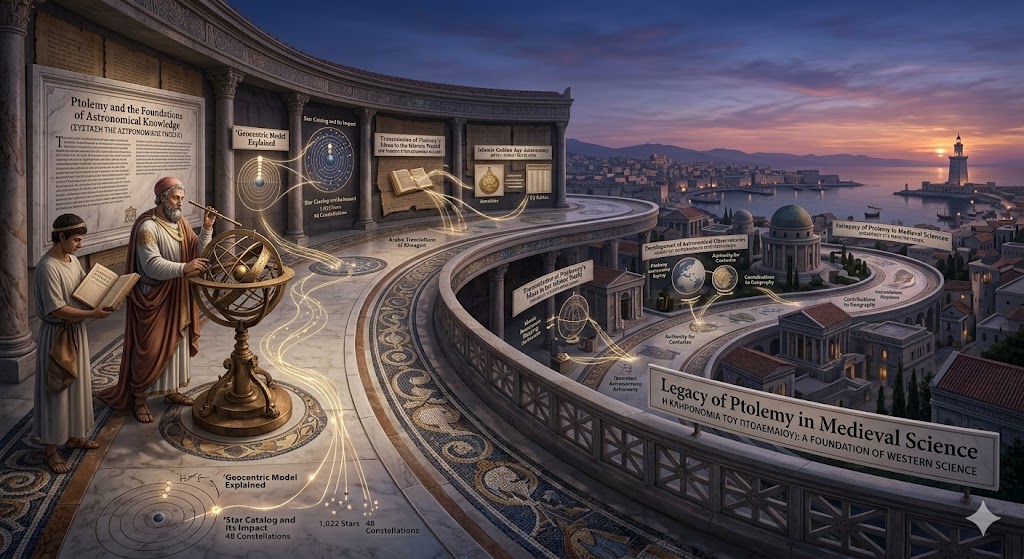
Ptolemy’s greatest achievement was synthesizing centuries of Greek mathematical thought into a single, workable system. He didn’t just observe the stars; he built a geometric machine that could predict their future positions. Ptolemy Contributions to Astronomy included the introduction of epicycles, deferents, and equants—complex mathematical tools designed to explain why planets sometimes appear to move backward in the sky.
This rigorous approach turned astronomy from simple stargazing into a precise branch of mathematics. Medieval scholars inherited this system, viewing it as a finished masterpiece that required only minor adjustments rather than a complete overhaul. The Star Catalog and Its Impact provided these scholars with a baseline of over 1,000 stars, allowing them to track celestial changes across generations.
Transmission of Ptolemy’s Ideas to the Islamic World
The first major chapter of Ptolemy’s influence on medieval astronomy began with the Arabic translations of the Almagest during the Islamic Golden Age. In the 8th and 9th centuries, the Abbasid Caliphate in Baghdad established the House of Wisdom, where scholars translated Greek texts into Arabic. This transmission of Greek astronomy was vital; it ensured that Ptolemaic thought survived while Western Europe was in a period of transition.
Islamic astronomers like Al-Battani and Al-Farghani did not just read Ptolemy; they refined him. While they accepted the Geocentric Model Explained in his works, they used more advanced instruments to correct his data. This period saw the Almagest: Mapping the Heavens reach a new level of accuracy, as Arabic thinkers applied spherical trigonometry to Ptolemy’s geometric models, creating a more robust version of the Ptolemaic system.
Development of Astronomical Observatories
As the Islamic world embraced Ptolemy, they realized that his theories required constant empirical testing. This led to the development of medieval astronomical observatories, such as those in Maragha and Samarkand. These institutions were the most advanced of their time and were built specifically to update the parameters of Ptolemy’s influence on medieval astronomy.
Scholars at these observatories produced “Zij” tables—astronomical handbooks that used Ptolemaic math to provide precise data for calendars, navigation, and prayer times. This tradition of observation kept the Ptolemy astronomy legacy alive and relevant, ensuring that the ancient Greek astronomy influence remained the dominant force in global science well into the 15th century.
Influence on Medieval European Universities
In the 12th century, the Almagest was translated from Arabic into Latin, marking a turning point for European education. Ptolemy’s influence on medieval astronomy became a cornerstone of the “Quadrivium,” the four subjects taught in medieval European universities (arithmetic, geometry, music, and astronomy).
University students from Paris to Oxford studied the Sphaera, a simplified version of Ptolemy’s theories. His Contributions to Geography were also integrated into the curriculum, as scholars realized that mapping the Earth and mapping the stars were two sides of the same coin. During this time, the Ptolemaic system was viewed as more than just a theory; it was a fundamental truth that governed the physical world.
The Role of the Geocentric Model
The defining feature of Ptolemy’s influence on medieval astronomy was the geocentric model. This model, which placed a stationary Earth at the center of the universe, was perfectly aligned with the medieval religious perspective. If the Earth was the stage for the human drama, it stood to reason that it should be the center of all creation.
The Geocentric Model Explained by Ptolemy provided a sense of order and hierarchy. The celestial spheres were seen as perfect and unchanging, contrasting with the imperfect and changing Earth. This philosophical synergy is why the Ptolemaic system remained the Authority for Centuries; to challenge Ptolemy was not just to challenge a scientist, but to challenge the very order of the universe itself.
Challenges and Gradual Changes
By the late Middle Ages, the cracks in the Ptolemaic system began to show. As observations became more precise, astronomers found that they had to add more and more epicycles to make Ptolemy’s math match the actual positions of the planets. This made the system incredibly cumbersome.
During the 14th century, scholars like those at the Maragha school began to develop new mathematical models, such as the “Tusi Couple,” to address these inconsistencies while still maintaining a geocentric view. These developments were the first steps toward the eventual Copernican revolution. However, even these challengers worked within the framework established by Ptolemy’s influence on medieval astronomy, showing that his legacy was the very foundation they were trying to improve.
Legacy of Ptolemy in Medieval Science
The Ptolemy astronomy legacy is one of the most enduring in the history of science. He provided the language and the tools that allowed medieval humanity to converse with the stars. Without the Star Catalog and Its Impact, the navigators of the Age of Discovery would have had no map. Without his mathematical rigor, the astronomers of the Renaissance would have had no system to overturn. Ptolemy’s influence on medieval astronomy ensured that for a thousand years, the human mind was focused upward, seeking a mathematical harmony in the heavens.
Frequently Asked Questions (FAQs)
Why was Ptolemy so important to medieval scholars?
Ptolemy provided a complete, mathematically consistent model of the universe. For medieval scholars, he represented the “final word” on how the cosmos functioned, allowing them to perform complex calculations for navigation and calendars.
Did medieval astronomers know Ptolemy was wrong about the Earth being the center?
Most did not. The geocentric model was physically intuitive (the Earth doesn’t feel like it’s moving) and matched the philosophical and religious views of the time. It wasn’t until the 16th century that evidence for a sun-centered system became overwhelming.
How did Ptolemy’s work reach Europe after the fall of Rome?
His works were preserved and expanded by Islamic scholars. They were eventually translated from Arabic into Latin in centers of learning like Toledo, Spain, during the 12th-century translation movement.
What are epicycles in the Ptolemaic system?
Epicycles were small circles that planets were thought to move in, while those circles themselves moved along a larger circle (the deferent) around the Earth. This was Ptolemy’s way of explaining the “retrograde motion” of planets.
What is the Almagest?
The Almagest is Ptolemy’s most famous book. It is a mathematical treatise on the motions of the stars and planets and served as the primary astronomical textbook for over 1,400 years.
Conclusion
The story of Ptolemy’s influence on medieval astronomy is a testament to the power of a single great idea. For centuries, his geocentric model provided the stability and predictability that the medieval world craved. From the bustling libraries of the Islamic Golden Age to the stone halls of early European universities, the Ptolemy astronomy legacy shaped the way humanity perceived its place in the universe. While his model eventually gave way to modern science, the intellectual discipline he fostered—combining observation with mathematics—remains the heartbeat of astronomy today.