For over a millennium, the way humanity visualized the Earth was governed by a single, revolutionary text. Ptolemy contributions to geography represent a watershed moment in the history of science, transforming vague travelers’ tales into a structured, mathematical discipline. Claudius Ptolemy, working in the intellectual crucible of 2nd-century Alexandria, did for the Earth what he had already done for the stars: he imposed a grid of logic upon the unknown. His seminal work, Geographia, provided the first comprehensive geographic coordinate system, ensuring his status as the Authority for Centuries in the field of mapmaking.
Introduction
While many recognize Claudius Ptolemy for his Geocentric Model Explained in the field of physics, his impact on how we navigate our own planet is equally profound. Ptolemy contributions to geography shifted the focus of mapmaking from mere artistic illustration to rigorous scientific data. By cataloging thousands of locations across Europe, Asia, and Africa, he created a bridge between ancient geographic knowledge and the modern geographic coordinate system. The Geographia was not just an atlas; it was an instruction manual for how to project a three-dimensional sphere onto a two-dimensional surface, a challenge that remains central to the evolution of geographic science today.
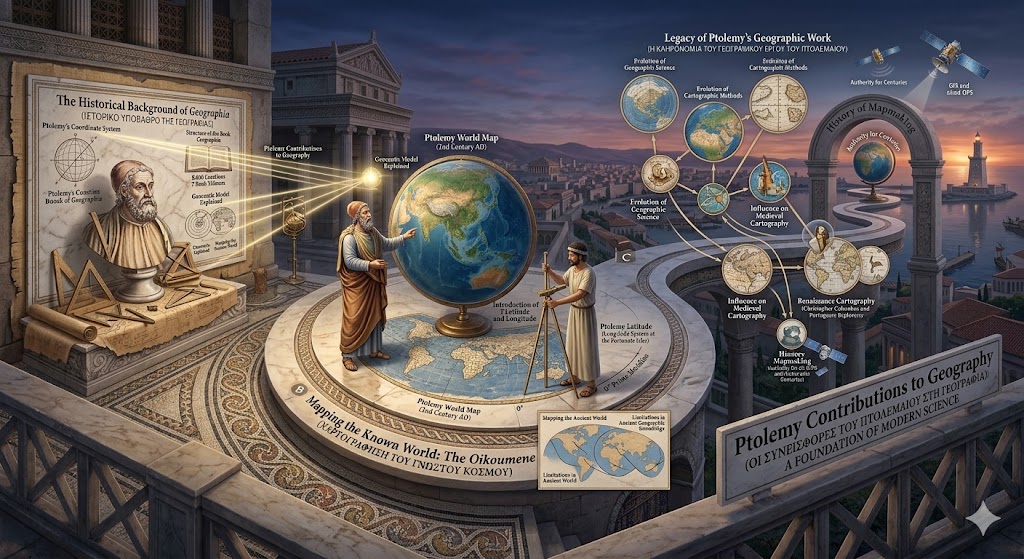
The Historical Background of Geographia
Ptolemy did not invent geography in ancient Greece, but he refined it to an unprecedented degree. Building upon the earlier works of Marinus of Tyre and the mathematical foundations of Eratosthenes—who had famously calculated the Earth’s circumference—Ptolemy sought to create a more practical and standardized method for mapping the ancient world.
During this period, the Roman Empire was at its height, and the influx of trade data from the Silk Road and maritime routes provided a wealth of new information. Ptolemy contributions to geography involved synthesizing these early cartographic methods into a singular, cohesive volume that would eventually mirror the success of his Almagest: Mapping the Heavens.
Structure of the Book Geographia
The Geographia is divided into eight books. Rather than being a collection of finished maps, it is primarily a massive database of coordinates.
- Book 1: Discusses the theoretical aspects of cartography, including the difficulty of map projection.
- Books 2 through 7: Contain a gazetteer of roughly 8,000 locations, including cities, islands, and mountains, each assigned a specific latitude and longitude.
- Book 8: Provides instructions on how to divide the world map into smaller, more detailed regional maps.
This structured approach is one of the most significant Ptolemy contributions to geography, as it allowed any trained scribe or scholar to recreate his world map using the data provided, a precursor to the way modern software renders maps from digital coordinates.
Introduction of Latitude and Longitude
Perhaps the most enduring of all Ptolemy contributions to geography is the Ptolemy latitude longitude system. While the concept of a grid had been proposed by earlier Greeks, Ptolemy was the first to apply it systematically to the entire known world.
He established the “Fortunate Isles” (the Canary Islands) as his prime meridian (0° longitude) and the equator as his base for latitude. By using a geographic coordinate system, he allowed for the precise measurement of distances between distant points like Londinium and Alexandria. This development of cartography was a massive leap forward, as it moved the world away from “itineraries”—which simply listed stops along a road—toward a holistic view of the Earth’s surface.
Mapping the Known World
Ptolemy’s mapping methods were groundbreaking. He utilized two primary types of map projections to solve the problem of depicting a curved Earth on flat papyrus. One projection used straight lines for meridians, while the other used curved lines to better represent the spherical nature of the planet.
The Ptolemy world map encompassed the Oikoumene, or the inhabited world known to the Greco-Romans. His Ptolemy geographic discoveries (or rather, his cataloging of them) included detailed outlines of the Mediterranean, the British Isles, and the Nile’s headwaters. His work represents the peak of ancient world maps, providing a level of detail that would not be surpassed until the Renaissance.
Influence on Medieval Cartography
As the Roman Empire faded, Ptolemy contributions to geography were preserved in the Byzantine Empire and later flourished through Influence on Medieval Astronomy and geography in the Islamic world. Arabic scholars translated Geographia, correcting many of its coordinates based on their own travels.
In Western Europe, the Influence on Medieval Cartography was dormant until the 15th century, when the text was translated into Latin. This rediscovery sparked a revolution in mapmaking. Explorers like Christopher Columbus famously used Ptolemaic maps to plan their voyages. Ironically, Ptolemy’s underestimation of the Earth’s size encouraged Columbus to sail west, believing Asia was much closer than it actually was. Thus, even Ptolemy’s errors played a pivotal role in the history of mapmaking and discovery.
Limitations and Errors in Geographia
Despite the brilliance of Ptolemy contributions to geography, the work was not without significant flaws. His geographic theory relied on an Earth that was roughly 30% smaller than its actual size. This error was compounded by his reliance on “dead reckoning” from sailors—who often exaggerated distances—rather than astronomical observations for every location.
His map also famously depicted the Indian Ocean as an enclosed sea, with a “Southern Land” connecting Africa to Asia. These limitations in ancient geographic knowledge were a result of the technology of the time; without the Star Catalog and Its Impact being applied to terrestrial navigation through accurate chronometers (which wouldn’t exist for centuries), perfect longitude was impossible.
Legacy of Ptolemy’s Geographic Work
The legacy of Ptolemy contributions to geography is found in every GPS device and digital map used today. He established the standard for Renaissance cartography and laid the groundwork for the modern coordinate system. By treating the Earth as a mathematical object that could be measured and divided, he initiated the evolution of geographic science.
His Ptolemy Contributions to Astronomy and his geographic work together formed a complete worldview. He taught humanity that the world—both celestial and terrestrial—could be understood through the language of geometry. Today, we still use the terms “latitude” and “longitude” because of the foundation he laid in classical antiquity.
Frequently Asked Questions (FAQs)
What is the “Geographia”?
It is a 2nd-century treatise by Claudius Ptolemy that served as the world’s first scientific atlas, providing coordinates for 8,000 locations and instructions on map projection.
How did Ptolemy calculate longitude?
Without accurate clocks, Ptolemy relied on lunar eclipses observed from different locations and, more commonly, travelers’ accounts of travel times, which led to significant errors.
Why are Ptolemy contributions to geography considered so important?
He was the first to systematically apply a grid of latitude and longitude to the world, creating a mathematical framework that replaced descriptive “itineraries.”
Did Ptolemy actually draw the maps in Geographia?
It is debated whether the original scrolls contained maps or just the coordinates and instructions to draw them. However, his data allowed later scholars to recreate his world vision accurately.
How did Ptolemy influence Christopher Columbus?
Columbus used a version of Ptolemy’s map that underestimated the Earth’s circumference. This led Columbus to believe that the distance from Europe to Asia was much shorter, prompting his 1492 voyage.
Conclusion
The story of Ptolemy contributions to geography is a testament to the enduring power of mathematical order. While his maps contained errors that seem obvious today, his method was flawless in its intent. By introducing the geographic coordinate system, Claudius Ptolemy gave us the eyes to see the world as a whole. From the development of cartography in Alexandria to the high-tech mapping of the 2020s, his influence remains the bedrock of how we find our way across the globe. Ptolemy did not just map the world; he gave us the tools to discover it.