In the annals of intellectual history, few figures have exerted as much control over the human mind as Claudius Ptolemy. For nearly fifteen hundred years, his word was the final arbiter of truth regarding the position of the stars and the shape of the world. But why exactly is it that Ptolemy remained an authority for centuries, even when his fundamental premise—that the Earth stood still—was eventually proven wrong? The answer lies in the sheer mathematical brilliance of his work, its internal consistency, and its ability to harmonize with the religious and philosophical needs of diverse civilizations.
Introduction
To understand the history of Ptolemy astronomy, one must first appreciate the vacuum he filled. Before the 2nd century AD, ancient astronomical theories were often fragmented or purely speculative. Ptolemy provided a unified, comprehensive, and predictive system that functioned with the precision of a clock. Because his models worked—allowing scholars to predict eclipses and planetary alignments—Ptolemy remained an authority for centuries across the Roman, Islamic, and Christian worlds. His work was not just a theory; it was a complete scientific infrastructure that governed the evolution of astronomy theories from antiquity to the Renaissance.
The Power of the Almagest
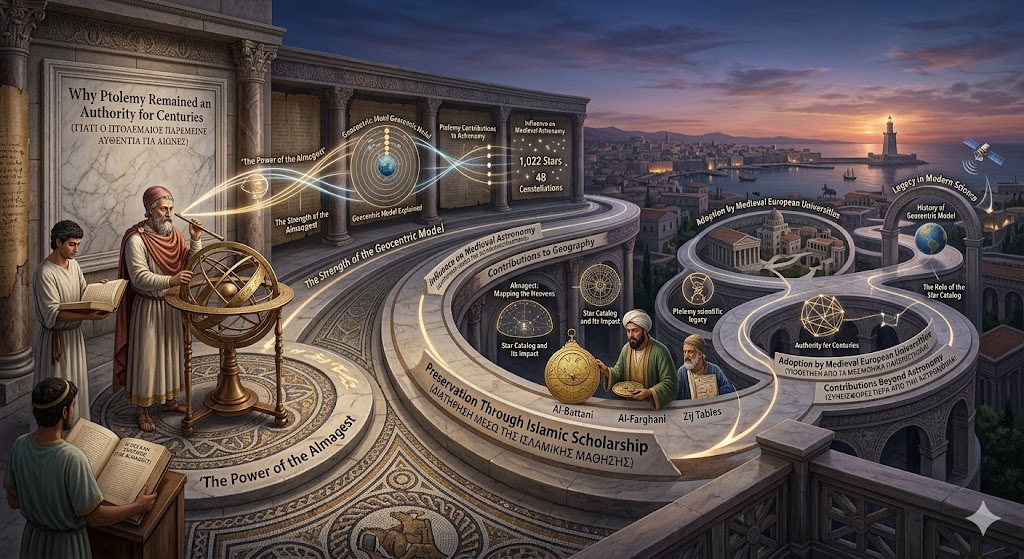
The cornerstone of Claudius Ptolemy influence was the Almagest. Originally titled Mathematikē Syntaxis (Mathematical Compilation), it was later renamed by Arabic translators as “The Greatest.” This was not hyperbole. The Almagest was a monumental achievement in classical Greek science, synthesizing centuries of ancient Greek astronomy into a single, cohesive narrative.
Through Almagest: Mapping the Heavens, Ptolemy offered a mathematical rigor that was previously unseen. He used geometry to solve the “riddle of the planets,” providing a manual that any educated person could use to calculate celestial positions. This utility ensured that the Almagest became the definitive textbook for the history of astronomy development, making it nearly impossible for any competing theory to gain a foothold.
The Strength of the Geocentric Model
The most famous—and eventually controversial—aspect of his work was the Geocentric Model Explained in his texts. While we now know the solar system is heliocentric, the Ptolemaic system was incredibly robust for its time. It accounted for the apparent “retrograde motion” of planets through a complex system of epicycles and deferents.
The geocentric model influence was strengthened by the fact that it matched human sensory experience. To an observer on the ground, the Earth feels stationary, and the sun appears to move. By aligning scientific theory with common sense and the prevailing ancient astronomical theories, Ptolemy created a worldview that was difficult to challenge without the aid of telescopes. This alignment with “obvious” reality is a primary reason why Ptolemy remained an authority for centuries.
Contributions Beyond Astronomy
Ptolemy was not a one-note scientist. His authority was bolstered by his mastery of multiple disciplines. His Contributions to Geography were just as revolutionary as his astronomical work. By introducing a grid system of latitude and longitude, he gave the world its first scientific map.
Furthermore, his work in optics and music (harmonics) demonstrated a universal application of mathematics to the physical world. This multi-disciplinary expertise solidified the Ptolemy influence on science, making him appear as a universal sage whose methods could be trusted across all domains of medieval scientific knowledge.
Preservation Through Islamic Scholarship
The survival of Ptolemy’s work is largely thanks to the scholars of the Islamic Golden Age. While Europe was in a period of intellectual transition, Islamic astronomers in Baghdad, Cairo, and Cordoba were translating, commenting upon, and refining the Ptolemaic system.
Islamic Golden Age astronomy did not just accept Ptolemy blindly; they tested him. They built massive observatories to check his data, yet they found his underlying geometric framework so sound that they continued to use it. This period of history of Ptolemy astronomy saw the creation of more accurate tables and instruments, all based on the original Greek models. This cross-cultural validation is a key reason Ptolemy remained an authority for centuries.
Adoption by Medieval European Universities
When Ptolemy’s works were translated into Latin in the 12th century, they became the bedrock of the newly emerging European universities. The Influence on Medieval Astronomy was total. For the medieval scholar, Ptolemy represented the pinnacle of “Natural Philosophy.”
His models were integrated into the Christian worldview, where the “Perfect Heavens” mirrored the divine order. In the medieval scientific traditions, the Almagest was studied alongside the works of Aristotle. This institutionalization meant that for hundreds of years, every doctor, lawyer, and priest was educated in the Ptolemaic system, further cementing his status as the ultimate early scientific authority in history.
The Role of the Star Catalog
A significant part of Ptolemy’s practical authority came from his empirical data. The Star Catalog and Its Impact cannot be overstated. By cataloging 1,022 stars and their magnitudes, Ptolemy provided a permanent reference point for navigation and timekeeping.
Even those who might have questioned his planetary theories still relied on his Ptolemy Contributions to Astronomy regarding the fixed stars. His catalog remained the most accurate available until the work of Tycho Brahe in the late 16th century. This practical utility ensured that even as theoretical doubts grew, his books remained on the desks of every working astronomer.
Gradual Decline of Ptolemy’s Authority
The decline of the Ptolemy scientific legacy was not a sudden event but a slow erosion. As measurement tools improved, the “fixes” required to keep the geocentric model accurate became too complex. The “Copernican Revolution” in the 16th century offered a simpler, more elegant sun-centered model.
However, even as the heliocentric model took hold, scholars like Galileo and Kepler continued to use Ptolemaic methods and data. It took the invention of the telescope and the laws of gravity to finally displace him. The fact that it took such a massive technological and theoretical shift to unseat him proves just how deeply Ptolemy remained an authority for centuries.
Frequently Asked Questions (FAQs)
Why did Ptolemy’s geocentric model last so long?
It lasted because it was mathematically functional and predicted planetary movements with enough accuracy for the needs of the time, such as calendar making and navigation.
What was Ptolemy’s most important book?
The Almagest is considered his most important work as it defined the field of astronomy for over 1,400 years.
Did Ptolemy influence the Age of Discovery?
Yes, his geographic works and his underestimation of the Earth’s size influenced Christopher Columbus to sail west in search of Asia.
Is any of Ptolemy’s work still used today?
While his geocentric theory is obsolete, his system of star magnitudes and many of his 48 constellations are still the basis for modern astronomical standards.
How did the Islamic world view Ptolemy?
Islamic scholars viewed him with immense respect, calling his work “The Greatest,” but they were also his first systematic critics, improving his observations and mathematical proofs.
Conclusion
The reason Ptolemy remained an authority for centuries is that he provided humanity with something it desperately needed: an orderly, predictable, and measurable universe. His Ptolemaic system history is a story of the human desire for structure. While he was eventually proven wrong about the center of the universe, his Ptolemy astronomy discoveries and his rigorous application of geometry to the natural world laid the very foundation for the scientific method. Claudius Ptolemy was the bridge between the ancient world and the modern, a figure whose influence reminds us that even “incorrect” theories can lead us toward the ultimate truth.