Introduction
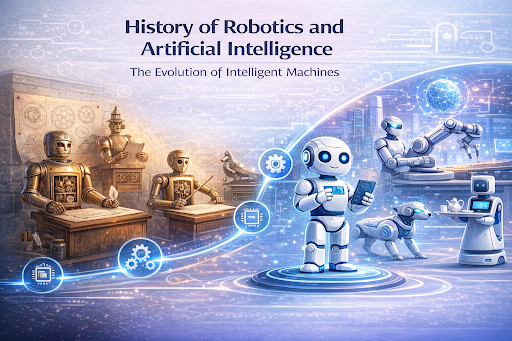
The history of robotics and artificial intelligence is a captivating saga of human ingenuity, stretching from the mythical dreams of antiquity to the silicon-based reality of the 21st century. For centuries, humanity has been obsessed with the idea of creating artificial life—mechanical servants or companions that could perform tasks with precision and tireless energy. Today, we no longer view these as mere clockwork toys; we see them as sophisticated AI robotics systems capable of learning, adapting, and interacting with the world in ways that were once confined to science fiction.
Understanding the history of robotics and artificial intelligence is essential to appreciating the technological landscape of 2026. This journey is not just about metal and wires; it is about the evolution of machine intelligence and our quest to replicate the complexities of the human mind. As we delve into the development of robotics and artificial intelligence, we see how these two distinct fields merged to create the “intelligent machines” that now define our modern era.
Early Concepts of Robots (Ancient Times)
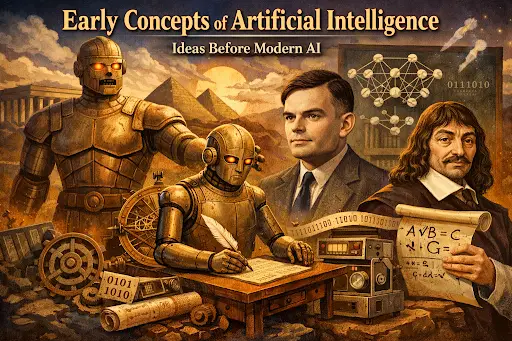
Long before the first transistor was ever soldered, the history of robotics and artificial intelligence began in the imagination of ancient philosophers and engineers. In Greek mythology, the god Hephaestus was said to have forged golden handmaidens who could speak and learn. More tangibly, the “Antikythera mechanism” from the 2nd century BCE shows that ancient civilizations possessed a profound understanding of complex gear systems.
During the Islamic Golden Age, the polymath Al-Jazari created elaborate automatons, including a musical robot band and water-powered clocks. These early mechanical wonders are the ancestors of robotics technology history. While they lacked what we now call machine intelligence, they established the foundational principle of robotics engineering: using mechanical design to automate human tasks. These ancient automatons proved that the desire to build autonomous-like entities is a deep-seated part of the human experience.
The Birth of the Word “Robot” (1920)
A pivotal moment in the history of robotics and artificial intelligence occurred not in a lab, but on a theater stage. In 1920, Czech writer Karel Čapek introduced the word “robot” in his play R.U.R. (Rossum’s Universal Robots). Derived from the Old Church Slavonic word robota, meaning “forced labor” or “drudgery,” the term gave a name to the mechanical beings that had occupied human dreams for millennia.
This era in the history of robotics and artificial intelligence shifted the focus from purely mechanical toys to the societal and ethical implications of artificial workers. Čapek’s robots were not metal machines but biological entities created in a factory—a precursor to modern bio-robotics. This literary milestone galvanized scientists to turn fiction into reality, sparking the robotics and artificial intelligence history we recognize today.
Early Robotics Research (1950s–1960s)
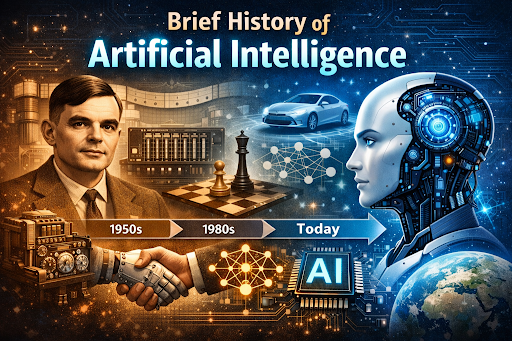
The formalization of the history of robotics and artificial intelligence took place during the mid-20th century. This was the era of the Dartmouth Conference, where the term “Artificial Intelligence” was officially coined. It was also the time of AlanTuring Artificial Intelligence theories, which proposed that if a machine could mimic human responses perfectly, it could be considered “intelligent.”
In 1961, the world saw the first industrial robots: the Unimate. Developed by George Devol and Joseph Engelberger, the Unimate was installed at a General Motors plant to perform dangerous tasks like lifting hot pieces of metal. Simultaneously, researchers were developing the First AI Programs to give these machines basic logic. Shakey the Robot, developed at SRI International in the late 1960s, became the first mobile intelligent robot. Shakey could reason about its actions, navigating a room to perform simple tasks, marking a massive leap in the growth of robotics and artificial intelligence.
Growth of Artificial Intelligence in Robotics (1970s–1980s)
During the 1970s and 1980s, the history of robotics and artificial intelligence faced both immense progress and significant hurdles. While industrial robots became staples in automotive manufacturing, the AI side experienced the AI Winters, periods where funding and interest dried up due to over-inflated expectations.
Despite these setbacks, the robotics and AI development continued in specialized labs. This period saw the rise of Expert Systems in Artificial Intelligence, which were software programs designed to mimic the decision-making ability of a human expert. In robotics, this meant creating robot learning systems that could follow complex, albeit rigid, logical trees. However, these machines still lacked the “common sense” or flexibility of biological entities. The focus during this chapter of the history of robotics and artificial intelligence was on perfecting robotics automation—making machines faster and more precise, even if they weren’t yet truly “smart.”
Intelligent Robots and Machine Learning (1990s–2000s)
The 1990s marked a Revival of Artificial Intelligence in the 1990s, fundamentally altering the history of robotics and artificial intelligence. Instead of trying to program every single rule into a robot’s “brain,” researchers began focusing on the Evolution of Machine Learning Algorithms. This allowed robots to learn from data and experience.
Significant milestones included the Mars Pathfinder’s Sojourner rover in 1997, which used AI to navigate the Martian terrain autonomously. In the consumer world, the 2002 release of the Roomba vacuum introduced millions to the concept of service robots. This era also saw the development of humanoid robots like Honda’s ASIMO, which could walk, climb stairs, and interact with people. The integration of The Rise of Neural Networks began to give these machines better computer vision and speech recognition, moving intelligent robots history toward more natural human-robot interaction.
Modern Robotics and Artificial Intelligence (2010s–Present)
We are currently living in the most explosive era of the history of robotics and artificial intelligence. The convergence of big data, powerful GPUs, and advanced sensors has created AI-powered robots that are no longer confined to factory floors. Within this history of robotics and artificial intelligence, Modern Artificial Intelligence Applications have made robots an everyday reality.
Autonomous Robots
Modern autonomous robots use deep learning to navigate unpredictable environments. From delivery drones in cities to warehouse robots in Amazon fulfillment centers, these machines use complex SLAM (Simultaneous Localization and Mapping) to move safely alongside humans.
Medical Robots
In healthcare, the Da Vinci Surgical System allows surgeons to perform minimally invasive procedures with robotic precision. Furthermore, AI-driven prosthetic limbs now use muscle signals to allow patients to control artificial hands with their thoughts.
Self-Driving Vehicles
Perhaps the most high-profile application in the history of robotics and artificial intelligence is the self-driving car. Companies like Tesla and Waymo use massive AI robotics systems to process visual data in real-time, allowing cars to navigate traffic, recognize pedestrians, and make split-second safety decisions.
Service Robots
From hospitality robots that deliver towels in hotels to social robots designed to assist the elderly, service robots are becoming increasingly empathetic. They use natural language processing to understand human emotions and provide companionship or assistance.
Future of Robotics and Artificial Intelligence
The future history of robotics and artificial intelligence points toward “General Purpose Robots.” Rather than a machine designed for just one task, we are moving toward humanoid robots that can be “taught” any household or industrial chore. The development of soft robotics—machines made from flexible materials—will allow robots to interact more safely with biological organisms.
Furthermore, the growth of robotics and artificial intelligence will likely see a shift toward “Swarm Robotics,” where hundreds of small robots work together like an ant colony to solve massive problems, such as cleaning up ocean plastic or constructing buildings. However, as these machines become more integrated into our lives, the history of robotics and artificial intelligence will also have to address critical ethical questions regarding job displacement and robot rights.
Frequently Asked Questions (FAQs)
What is the difference between a robot and AI?
Robotics deals with the physical machine (the body), while AI deals with the computer systems that perform tasks requiring intelligence (the brain). The history of robotics and artificial intelligence is the story of these two fields coming together.
Who is the father of robotics?
Joseph Engelberger is often called the father of robotics for creating the Unimate, the first industrial robot, in the late 1950s.
Are self-driving cars considered robots?
Yes. In the context of the history of robotics and artificial intelligence, self-driving cars are considered complex autonomous robots because they sense their environment and act upon it without human intervention.
Conclusion
The history of robotics and artificial intelligence is a testament to the fact that we are a species of builders. From the clockwork automatons of the ancient world to the self-learning neural networks of today, our journey has been defined by a desire to extend our capabilities through technology.
Today, the history of robotics and artificial intelligence has reached a point where the line between “machine” and “intelligent being” is beginning to blur. As we continue to refine these AI-powered robots, we aren’t just building tools; we are creating partners that will help us explore space, heal the sick, and build a more efficient future. The saga of intelligent machines is only just beginning.