Introduction to Image Recognition in AI
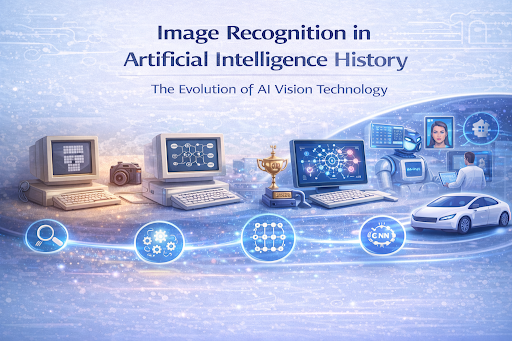
The journey of teaching machines to “see” is one of the most fascinating narratives in modern science. When we explore image recognition in artificial intelligence history, we uncover a timeline filled with audacious goals, unexpected roadblocks, and groundbreaking technological triumphs. At its core, image recognition is the ability of a computer system to identify objects, people, places, and actions within digital images or videos.
Understanding the computer vision image recognition history is essential for appreciating how far we have come. In the early days, teaching a machine to differentiate between a simple square and a circle was a monumental task. Today, these systems can instantly identify a specific human face in a bustling crowd or diagnose complex medical conditions from an X-ray faster than a human doctor. The trajectory of image recognition in artificial intelligence history is not just about writing better code; it is about fundamentally replicating human cognitive processes through computational power. By examining this history of image recognition, we gain valuable insights into the broader narrative of digital innovation and the relentless human drive to create intelligent machines.
Early Research in Image Recognition (1960s–1970s)
The foundational years of image recognition in artificial intelligence history were characterized by boundless optimism. Researchers believed that replicating human vision would be a relatively straightforward task that could be solved in a matter of months. A pivotal moment in the broader context of AI was the Dartmouth Conference in 1956, which laid the ideological groundwork for teaching machines to mimic human intelligence.
By the 1960s, early pioneers began tackling visual data. One of the most famous anecdotes in image recognition in artificial intelligence history is the “Summer Vision Project” launched by Seymour Papert at MIT in 1966. The goal was to attach a camera to a computer and have it describe what it saw within a single summer. While the project fell drastically short of its goal, it formally launched the development of image recognition systems. During this era, researchers focused on extracting basic 3D structures from 2D images, creating algorithms that could identify simple edges, lines, and geometric shapes. These foundational steps were crucial for all subsequent AI image recognition development.
Development of Pattern Recognition Techniques (1980s)
As the limitations of the 1960s and 70s became apparent, the 1980s ushered in a more systematic approach. The focus of image recognition in artificial intelligence history shifted toward rigorous mathematical models and pattern recognition. Rather than trying to solve vision all at once, scientists began breaking images down into manageable computational chunks.
During this decade, the evolution of image recognition technology saw the introduction of optical character recognition (OCR) and more advanced edge-detection algorithms, such as the Canny edge detector. Researchers realized that before a computer could identify a complex object, it first needed to understand the boundaries and textures of that object. This era of image recognition in artificial intelligence history also witnessed the early conceptualization of the Neocognitron by Kunihiko Fukushima, a hierarchical, multilayered artificial neural network inspired by the visual cortex. This foundational work in pattern recognition served as a critical stepping stone, proving that visual data could be systematically categorized and analyzed by machines.
Machine Learning and Image Recognition (1990s–2000s)
The late 1990s and early 2000s marked a significant turning point in image recognition in artificial intelligence history. The field moved away from relying solely on hand-crafted rules and began embracing statistical models. This period was heavily defined by the Evolution of Machine Learning Algorithms, which allowed computers to learn from vast datasets rather than relying on explicit programming for every possible visual scenario.
Machine learning image recognition gained immense traction during this time. Techniques such as Support Vector Machines (SVMs) and the Viola-Jones object detection framework revolutionized the field. The Viola-Jones algorithm, introduced in 2001, was a massive leap forward in image recognition in artificial intelligence history because it allowed for real-time facial recognition technology on relatively standard hardware. The growth of image recognition in AI was accelerating rapidly, proving that with enough labeled data, machines could be trained to identify specific features, such as the distance between eyes or the curve of a jawline, with astonishing accuracy.
Deep Learning Revolution in Image Recognition (2010s)
If earlier decades represented steady progress, the 2010s represented an explosive paradigm shift in image recognition in artificial intelligence history. This era was undeniably defined by The Rise of Neural Networks, specifically convolutional neural networks (CNNs). While the theoretical framework for these networks had existed for years, they required massive amounts of data and immense computational power (specifically GPUs) to become viable.
The watershed moment for deep learning image recognition occurred in 2012 at the ImageNet Large Scale Visual Recognition Challenge. An architecture known as AlexNet obliterated the competition, dropping the error rate by a staggering margin. This single event altered the trajectory of image recognition in artificial intelligence history forever. Suddenly, neural networks were capable of identifying thousands of different objects, animals, and scenes with near-human accuracy. This breakthrough transformed computer vision from a niche academic pursuit into a mainstream technological powerhouse, laying the absolute foundation for the intelligent systems we interact with today.
Modern Applications of Image Recognition
Today, we are living in the era of Modern Artificial Intelligence Applications, where the theoretical research of the past has materialized into tools that touch every aspect of our daily lives. The current state of image recognition in artificial intelligence history is defined by seamless integration and widespread utility.
Here are some of the most prominent ways this technology is deployed today:
Facial Recognition
Facial recognition technology has become completely ubiquitous. From unlocking our smartphones with a simple glance to tagging friends in social media photos, AI visual recognition systems map distinct facial landmarks in milliseconds. It has revolutionized personal device security and identity verification.
Medical Imaging
Perhaps the most life-saving application in image recognition in artificial intelligence history is its use in healthcare. Advanced algorithms can now analyze MRIs, CT scans, and X-rays to detect early signs of tumors, fractures, and diseases. These systems act as a powerful second set of eyes for radiologists, significantly improving diagnostic accuracy and patient outcomes.
Autonomous Vehicles
Self-driving cars rely heavily on object detection systems to navigate safely. By processing real-time video feeds from multiple cameras, the vehicle’s computer vision system can distinguish between pedestrians, other vehicles, traffic lights, and road signs, making split-second decisions that ensure passenger safety.
Retail and E-Commerce
The evolution of image recognition technology has transformed how we shop. Visual search allows consumers to upload a photo of an item they like—such as a pair of shoes or a piece of furniture—and instantly find similar products online. Additionally, automated checkout systems in physical stores use cameras to track which items a customer has picked up, eliminating the need for cashiers.
Security and Surveillance
In the realm of public and private security, AI image recognition development has led to intelligent surveillance systems capable of identifying unauthorized intrusions, tracking suspicious behavior, or locating missing persons in crowded environments, dramatically enhancing situational awareness.
Future of Image Recognition Technology
As we look toward tomorrow, the next chapter in image recognition in artificial intelligence history promises to be even more extraordinary. Researchers are currently pushing the boundaries of what is possible, moving beyond simple 2D image analysis into real-time 3D spatial understanding and augmented reality integration.
The future will likely see a deeper fusion of image recognition in AI with other modalities, such as natural language processing, allowing machines to not only identify what is in a picture but to understand the context, emotion, and narrative behind it. Furthermore, as edge computing becomes more powerful, we will see these capabilities embedded directly into smaller, lower-power devices. The continuing narrative of image recognition in artificial intelligence history will focus heavily on minimizing algorithmic bias and ensuring these powerful vision systems are deployed ethically and transparently across society.
Frequently Asked Questions (FAQs)
What is the most significant milestone in image recognition in artificial intelligence history?
While there are many, the 2012 ImageNet competition, where the AlexNet convolutional neural network drastically reduced error rates, is widely considered the watershed moment that kicked off the modern deep learning revolution in image recognition in artificial intelligence history.
How does computer vision differ from image recognition?
Computer vision is the broad overarching field of AI that trains computers to interpret and understand the visual world. Image recognition is a specific sub-task within computer vision that focuses explicitly on identifying and categorizing objects, places, or people within a single image.
Why did image recognition systems struggle in the early decades?
Early attempts in image recognition in artificial intelligence history struggled primarily due to a lack of computational power and a lack of large, labeled datasets. Early researchers also underestimated the sheer complexity of the human visual cortex, trying to solve it with rigid, rule-based programming rather than flexible machine learning.
What role do neural networks play in this technology?
Neural networks, particularly convolutional neural networks (CNNs), are the engine driving modern image recognition. They work by passing image pixels through multiple layers of artificial nodes, gradually recognizing basic edges, then shapes, and finally complex objects, mimicking the way human vision processes information.
Conclusion
The vast and complex narrative of image recognition in artificial intelligence history is a testament to human ingenuity. What began as a wildly optimistic summer project in the 1960s has evolved into a foundational pillar of modern computing. We have transitioned from machines that could barely identify a straight line to sophisticated neural networks that can drive cars, diagnose diseases, and secure our personal devices.By tracking the development of pattern recognition, the integration of statistical machine learning, and the ultimate triumph of deep neural networks, we can truly appreciate the magnitude of these technological leaps. As we continue to refine and expand these systems, the next phases of image recognition in artificial intelligence history will undoubtedly reshape our world in ways we are only just beginning to imagine, forever altering the way humanity interacts with the digital realm.