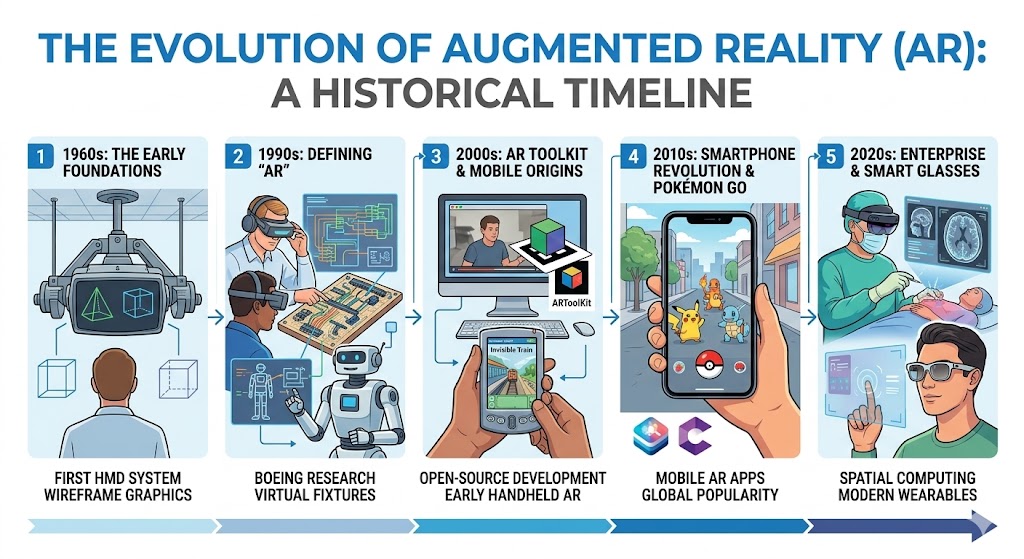
The history of augmented reality reflects one of the most fascinating technological evolutions in modern computing. Augmented reality (AR) blends digital elements with the real world through devices such as smartphones, tablets, and smart glasses. Unlike fully immersive virtual environments, AR enhances the physical world by overlaying digital information like images, text, and holographic overlays.
From experimental laboratories in the 1960s to today’s advanced spatial computing systems, the history of augmented reality shows how computer science, wearable technology, and mobile computing combined to create powerful new experiences.
Advancements in graphics processing and display technology—covered in history of computer graphics—played a crucial role in enabling realistic AR experiences. At the same time, innovations in connectivity and infrastructure described in history of computer networking allowed AR systems to access real-time data and cloud-based services.
Today, AR technology powers navigation tools, gaming experiences, industrial training systems, and modern artificial intelligence applications that interpret real-world environments in real time.
A. The Conceptual Origins – 1950–1968
The roots of the history of augmented reality can be traced back to the mid-20th century, when scientists began exploring ways to combine digital visuals with real-world environments.
During the 1950s and early 1960s, researchers experimented with immersive displays and simulation systems. These early technologies laid the groundwork for modern wearable technology milestones and spatial computing systems.
Many early experiments involved heads-up display (hud) systems that projected information directly into a user’s field of view. These displays were initially developed for aviation and military applications.
The First Head-Mounted Display – 1968
A major milestone in the history of augmented reality occurred in 1968, when computer scientist Ivan Sutherland created the first head-mounted display (hmd).
This device, often called the “Sword of Damocles,” used an optical see-through system that allowed users to view simple computer graphics overlaid on the real world. The display tracked head movement and adjusted graphics accordingly.
Although the system was large and impractical, it introduced key ideas such as spatial mapping, real-time rendering, and interactive visualization.
B. Defining the Terminology – 1990–1992
The next major step in the history of augmented reality occurred in the early 1990s, when researchers formally defined the concept of augmented reality.
During this period, advances in computer vision, tracking systems, and interactive displays made it possible to overlay digital content more accurately onto real-world environments.
Boeing and the Birth of “AR” – 1990
In 1990, researcher Tom Caudell at Boeing introduced the term augmented reality while working on a system designed to assist aircraft manufacturing.
The system used holographic overlays and digital guides to help workers assemble aircraft components more efficiently.
This marked a major step in the evolution of ar technology, as AR moved from experimental research into industrial applications.
Virtual Fixtures – 1992
Another important development in the history of augmented reality occurred in 1992 with the creation of virtual fixtures.
This system combined robotics and AR to guide human operators performing complex tasks. It demonstrated how AR could enhance precision and safety in industrial environments.
C. The Arrival of Open Source and Gaming – 1999–2005
The late 1990s and early 2000s introduced important innovations that expanded AR development beyond research laboratories.
ARToolKit – 1999
In 1999, researchers developed artoolkit, one of the first open-source AR libraries.
ARToolKit allowed developers to create AR applications using camera tracking and simultaneous localization and mapping (slam) techniques.
This innovation significantly accelerated the development of smart glasses and interactive AR software.
Goes Mobile – 2003–2005
Between 2003 and 2005, early experiments began integrating AR with mobile devices.
Although smartphones were still limited, these early mobile ar apps demonstrated how handheld devices could display augmented content using cameras and sensors.
Advances in software architecture described in history of software engineering also helped developers build more sophisticated AR systems.
D. The Smartphone Revolution and the History of Augmented Reality – 2008–2012
The smartphone era transformed the history of augmented reality by providing powerful processors, cameras, and sensors in portable devices.
Wikitude and Layar – 2008
In 2008, applications like Wikitude and Layar introduced AR navigation and location-based overlays on smartphones.
These apps used GPS, cameras, and motion sensors to display information about nearby landmarks and businesses.
The rise of smartphones—explained in history of mobile technology—played a critical role in making AR accessible to millions of users worldwide.
The Debut of Google Glass – 2012
A major milestone in the history of augmented reality occurred in 2012 with the release of Google Glass.
This device introduced consumer-friendly smart glasses that displayed notifications, navigation information, and camera feeds directly in the user’s field of view (fov).
Although early versions faced privacy concerns, Google Glass demonstrated the potential of wearable AR devices.
E. The Pokémon GO Phenomenon and Enterprise AR – 2016–2017
The next major chapter in the history of augmented reality came with the widespread adoption of AR gaming and enterprise applications.
Pokémon GO – 2016
In 2016, the mobile game Pokémon GO became a global sensation.
Using smartphone cameras and GPS technology, the game placed virtual creatures in real-world environments.
This event became one of the most important wearable technology milestones and demonstrated the power of AR for entertainment and social interaction.
ARKit and ARCore – 2017
In 2017, Apple and Google released arkit / arcore, powerful frameworks that allowed developers to create advanced AR applications.
These platforms used computer vision, spatial mapping, and slam algorithms to accurately track real-world environments.
This development significantly accelerated the evolution of ar technology.
F. The Era of Spatial Computing and Modern Smart Glasses – 2020–2024
The 2020s represent a new phase in the history of augmented reality, characterized by spatial computing and advanced wearable devices.
Industrial Transformation
Industries such as manufacturing, healthcare, and logistics increasingly use AR systems for training, maintenance, and visualization.
These solutions combine AR with data processing systems discussed in history of data science.
Consumer Smart Glasses Return
Recent smart glasses from companies like Meta, Apple, and Microsoft have revived interest in consumer AR devices.
Modern systems feature improved displays, wider field of view, and better spatial computing origins capabilities.
G. The Future – 2025 and Beyond
Looking ahead, the history of augmented reality is expected to evolve rapidly with new technologies.
Future AR systems may include:
- lightweight smart glasses with full-day battery life
- advanced holographic overlays for immersive interfaces
- seamless integration with artificial intelligence
- improved spatial mapping and real-time environment recognition
As AR continues to mature, it will likely transform industries ranging from education to healthcare and entertainment.
Frequently Asked Questions (FAQs)
What is augmented reality?
Augmented reality is a technology that overlays digital elements onto the real world using cameras, sensors, and displays.
When did augmented reality begin?
The history of augmented reality began in the 1960s with early head-mounted displays developed by Ivan Sutherland.
What devices use augmented reality?
AR can be experienced using smartphones, tablets, smart glasses, and specialized head-mounted displays.
How is AR different from VR?
The ar vs. vr history shows that AR enhances the real world with digital elements, while VR creates a completely immersive virtual environment.
Conclusion
The history of augmented reality illustrates how a concept developed in research laboratories evolved into a transformative technology used worldwide. From early head-mounted displays to modern spatial computing platforms and smart glasses, AR has undergone remarkable progress over the past six decades.
As advancements in computer vision, wearable devices, and artificial intelligence continue, the future of augmented reality will likely bring even more immersive experiences and powerful real-world applications.