Introduction
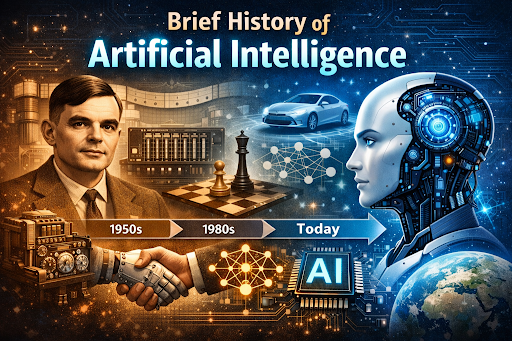
The generative ai history is a fascinating journey from simple logical machines to systems capable of writing poetry, coding software, and painting masterpieces. While it feels like a modern phenomenon, the roots of generative artificial intelligence development stretch back much further than the viral chatbots of today. This evolution represents a fundamental shift in computing: moving from machines that merely analyze data to machines that can create entirely new content.
Understanding the generative AI technology history is essential for anyone looking to grasp the future of work, art, and science. By looking at how generative AI models evolution occurred, we see a story of persistence through technical hurdles and brilliant breakthroughs in neural networks. Today, generative AI systems are no longer a niche academic interest but a central pillar of global innovation. This article explores the milestones that define the growth of generative AI and how it has permanently altered the creative landscape.
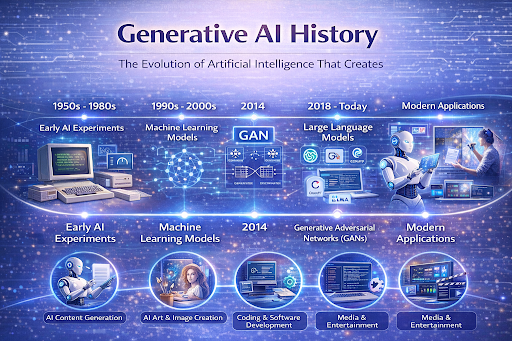
Early Foundations of Generative AI (1950s–1980s)
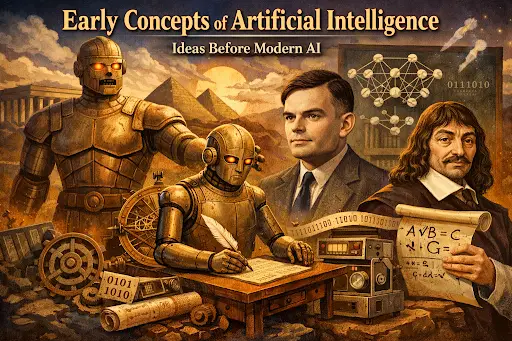
The earliest chapters of generative ai history were written by pioneers who wondered if a machine could ever mimic human thought. During the Dartmouth Conference of 1956, the goal of creating “intelligent” machines was formalized. Early researchers focused on symbolic logic, creating the First AI Programs designed to solve specific mathematical problems.
In the 1960s, one of the first true examples of generative AI technology history emerged with ELIZA, a chatbot created by Joseph Weizenbaum. ELIZA used simple pattern matching to simulate a psychotherapist, marking an early attempt at AI text generation. Though it didn’t “understand” language, it could generate responses that felt surprisingly human to users. This era also saw the development of The Perceptron, an early type of neural network that laid the structural groundwork for how machines might eventually learn to perceive and generate patterns. However, these early successes were eventually met with the AI Winters, periods where funding and interest dried up because the technology could not yet live up to the massive hype.
Machine Learning and Generative Models (1990s–2000s)
As computing power increased in the late 1990s, the Revival of Artificial Intelligence in the 1990s brought new life to the field. This period was crucial for the history of generative AI as it shifted from “hand-coded” rules to machine learning models that could learn from data. Early machine learning techniques, such as Hidden Markov Models (HMMs), began to improve the accuracy of speech and text sequences.
During this stage of generative ai history, researchers experimented with N-grams and basic probabilistic models for content creation. While these systems could generate text, they often lacked long-term coherence, frequently losing the “thread” of a conversation or a paragraph. However, this era established the necessity of massive datasets for training. The evolution of generative AI was quietly gaining momentum as researchers refined the math behind backpropagation and deep learning models, preparing the world for the neural network explosion that was just around the corner.
Generative Adversarial Networks (2014)
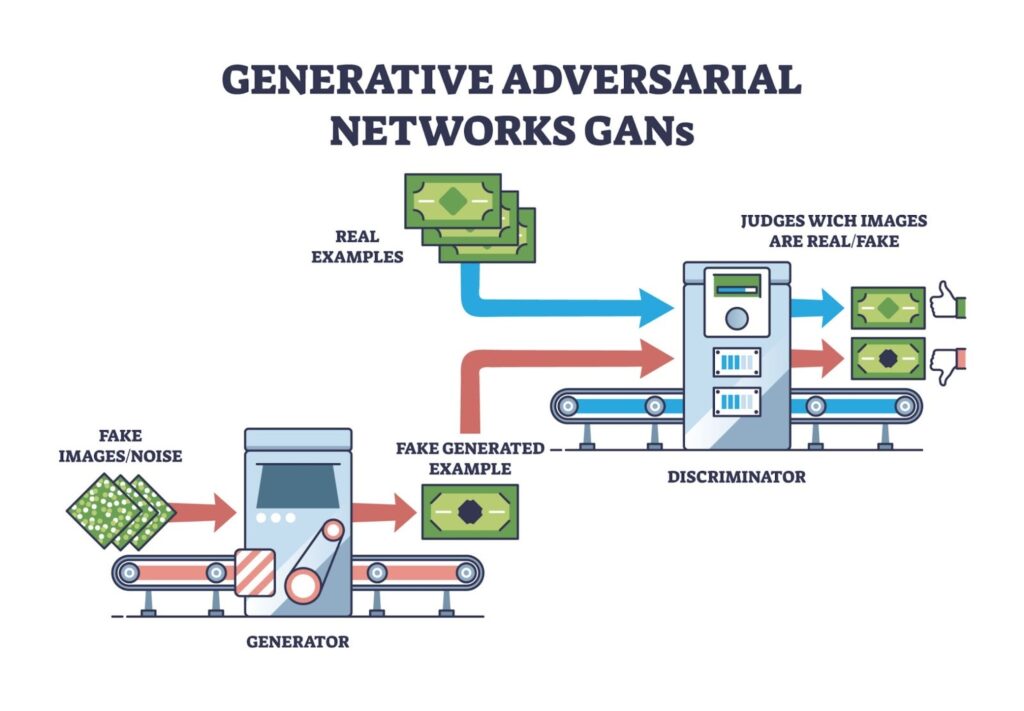
One of the most explosive moments in generative ai history occurred in 2014 when Ian Goodfellow and his colleagues introduced Generative Adversarial Networks (GANs). This was a revolutionary leap in generative AI development. A GAN consists of two neural networks—a generator and a discriminator—that “compete” against each other. The generator tries to create fake data (like a human face), while the discriminator tries to tell if the data is real or fake.
This competition forced the generator to become incredibly skilled at mimicry. GANs were the first models to produce high-quality, realistic images, sparking a massive surge in AI art and deepfake technology. The growth of generative AI during this period showed the world that AI could do more than just classify images; it could imagine them. This architecture became a staple in generative AI systems used for everything from improving medical imaging to creating high-resolution video game textures.
Rise of Large Language Models (2018–Present)
The current era of generative ai history is dominated by the transformer architecture, which led to the birth of large language models (LLMs). Starting around 2018 with the release of models like GPT and BERT, the ability of AI to perform natural language processing reached a superhuman scale. Unlike previous models, these LLMs could process vast amounts of text in parallel, allowing them to understand context and nuance over thousands of words.
The generative AI model’s evolution reached a fever pitch with the release of ChatGPT in late 2022. Suddenly, the public had access to sophisticated AI text generation that could write essays, explain quantum physics, and even write functional code. This milestone in the evolution of generative AI proved that scaling up neural networks with billions of parameters could result in emergent abilities that no one had predicted. Today, large language models are the primary engine behind the global artificial intelligence boom.
Diffusion Models and AI Image Generation
Parallel to the rise of text models, another breakthrough was occurring in the visual realm: diffusion models. In the timeline of generative ai history, diffusion models replaced GANs as the gold standard for image creation. These models work by adding “noise” to an image until it is unrecognizable and then learning how to reverse that process to create a clear image from scratch.
This technology led to the creation of platforms like DALL-E, Midjourney, and Stable Diffusion. These generative AI systems allowed users to type a simple text prompt and receive a stunning, high-definition piece of art in seconds. This represented a major milestone in generative artificial intelligence development, as it bridged the gap between language and vision, allowing for a “multimodal” creative process that was previously thought to be decades away.
Modern Applications of Generative AI
Today, the generative ai history has transitioned from research papers into Modern Artificial Intelligence Applications that touch every industry.
Content Creation
Marketers and writers now use generative AI for brainstorming, drafting, and SEO optimization. AI text generation tools have become standard assistants, helping to overcome “writer’s block” and speed up the production of digital content at an unprecedented scale.
AI Art and Design
Architects and graphic designers use diffusion models to generate mood boards, concepts, and intricate patterns. The ability of generative AI to iterate through hundreds of designs in minutes has fundamentally changed the creative workflow in high-end design studios.
Software Development
Coding has been revolutionized by tools that use large language models to suggest lines of code or debug complex scripts. This application of generative AI development allows developers to focus on high-level architecture while the AI handles the repetitive syntax.
Video and Media Production
Generative AI systems are now capable of creating realistic video clips from text prompts and synthesizing human-like voices. This is transforming the film industry, enabling better special effects and more efficient dubbing and localization for global audiences.
Healthcare and Science
Perhaps the most noble use of generative AI is in drug discovery and protein folding. Scientists use generative models to “imagine” new molecular structures that could lead to life-saving medications, significantly cutting down the time required for lab experimentation.
Future of Generative AI
Looking beyond the current generative ai history, the future points toward “Agentic AI”—systems that don’t just create content but can execute complex tasks autonomously. We are moving toward a world where generative AI systems will collaborate as partners, managing entire projects from start to finish.
The evolution of generative AI will also likely focus on efficiency. Instead of needing massive server farms, future models may run locally on personal devices. Additionally, as we move past the initial “wow” factor, the focus will shift heavily toward ethical guardrails, ensuring that the history of generative AI is not tarnished by misinformation or copyright issues. The artificial intelligence development of tomorrow will be defined by its ability to be both creative and responsible.
Frequently Asked Questions (FAQs)
What is the starting point of generative ai history?
While the term is modern, the foundations go back to the 1950s and 60s with early experiments like ELIZA and the basic neural network research conducted after the Dartmouth Conference.
How did GANs change the history of generative AI?
Generative Adversarial Networks (GANs) introduced in 2014 were the first models capable of creating highly realistic images by having two neural networks compete against each other, drastically improving AI’s creative output.
What is the difference between discriminative and generative AI?
Discriminative AI is designed to classify or label data (e.g., “is this a cat or a dog?”), while generative AI is designed to create new data that looks like the training set (e.g., “create a new picture of a cat”).
Why are large language models so important to the growth of generative AI?
LLMs allowed for the processing of context at a massive scale. Their ability to handle diverse tasks—from translation to coding—made generative AI a versatile tool for the general public, not just specialized researchers.
Conclusion
The generative ai history is a testament to human ingenuity and the relentless pursuit of machines that can “think” and “create.” From the early days of symbolic logic to the modern era of diffusion models and LLMs, the evolution of generative AI has consistently broken through barriers that were once thought impenetrable. As these generative AI systems become more integrated into our daily lives, they promise to unlock new levels of human potential, acting as a co-pilot for creativity and a catalyst for scientific discovery. The journey of generative artificial intelligence development is far from over, but the progress made so far has already secured its place as one of the most transformative chapters in the history of technology.