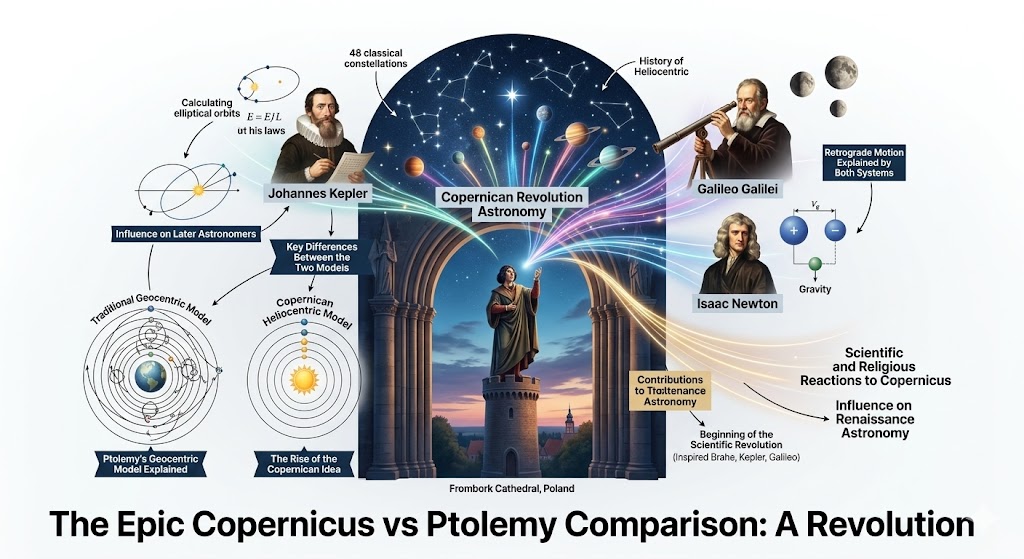
For nearly 1,500 years, humanity lived in a universe that was comfortably, if incorrectly, centered on the Earth. This perception was shattered by the most significant intellectual rivalry in history. A copernicus vs ptolemy comparison is not just a study of two men, but a study of two completely different ways of seeing our existence. While Claudius Ptolemy gave us a world where we were the literal center of creation, Nicolaus Copernicus dared to suggest we were merely passengers on a moving rock. This copernicus vs ptolemy comparison represents the moment the human race finally looked up and saw the truth.
Introduction: The Great Astronomical Debate
The history of heliocentric theory is often framed as a battle between light and dark, but in reality, it was a battle of mathematics and philosophy. The copernicus vs ptolemy comparison began when the inconsistencies of the old world could no longer be ignored. Ptolemy’s system had been the gold standard since the 2nd century, but by the Renaissance, the stars were no longer where his math said they should be. This debate wasn’t just for scholars; it influenced navigation, timekeeping, and the very structure of religious belief.
The Geocentric Universe of Ptolemy
To understand the copernicus vs ptolemy comparison, we must first look at the Ptolemaic system. Ptolemy’s work, the Almagest, solidified the Earth-centered universe. In this model, the Earth sat motionless at the center, while the Moon, Sun, and planets moved around it in perfect circular orbits.
This ptolemy’s geocentric model explained that because humans didn’t feel the Earth moving, it must be stationary. To account for the strange movements of planets, Ptolemy introduced “epicycles”—small circles that planets moved along while they traveled on their larger orbital paths. For over a millennium, this was the undisputed truth of the Western world.
The Rise of the Copernican Idea
By the early 1500s, Nicolaus Copernicus began to find Ptolemy’s “perfect” system to be mathematically “ugly.” He realized that if he swapped the positions of the Earth and the Sun, the need for dozens of complex epicycles vanished. This led to the birth of copernicus’ heliocentric model, where the Sun was the stationary center of the solar system.
The copernicus vs ptolemy comparison highlights a shift in values; Copernicus valued simplicity and harmony (parsimony) over traditional authority. He documented his revolutionary findings in the famous books of copernicus (de revolutionibus), though he was so fearful of the “absurdity” of his claims that he waited until he was on his deathbed to publish the full work.
Key Differences Between the Two Models
When performing a detailed copernicus vs ptolemy comparison, several technical and philosophical differences emerge:
- The Center: Ptolemy placed Earth at the center; Copernicus placed the Sun at the center.
- Earth’s Status: In the Ptolemaic system, Earth is a unique, stationary body. In the Copernican system, Earth is just another planet that rotates and revolves.
- Complexity: The Ptolemaic system required nearly 80 circles (epicycles) to work. The copernicus vs ptolemy comparison shows that the heliocentric model reduced this complexity significantly.
- Order of Planets: Copernicus was able to correctly order the planets (Mercury, Venus, Earth, Mars, Jupiter, Saturn) based on their orbital speeds, something Ptolemy could only guess at.
Retrograde Motion Explained by Both Systems
One of the biggest hurdles in Renaissance astronomy history was the retrograde motion explanation—the phenomenon where planets like Mars appear to stop and move backward in the sky.
In the copernicus vs ptolemy comparison, the two explanations are vastly different:
- Ptolemy’s View: He claimed planets physically moved backward because they were traveling on their small epicycles while orbiting the Earth.
- Copernicus’ View: He explained it as an optical illusion. Because Earth is on a smaller, faster orbit, it simply “laps” the outer planets. As we pass Mars, it only looks like it is moving backward relative to the stars.
[Image comparing the geometric explanation of retrograde motion in geocentric vs heliocentric systems]
This part of the copernicus vs ptolemy comparison was the “smoking gun” for many astronomers. The heliocentric explanation was more natural and didn’t require “ghost circles” in the sky.
Scientific and Religious Reactions to Copernicus
The copernicus vs ptolemy comparison caused an immediate firestorm, though it was slow-burning. Initially, many scientists used Copernicus’ math but rejected his physical reality—they treated the Sun-centered idea as a “useful fiction” for calculations.
The religious reaction was more severe. The Bible mentioned the Sun “standing still,” which implied the Sun usually moved. By suggesting a stationary Sun, Copernicus was seen as contradicting scripture. This tension is a major theme in the influence on renaissance astronomy, eventually leading to the famous trials of Galileo, who championed the Copernican system against the Church’s Ptolemaic preference.
The Beginning of the Scientific Revolution
The copernicus vs ptolemy comparison is widely regarded as the spark that ignited the Scientific Revolution. It taught humanity that the “obvious” truth (that the Earth is still) could be a total illusion. This encouraged scholars to stop relying on ancient texts and start relying on observation and mathematics.
The transition from geocentric to heliocentric wasn’t just about space; it was about the birth of the scientific method. Copernicus showed that the universe was a machine that could be understood through logic. This copernicus vs ptolemy comparison shifted the goal of science from justifying philosophy to discovering objective reality.
Influence on Later Astronomers
The copernicus vs ptolemy comparison provided the foundation for every great mind that followed.
- Tycho Brahe took the most accurate measurements of the time to try and settle the debate.
- Johannes Kepler used those measurements to prove that while Copernicus was right about the center, the orbits were actually ellipses, not perfect circles.
- Galileo Galilei used the telescope to see the phases of Venus, providing physical proof for the Copernican system.
These contributions to astronomy by later giants would have been impossible without the initial “permission” given by Copernicus to question the Ptolemaic system vs Copernican system.
Frequently Asked Questions (FAQs)
Which model was more accurate for predicting the future positions of planets?
Initially, both were roughly equal because Copernicus still used circular orbits. It wasn’t until Kepler added elliptical orbits that the Copernican system became significantly more accurate.
Why did people believe Ptolemy for so long?
Because it matched everyday experience. We don’t feel the Earth spinning or moving through space, and the Sun clearly appears to rise and set.
Did Copernicus hate Ptolemy?
No, he had great respect for him. He viewed his own work as a completion and correction of the ancient Greek’s mathematical goals.
What was the “equant” in Ptolemy’s system?
The equant was a mathematical point used to explain why planets seemed to speed up or slow down. Copernicus hated it because it violated the rule of “uniform circular motion.”
How does the copernicus vs ptolemy comparison affect us today?
It is the reason we have modern physics. It established the “Copernican Principle,” which says we don’t have a special place in the universe, allowing us to apply the laws of physics to the entire cosmos.
Conclusion
The copernicus vs ptolemy comparison serves as a permanent reminder that human knowledge is always a work in progress. While Ptolemy provided the framework that guided humanity for centuries, it was Copernicus who had the vision to look beyond the surface of things. By examining how ancient greek scientists changed modern science, we see that Copernicus used their own mathematical tools to dismantle their errors. This copernicus vs ptolemy comparison ended the era of the Earth centered universe and launched the Sun centered solar system, forever changing our place in the stars. Copernicus didn’t just win a debate; he liberated the human mind to explore a universe without limits.