The story of how humanity first reached for the stars begins not with telescopes, but with the power of the human mind. The ancient greek astronomy history is a saga of intellectual bravery, where philosophers transformed the night sky from a realm of gods into a realm of geometry. By combining meticulous observation with early planetary models, the Greeks laid the foundation for the Western scientific tradition. This journey through ancient greek astronomy history reveals how the ancient world sought to bring order to the chaos of the heavens, creating a system that would dominate human thought for nearly two millennia.
Introduction to Ancient Greek Astronomy
Ancient Greek astronomy history is unique because it shifted the focus from simple timekeeping to theoretical modeling. While the Babylonians and Egyptians were excellent at recording events, the Greeks were the first to ask why the planets moved as they did. This period of early astronomy in ancient Greece was characterized by a desire to find “perfection” in the cosmos. They believed that the universe was a rational place, governed by laws that the human mind could decipher. This pursuit of cosmic harmony is the heartbeat of ancient greek astronomy history, leading to some of the most enduring—and some of the most mistaken—ideas in the history of science.
Aristotle’s View of the Universe
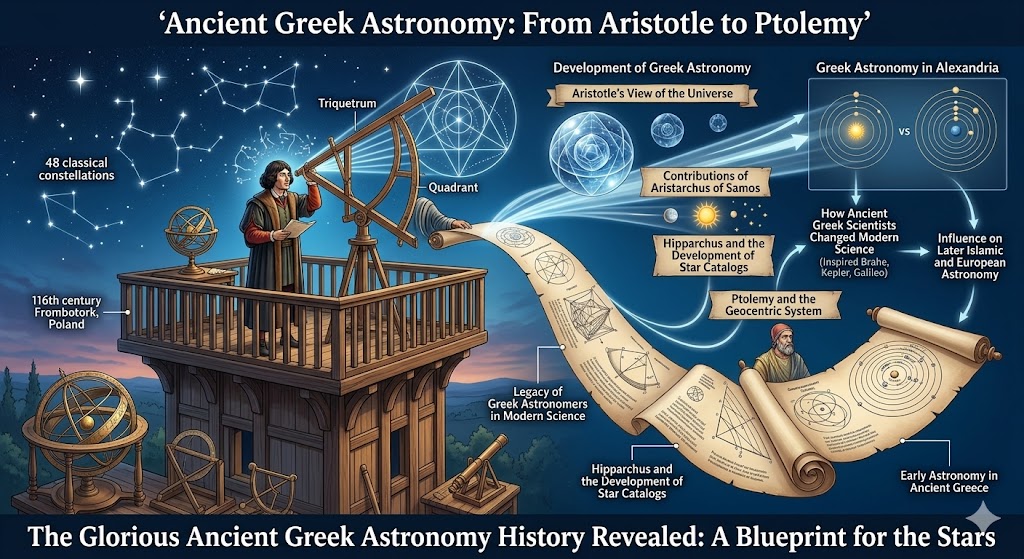
No figure looms larger over the early stages of ancient greek astronomy history than Aristotle. His Aristotle astronomy ideas became the “common sense” of the ancient and medieval worlds. Aristotle proposed a geocentric universe theory where the Earth was a stationary sphere at the center of the cosmos. He argued that the heavens were made of a fifth element called “aether,” which was perfect and unchanging.
In Aristotle’s model, the planets were embedded in transparent, concentric spheres that rotated around the Earth. This vision provided a physical explanation for the sky that lasted for centuries. While we now know it was incorrect, it was a vital step in the ancient greek astronomy history because it attempted to explain the universe through physical laws rather than divine whims.
Early Greek Observations of the Sky
Before the great theories were written, there were the observers. Early sky observation in Greece relied on simple but effective Greek astronomical instruments. These ancient star observations allowed Greeks to determine the tilt of the Earth’s axis and the timing of the solstices.
Figures like Thales of Miletus and Anaximander began the ancient greek astronomy history by suggesting that the Earth was a body suspended in space. These early breakthroughs were essential; without the data gathered from centuries of watching the horizon, the later, more complex development of Greek astronomy would never have been possible.
Contributions of Aristarchus of Samos
One of the most fascinating “what if” moments in ancient greek astronomy history belongs to Aristarchus of Samos. Often called the “Copernicus of Antiquity,” Aristarchus was the first to propose a heliocentric (Sun-centered) model. He used geometry to estimate the sizes of the Sun and Moon, realizing that the Sun was much larger than the Earth.
He logically concluded that the smaller body should revolve around the larger one. However, his ideas were largely rejected because they contradicted the prevailing Aristotle astronomy ideas. Despite his rejection, his work remains a brilliant chapter in ancient greek astronomy history, proving that the truth was hidden in plain sight even two thousand years ago.
Hipparchus and the Development of Star Catalogs
Hipparchus is often considered the greatest observational astronomer of the ancient world. His hipparchus star catalog was a monumental achievement, listing the positions and brightness of over 850 stars. He invented the magnitude scale for stellar brightness—a system astronomers still use today.
The creation of this star catalog and its impact cannot be overstated; it allowed future generations to track changes in the sky over long periods. Hipparchus also discovered the “precession of the equinoxes,” a slow wobble in the Earth’s rotation. His meticulousness is a shining example of the Greek astronomers contributions to the rigor of modern science.
Ptolemy and the Geocentric System
The climax of ancient greek astronomy history occurred in the 2nd century AD with Claudius Ptolemy. Working in the Great Library of Alexandria, he synthesized all previous Greek knowledge into a single work called the Almagest. Here, ptolemy contributions to astronomy reached their peak. He refined the geocentric model by adding “epicycles” and “equants” to explain why planets appeared to move backward (retrograde motion).
While his system was incredibly complex, it worked. It could predict the positions of the planets with surprising accuracy. This success is why ancient greek astronomy history remained centered on Ptolemy for 1,400 years. His model was a mathematical masterpiece that perfectly served the needs of sailors, priests, and scholars until the time of Copernicus.
Greek Astronomy in Alexandria
Alexandria was the melting pot of the ancient world and the final home of ancient greek astronomy history. Under the patronage of the Ptolemaic kings, the city became a center for the development of Greek astronomy. Here, Eratosthenes used shadows and geometry to calculate the circumference of the Earth with incredible precision.
The Library of Alexandria served as a repository for centuries of ancient greek astronomy history, allowing scholars to compare their findings with the records of the past. It was here that the transition from philosophy to a more technical, mathematical science truly took place.
Influence on Later Islamic and European Astronomy
The end of the Western Roman Empire did not mean the end of ancient greek astronomy history. During the Middle Ages, Greek texts were translated into Arabic, leading to a massive influence on medieval astronomy in the Islamic world. Scholars like Al-Battani and Al-Zarqali refined Ptolemy’s math and corrected his data.
Eventually, these texts were translated back into Latin and reached Europe, sparking the Renaissance. The ancient greek astronomy history provided the “language” of science that Copernicus, Kepler, and Galileo used to build their own theories. Without the Greek foundation, the Scientific Revolution would have had no starting point.
Legacy of Greek Astronomers in Modern Science
When we look at how ancient greek scientists changed modern science, we see their fingerprints everywhere. They gave us the names of the constellations, the concept of a spherical Earth, and the idea that the universe can be mapped through mathematics.
The ancient greek astronomy history taught us the importance of the star catalog and the necessity of building models that can be tested against observation. Even though we have moved from the Earth-centered view to a multi-galactic perspective, the spirit of inquiry that began in ancient Greece remains the driving force of all modern astrophysics.
Frequently Asked Questions (FAQs)
Who was the first person in ancient Greek astronomy history to suggest the Sun was the center?
Aristarchus of Samos was the first known person to propose a heliocentric model, though his idea was not widely accepted at the time.
What was the primary instrument used in ancient star observations?
Greeks used instruments like the gnomon (a simple shadow-casting rod), the armillary sphere, and the astrolabe to measure the positions of celestial bodies.
Why did the Greeks believe in a geocentric (Earth-centered) universe?
It was based on sensory evidence (we don’t feel the Earth moving) and the philosophical belief that the Earth was a heavy, stationary body while the heavens were made of light, perfect material.
How accurate were the Greek measurements of the Earth?
Remarkably accurate! Eratosthenes calculated the Earth’s circumference to within about 1% to 15% of the modern value (depending on how you interpret the unit of measurement he used).
What is the Almagest?
The Almagest is the definitive book written by Ptolemy that summarized all Greek astronomical knowledge and served as the standard textbook for over a thousand years.
Conclusion
The ancient greek astronomy history is a testament to the power of human curiosity. From the crystalline spheres of Aristotle to the complex epicycles of Ptolemy, the Greeks refused to look at the sky with passive eyes. They wrestled with the movements of the planets and the distances of the stars, leaving behind a legacy that defines the modern age. When we examine how ancient greek scientists changed modern science, we realize that they didn’t just give us answers—they gave us the right questions to ask. As we continue to explore the depths of space, we are still standing on the shoulders of the giants who first mapped the heavens in the cities of ancient Greece.