Introduction to Tycho Brahe
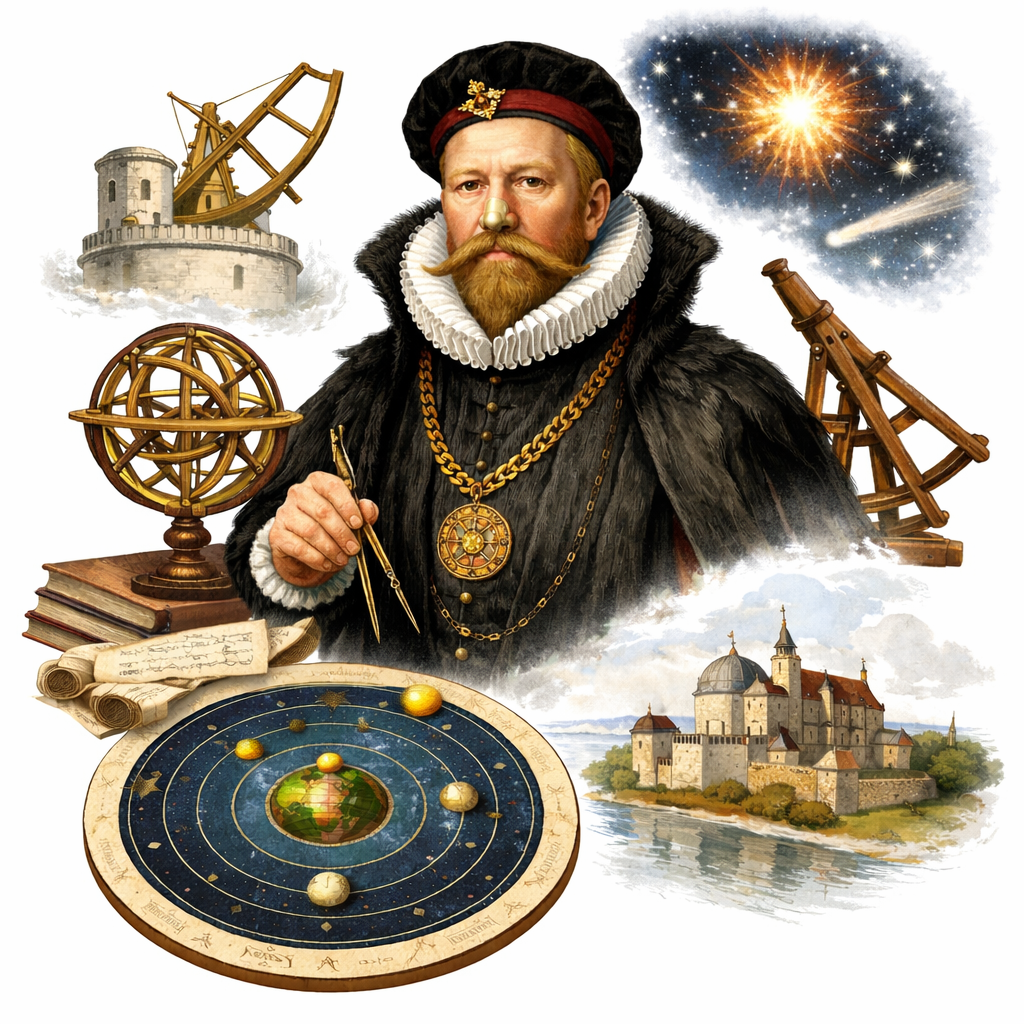
Tycho Brahe (1546–1601) was one of the most remarkable astronomers of the Renaissance era, widely known for his groundbreaking tycho brahe astronomical discoveries that transformed the study of the night sky. Born into a Danish noble family, Brahe dedicated his life to observing stars and planets with extraordinary precision long before the invention of the telescope. His detailed measurements of celestial objects and his famous observatories allowed him to produce the most accurate astronomical data of his time. These tycho brahe astronomical discoveries not only challenged traditional beliefs about the universe but also provided the essential data that later helped Johannes Kepler develop the laws of planetary motion, making Brahe a crucial figure in the history of astronomy.
Introduction to Tycho Brahe’s Astronomical Discoveries
The story of modern astronomy cannot be told without discussing the extraordinary work of tycho brahe astronomical discoveries. During the late 16th century, astronomy was going through a major transformation. Old theories were being questioned, and scientists were beginning to observe the sky with greater precision.
Tycho Brahe, a Danish nobleman and astronomer, played a critical role in this scientific transformation. His detailed observations of stars and planets became the most accurate astronomical records of his time. These observations laid the groundwork for later scientists like Johannes Kepler, who would eventually develop the laws of planetary motion.
The significance of tycho brahe astronomical discoveries lies in the incredible precision of his measurements. At a time when telescopes had not yet been invented, Tycho managed to create instruments capable of measuring celestial positions with remarkable accuracy.
His work built upon centuries of earlier knowledge, including discoveries from classical astronomy. To understand the broader historical context, it is important to consider how ancient greek scientists changed modern science, since many of their ideas shaped the foundations of astronomical thinking.
Tycho Brahe Astronomical Discoveries That Changed ScienceEarly Life and Education of Tycho Brahe
Tycho Brahe was born in 1546 in Denmark into a wealthy noble family. His family initially expected him to pursue a career in law or politics. However, an astronomical event changed the course of his life.
In 1560, a solar eclipse occurred exactly as predicted by astronomers. This event fascinated the young Tycho and convinced him that astronomy was a powerful scientific discipline capable of predicting celestial events.
From that moment onward, Tycho dedicated himself to studying the heavens. Over time, his passion led him to produce what we now recognize as tycho brahe astronomical discoveries, which revolutionized observational astronomy.
The Importance of Precise Astronomical Observation
Before Tycho Brahe, most astronomical observations lacked accuracy. Many earlier astronomers relied on ancient star catalogs that contained errors accumulated over centuries.
Tycho believed that astronomy needed more precise data. As a result, he spent decades observing the night sky and recording the positions of stars and planets.
His careful observations are often referred to as tycho brahe’s astronomical observations, and they represent one of the most important contributions to the history of astronomy. These measurements were so accurate that later scientists relied on them long after Tycho’s death.
The significance of tycho brahe astronomical discoveries lies in the fact that they provided reliable data for understanding planetary motion.
Tycho Brahe’s Observatory Uraniborg
One of the most fascinating aspects of Tycho’s career was the construction of his famous observatory. With support from the Danish king, Tycho built a scientific research center on the island of Hven.
This facility became known as tycho brahe’s observatory uraniborg, and it was one of the most advanced scientific institutions of its time. The observatory contained large astronomical instruments designed to measure celestial positions with extraordinary precision.
At tycho brahe’s observatory uraniborg, Tycho and his assistants conducted systematic observations of the sky every night. These observations produced a vast collection of astronomical data that later played a critical role in advancing astronomy.
The work carried out at tycho brahe’s observatory uraniborg transformed astronomy from a theoretical discipline into a science based on careful measurement.
Tycho Brahe and the New Star of 1572
One of Tycho’s most famous discoveries occurred in 1572, when he observed a bright new star appearing in the night sky. At the time, scholars believed that the heavens were unchanging and perfect.
However, Tycho carefully studied the star and concluded that it was located far beyond the Moon. This meant that the heavens could indeed change, contradicting long-standing philosophical beliefs.
This discovery became one of the most famous tycho brahe astronomical discoveries, because it challenged ancient ideas about the universe.
The observation of this supernova helped demonstrate that the cosmos was more dynamic than previously believed.
The Tychonic Model Explained
Although Tycho Brahe made revolutionary observations, he did not fully accept the heliocentric theory proposed by Copernicus. Instead, he proposed a hybrid system that attempted to combine both models.
This system is often referred to as the tychonic model explained, which places Earth at the center of the universe while allowing planets to orbit the Sun. In this model, the Sun itself revolves around Earth.
The tychonic model explained attempted to resolve conflicts between observational data and traditional beliefs. While this model was eventually replaced by the heliocentric system, it represented an important transitional step in astronomical thinking.
Despite the limitations of the model, the observational data gathered through tycho brahe astronomical discoveries remained extremely valuable.
How Tycho Brahe Improved Planetary Data
One of Tycho Brahe’s most important contributions was improving the accuracy of planetary measurements. Earlier astronomers relied on data that contained significant errors.
Tycho introduced better instruments and systematic observation techniques. Through his work, how tycho brahe improved planetary data became a key turning point in the development of astronomy.
By measuring planetary positions with unprecedented precision, Tycho created a dataset that would later help Johannes Kepler discover the true nature of planetary motion.
The improvements demonstrated by how tycho brahe improved planetary data allowed astronomers to move closer to understanding the real structure of the solar system.
Relationship Between Tycho Brahe and Copernican Theory
The work of Tycho Brahe also intersected with the revolutionary ideas introduced by Copernicus. The copernicus solar system model proposed that Earth and other planets orbit the Sun.
While Tycho respected the mathematical elegance of the copernicus solar system model, he remained skeptical of placing Earth in motion. His own model attempted to preserve Earth’s central position while incorporating new observational evidence.
Nevertheless, the observational accuracy achieved through tycho brahe astronomical discoveries ultimately helped prove the heliocentric model when Kepler later analyzed Tycho’s data.
Influence on Johannes Kepler and the Future of Astronomy
Perhaps the greatest legacy of Tycho Brahe lies in the influence he had on Johannes Kepler. Kepler worked as Tycho’s assistant and gained access to his vast collection of astronomical data.
Using this information, Kepler eventually developed the three laws of planetary motion. These laws confirmed that planets move in elliptical orbits around the Sun.
Without the detailed measurements obtained through tycho brahe astronomical discoveries, Kepler might never have been able to develop his groundbreaking theories.
Tycho Brahe’s Lasting Scientific Legacy
Today, Tycho Brahe is recognized as one of the most important figures in the history of astronomy. His dedication to precise observation transformed astronomy into a more accurate scientific discipline.
The impact of tycho brahe astronomical discoveries extends far beyond his lifetime. His work influenced later scientists, helped refine astronomical theories, and played a crucial role in the scientific revolution.
By combining careful observation with innovative instruments, Tycho demonstrated the importance of accurate data in scientific research.
Frequently Asked Questions (FAQs)
Who was Tycho Brahe?
Tycho Brahe was a Danish astronomer known for making extremely precise astronomical observations before the invention of telescopes.
What are Tycho Brahe’s major contributions?
His major contributions include accurate star catalogs, improved planetary data, and the creation of advanced observatories.
What is the Tychonic model?
The Tychonic model places Earth at the center while allowing planets to orbit the Sun.
Why were Tycho Brahe’s observations important?
His observations provided accurate data that later helped Johannes Kepler discover the laws of planetary motion.
What was Uraniborg?
Uraniborg was Tycho Brahe’s famous observatory where he conducted extensive astronomical observations.
Conclusion
The remarkable career of Tycho Brahe represents a turning point in the history of astronomy. Through dedication, innovation, and precision, he transformed the way scientists studied the universe.
The impact of tycho brahe astronomical discoveries continues to be recognized today. His observations helped bridge the gap between ancient astronomical theories and modern scientific understanding.
By gathering accurate data and building advanced observatories, Tycho Brahe laid the foundation for future discoveries that would ultimately reshape humanity’s view of the cosmos.