In the history of science, there is a bridge between the ancient world of philosophy and the modern world of precision. That bridge was built by a colorful, silver-nosed Danish nobleman whose tycho brahe’s astronomical observations changed the trajectory of human knowledge forever. Before the invention of the telescope, one man proved that the heavens were not unchanging and perfect, but dynamic and measurable. Through his relentless dedication to accuracy, tycho brahe’s astronomical observations provided the raw data that allowed the next generation of scientists to finally solve the puzzle of the solar system.
Introduction to Tycho Brahe’s Astronomical Observations
The story of tycho brahe’s astronomical observations is one of unprecedented obsession with detail. In the late 16th century, astronomy was in a state of crisis. The old maps were wrong, and the new theories were unproven. Tycho Brahe realized that the only way to settle the debate between the geocentric and heliocentric views was through better data. Over several decades, his tycho brahe’s astronomical observations reached a level of precision that was thought impossible for the human eye alone. By tracking the stars and planets night after night for twenty years, he laid the empirical groundwork for the Scientific Revolution.
Astronomy Before Tycho Brahe
To appreciate tycho brahe’s astronomical observations, we must look at the state of science in the mid-1500s. Most astronomers were still relying on data that was centuries old, much of it originating from the ptolemy contributions to astronomy. While the copernicus solar system model had been published in 1543, it was still treated by many as a mathematical trick rather than a physical reality.
Before Tycho, sky observation was often sporadic. Most people believed the “heavens” were a perfect, unchanging realm of aether. It was generally accepted that everything beyond the moon was eternal. This rigid worldview meant that many ignored subtle changes in the sky. It took the rigors of tycho brahe’s astronomical observations to show that the universe was far more complex and active than the ancients had dared to imagine.
I. 1576 – 1597: Instruments Used by Tycho Brahe
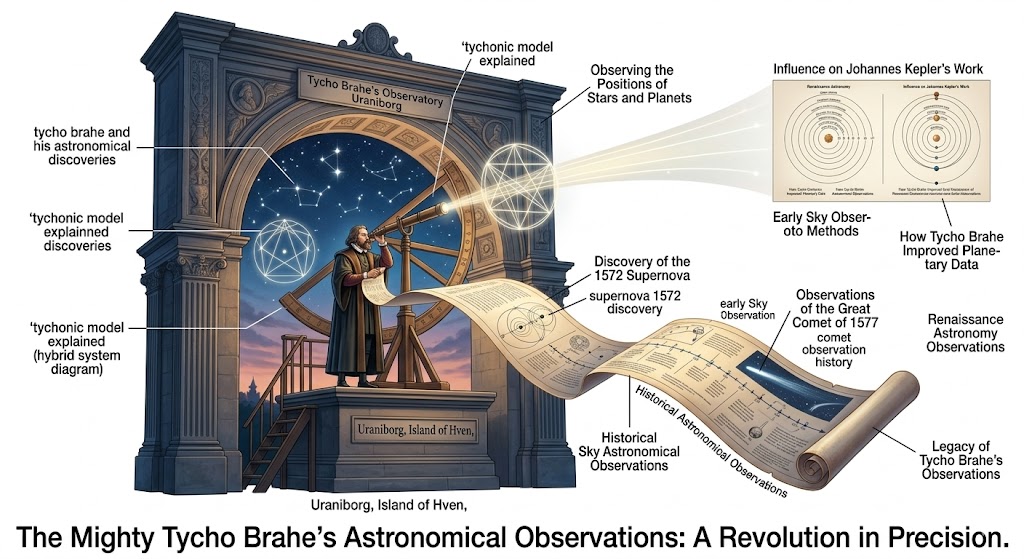
Tycho knew that his eyes were only as good as his tools. Since the telescope had not yet been invented, he focused on building the largest and most stable naked eye astronomy instruments in the world. At tycho brahe’s observatory uraniborg, located on the island of Hven, he designed massive quadrants, sextants, and armillary spheres.
These ancient astronomical instruments were built of brass and steel, calibrated to the minute of arc. By using a “mural quadrant”—a massive scale fixed to a wall—he could measure the altitude of stars with incredible precision as they crossed the meridian. This technological leap is a primary reason why tycho brahe’s astronomical observations were ten times more accurate than any data that had come before.
Observing the Positions of Stars and Planets
The core of tycho brahe’s astronomical observations was a systematic cataloging of the night sky. Unlike his predecessors, who only observed planets at specific points (like oppositions), Tycho tracked them throughout their entire orbits. This steady stream of early planetary observations was revolutionary.
Through his work, he created a star catalog of 777 stars (later expanded to 1,000) that was the gold standard for over a century. By painstakingly recording the positions of the planets against these fixed stars, he provided the evidence needed to test the copernicus solar system model. His ability to see the “errors” in the old tables led to the how tycho brahe improved planetary data legacy that we still respect today.
D. 1572: Discovery of the 1572 Supernova
In November 1572, Tycho witnessed something that shouldn’t have been possible: a “new star” appeared in the constellation Cassiopeia. It was so bright it could be seen during the day. This event, known as the supernova 1572 discovery, was a turning point in tycho brahe’s astronomical observations.
Using his precision instruments, Tycho proved that this “new star” had no parallax—meaning it was much further away than the moon. This directly contradicted the Aristotelian idea that the heavens were unchanging. This discovery is a highlight of tycho brahe and his astronomical discoveries, as it dealt a fatal blow to the medieval belief in the perfection of the celestial spheres.
O. 1577: Observations of the Great Comet of 1577
A few years later, a brilliant comet appeared in the sky. Most astronomers of the time believed comets were disturbances in the Earth’s atmosphere. However, tycho brahe’s astronomical observations showed otherwise. By comparing his measurements with other observers across Europe, he proved the comet was at least six times further away than the moon.
This comet observation history was vital because it showed that the comet was traveling through the space where the crystalline spheres were supposed to be. Tycho’s conclusion was bold: the spheres did not exist. This was one of the most significant tycho brahe astronomy discoveries, clearing the physical “clutter” from the solar system and allowing for a more fluid understanding of space.
Accuracy of Tycho Brahe’s Observational Data
The defining characteristic of tycho brahe’s astronomical observations was the error margin. While previous astronomers were often off by 10 to 15 minutes of arc, Tycho’s measurements were usually accurate to within 1 minute of arc. This precision astronomy before telescopes was the highest level of accuracy a human could achieve.
He pioneered early sky observation methods such as “averaging” multiple readings to reduce human error. Because of this, tycho brahe’s astronomical observations were the first in history to be reliable enough to serve as the basis for new physical laws. Without this level of detail, the transition from ancient philosophy to modern physics would have stalled.
Influence on Johannes Kepler’s Work
Toward the end of his life, Tycho took on a brilliant young assistant named Johannes Kepler. After Tycho’s death in 1601, Kepler gained access to the mountain of tycho brahe’s astronomical observations. Kepler specifically looked at Tycho’s data on Mars, which was notoriously difficult to map.
Kepler realized that Tycho’s data was so accurate that if a theory didn’t match it, the theory must be wrong. This led Kepler to abandon the idea of circular orbits and discover that planets move in ellipses. This monumental shift was entirely dependent on tycho brahe’s astronomical observations. Without Tycho’s “mighty” numbers, Kepler would never have had the confidence to defy two thousand years of circular geometry.
Legacy of Tycho Brahe’s Observations
The tycho brahe’s astronomical observations did not just help Kepler; they provided a new model for the universe. Tycho proposed the tychonic model explained as a hybrid system: the Sun and Moon go around the Earth, but all other planets go around the Sun.
While we now know the heliocentric model is correct, the Tychonic system was a necessary stepping stone that allowed people to accept the math of Copernicus without immediately abandoning the physics of the time. When we look at how ancient greek scientists changed modern science, we see that Tycho was the one who finally replaced their “thought experiments” with hard, undeniable evidence. His Renaissance astronomy observations transformed the sky into a laboratory.
Frequently Asked Questions (FAQs)
1. Why are tycho brahe’s astronomical observations still famous today?
They are famous because they were the most accurate observations ever made without a telescope. They provided the essential data that allowed Johannes Kepler to discover the three laws of planetary motion.
2. What was Tycho Brahe’s silver nose about?
Tycho lost part of his nose in a duel with a fellow nobleman over a mathematical formula. He wore a replacement made of silver and gold (and sometimes copper) for the rest of his life.
3. Did Tycho Brahe use a telescope?
No, the telescope was invented shortly after his death. All of tycho brahe’s astronomical observations were made using large-scale instruments designed for naked-eye sighting.
4. What was Uraniborg?
Tycho Brahe’s observatory uraniborg was a dedicated research center on the island of Hven. It was the first of its kind in Europe, featuring underground observatories and a printing press to publish his findings.
5. How did Tycho Brahe die?
Historically, it was said he died of a bladder ailment after a royal banquet. While there were rumors of mercury poisoning, modern forensic tests on his remains suggest he likely died of natural causes related to his kidney or bladder.
Conclusion
The story of tycho brahe’s astronomical observations is a story of human persistence. He was a man who looked at the stars and decided that “close enough” was not good enough. By spending his life recording the minute movements of the planets, he gave the world the gift of accuracy. We see his legacy in every satellite we launch and every planet we map. When we examine how ancient greek scientists changed modern science, we must acknowledge that Tycho Brahe was the one who provided the final, precise measurements to finish their work. Tycho brahe’s astronomical observations proved that the universe is a machine that can be measured, understood, and eventually, explored.