The history of science is often told through theories and grand ideas, but the real progress happens in the grueling, quiet work of measurement. Among the giants of the Renaissance, Nicolaus Copernicus gave us a new map, but it was Tycho Brahe who gave us the accurate coordinates. Understanding how tycho brahe improved planetary data is essential to recognizing why we eventually accepted the sun-centered universe. Brahe was a man of immense resources and even greater obsession, whose life was dedicated to tycho brahe and his astronomical discoveries. He realized that without better numbers, astronomy was merely guesswork. By the end of his career, the way he transformed observational astronomy history would provide the “mighty” foundation for everything we know about the cosmos today.
Introduction to Planetary Data in Renaissance Astronomy
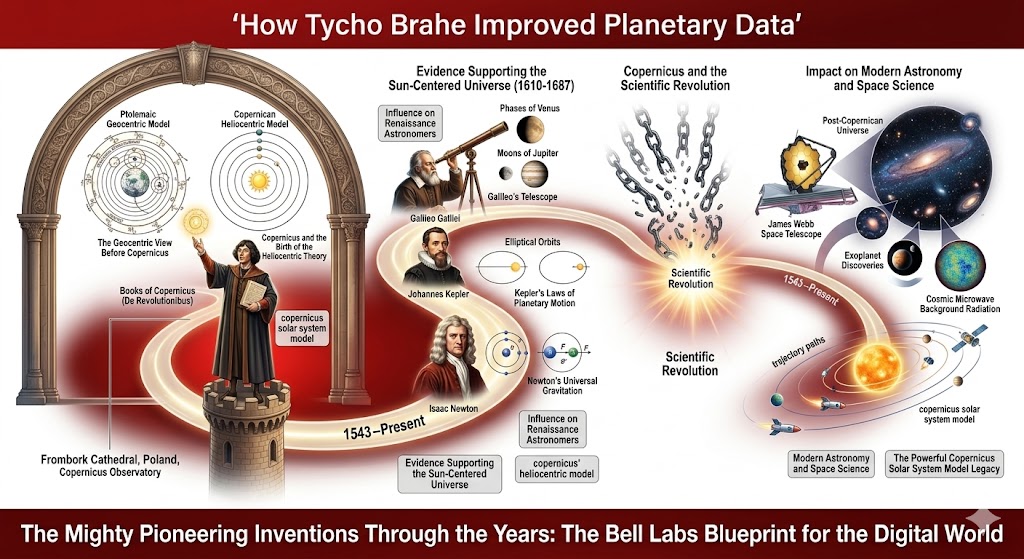
In the late 16th century, the state of astronomical data was, quite frankly, a mess. Astronomers were still largely dependent on records that were over a thousand years old. While the copernicus solar system model had introduced a beautiful new heliocentric concept in 1543, it lacked the observational evidence to prove it was physically superior to the old geocentric models.
At this time, “planetary data” consisted of sporadic notes on where a planet appeared to be against the backdrop of the stars. These Renaissance planetary measurements were often inaccurate by several degrees. Tycho Brahe entered this scene with a radical idea: he believed that to understand the heavens, one had to observe them every single night, not just during rare conjunctions. This shift in mindset is the primary answer to how tycho brahe improved planetary data, as it moved the field from philosophy into a rigorous, data-driven science.
Problems with Earlier Astronomical Data
Before we look at how tycho brahe improved planetary data, we must understand the “negative” state of the field he inherited. The how ancient greek scientists changed modern science story usually highlights their brilliance in geometry, but their data collection methods were limited. Most early astronomy calculations were based on the Almagest of Ptolemy, which contained errors that had compounded over centuries.
The primary issues were:
- Instrumental Flex: Wooden instruments warped over time, leading to inconsistent sightings.
- Inconsistent Observation: Most astronomers only looked at the sky when something “interesting” was happening, leaving huge gaps in the planetary tracks.
- Human Error: There was no standard method for cross-checking measurements between different observers.
These flaws meant that by the 1570s, the predicted positions of the planets were often days out of sync with reality. Tycho Brahe saw this as an insult to the majesty of the creator and made it his life’s mission to fix it.
Tycho Brahe’s Method of Data Collection
The “power” behind how tycho brahe improved planetary data lay in his methodology. He was the first to realize that a single observation was not enough. At tycho brahe’s observatory uraniborg, he established a systematic routine. He employed a team of assistants who would observe the same planet from different parts of the observatory simultaneously.
By averaging these multiple sightings, Tycho could eliminate individual human error. He also insisted on observing planets through their entire orbital cycle, even when they were not in opposition. This consistent tycho brahe astronomy research created a “movie” of planetary motion rather than just a few disconnected “snapshots.” This meticulousness is exactly how tycho brahe improved planetary data, providing a continuous record that had never existed in human history.
New Instruments for Measuring Planetary Positions
Tycho knew that the human eye could only be as accurate as the tools it used. Since the telescope was still decades away, he focused on building the largest and most stable astronomical instruments in the world. This is a key technical aspect of how tycho brahe improved planetary data.
- The Great Mural Quadrant: A massive brass arc with a radius of nearly two meters, fixed to a stone wall to prevent any vibration.
- Armillary Spheres: Used to measure coordinates relative to the celestial equator.
- Sextants: Massive tools used to measure the angular distance between two stars.
These instruments were equipped with “transversals”—a mathematical sighting method that allowed the observer to read fractions of a degree far more accurately than a standard scale. By increasing the physical size of his tools, Tycho could see smaller details. This is how tycho brahe improved planetary data to a level where he was accurate to within one-sixtieth of a degree (one minute of arc), a feat that remained unsurpassed until the invention of telescopic sights.
Accuracy of Tycho Brahe’s Planetary Data
The accuracy of how tycho brahe improved planetary data was so high that it forced a total rethink of physics. Before Tycho, a measurement that was “close enough” was accepted. After Tycho, the data was so precise that even a tiny discrepancy between a theory and an observation meant the theory was wrong.
His Tycho Brahe star observations formed a catalog of 777 stars (and later 1,000) that served as a stable coordinate system. By measuring the planets against these highly accurate fixed points, his historical planetary data accuracy became the gold standard. This precision allowed him to propose the tychonic model explained, a hybrid system that sought to explain the movements of the planets while keeping the Earth stationary. Though the model was eventually replaced, the data used to build it was flawless.
Role of Tycho’s Data in Kepler’s Discoveries
The most famous result of how tycho brahe improved planetary data came after his death. His assistant, Johannes Kepler, inherited Tycho’s logs—specifically the data on Mars. Kepler spent eight years trying to fit Tycho’s Mars observations into a circular orbit, but he was always off by eight minutes of arc.
In the past, an astronomer would have ignored those eight minutes as “observational error.” But Kepler knew how tycho brahe improved planetary data and trusted Tycho’s accuracy implicitly. He famously said that those eight minutes of arc led to a total reformation of astronomy. Because he trusted the data, Kepler abandoned circles and discovered that planets move in ellipses. Without the “mighty” precision of tycho brahe’s astronomical observations, Kepler’s Laws of Planetary Motion would never have been discovered.
Comparison with Earlier Astronomical Records
When we compare how tycho brahe improved planetary data to earlier records, the difference is night and day. Ptolemaic and Copernican tables were often off by as much as 5 to 10 degrees in certain parts of a planet’s orbit. Tycho’s data reduced this error to less than 0.02 degrees.
| Astronomer | Method | Average Error |
| Ptolemy | Ancient Sighting | 1° – 5° |
| Copernicus | Modified Ancient Data | 1° |
| Tycho Brahe | Precision Naked-Eye | 0.016° |
This jump in quality is why Tycho is often called the “Father of Modern Observational Astronomy.” He was the first to prove that the universe was not a place of “approximate” beauty, but of mathematical perfection. This is the enduring legacy of how tycho brahe improved planetary data.
Impact on the Development of Modern Astronomy
The long-term impact of how tycho brahe improved planetary data cannot be overstated. He proved that high-quality data is the judge and jury of all scientific theories. This mindset birthed the modern scientific method. His work at tycho brahe’s observatory uraniborg served as the blueprint for the Royal Observatory at Greenwich and NASA’s modern tracking stations.
Furthermore, his planetary motion measurements allowed Isaac Newton to later calculate the force of gravity. Newton needed Kepler’s laws to prove his theory of universal gravitation, and Kepler needed Tycho’s data. Therefore, every time we calculate a satellite trajectory today, we are using the descendants of the numbers generated by Tycho. This is how tycho brahe improved planetary data for all future generations.
Frequently Asked Questions (FAQs)
1. How did Tycho Brahe improve planetary data without a telescope?
He did this by building massive, stable instruments (like the mural quadrant) that were far larger than any used before. He also used a method called “transversals” to read angles with incredible precision and observed planets nightly for over 20 years.
2. Why was Tycho’s data better than the data used by Copernicus?
Copernicus largely relied on older, secondary data from the Greeks and Arabs. Tycho was the first to realize that these old records were flawed and insisted on creating a completely new set of primary observations using superior technology.
3. What was the “mighty” discovery that came from Tycho’s data?
The discovery of elliptical orbits by Johannes Kepler. Kepler realized that planets do not move in perfect circles, a breakthrough that was only possible because Tycho’s data was too accurate to allow for circular “fudge factors.”
4. Where did Tycho Brahe conduct his research?
Most of his best work was done at tycho brahe’s observatory uraniborg on the island of Hven. It was the most advanced research center of its time, featuring underground observatories to minimize wind vibration.
5. How accurate was Tycho’s data compared to modern standards?
For naked-eye astronomy, it was nearly perfect. He was accurate to within 1 minute of arc. Modern telescopes are more accurate, but for the 1500s, his work was a technological miracle.
Conclusion
The story of how tycho brahe improved planetary data is a reminder that in science, details matter. Tycho didn’t just look at the stars; he cataloged them with a “mighty” obsession that bridged the gap between the ancient world and the modern era. By improving the quality of astronomical data, he provided the key that unlocked the true shape of our solar system. We no longer look at the heavens as a series of mystical spheres, but as a predictable, mechanical system—a realization that began with a man, a quadrant, and a lifelong commitment to the truth of the numbers. Through how tycho brahe improved planetary data, humanity finally found its true coordinates among the stars.