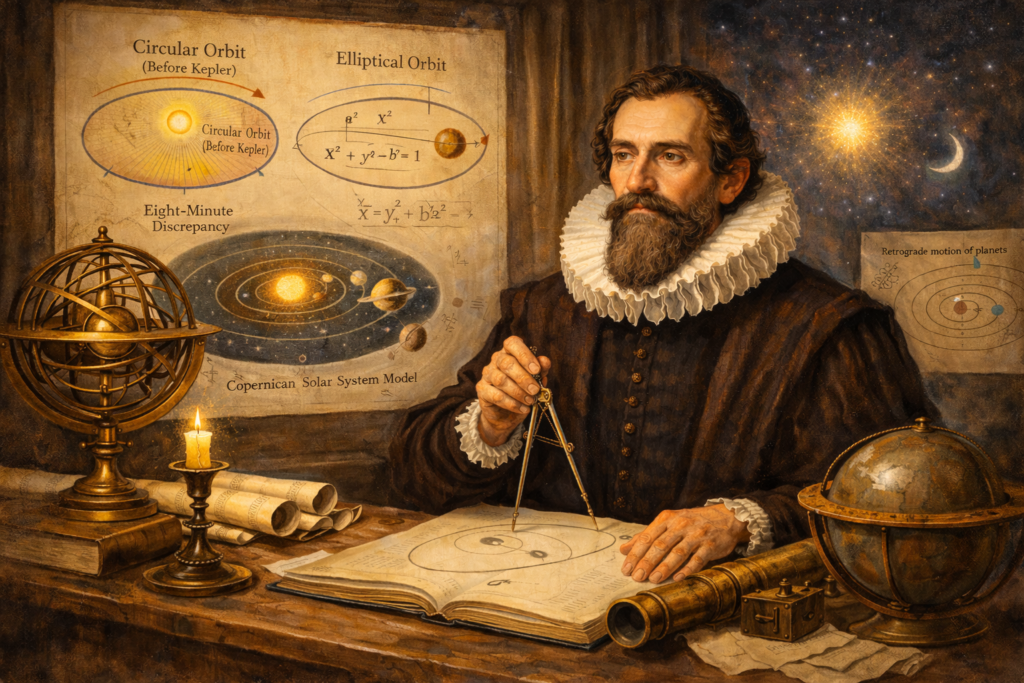
When scientists discuss the most revolutionary discoveries in astronomy, one moment stands above the rest when kepler discovered elliptical orbits and shattered centuries of belief in perfect circular motion in the heavens.
For nearly two thousand years, philosophers and astronomers believed planets must move in perfect circles. The idea was rooted in Greek philosophy and reinforced by the teachings of Aristotle and Ptolemy. Circles were considered divine, perfect, and eternal.
But reality turned out to be far more complex and fascinating.
In the early 17th century, johannes kepler carefully analyzed astronomical observations and uncovered a powerful truth: planetary paths were not circles at all. Instead, planets travel along elliptical trajectories.
This moment when kepler discovered elliptical orbits marked a turning point in the history of science. It ended the circular orbit theory and opened the door to modern celestial mechanics, orbital physics, and the geometry of the heavens.
Understanding how kepler discovered elliptical orbits reveals not only a scientific breakthrough but also a story of persistence, mathematical brilliance, and intellectual courage.
The Obsession with Circular Perfection Before Kepler
For centuries before kepler discovered elliptical orbits, astronomers believed the universe must follow perfect geometric patterns. Ancient philosophers argued that heavenly bodies should move in circles because circles represented perfection.
This belief dominated scientific thought for nearly 1,500 years.
Aristotle’s cosmology described a universe composed of perfect celestial spheres rotating around Earth. Later, Ptolemy attempted to explain planetary motion using complex circular paths known as epicycles.
These models became increasingly complicated as astronomers attempted to match observations.
Even Nicolaus Copernicus, who proposed the revolutionary copernicus solar system model, still assumed that planetary orbits were circular. His heliocentric model moved Earth away from the center of the universe but kept the circular orbit assumption.
Yet observational data refused to cooperate.
Planets sometimes appeared to move backward in the sky—a puzzling behavior known as retrograde motion. Circular models struggled to explain these celestial trajectories accurately.
Eventually, the problem would be solved when kepler discovered elliptical orbits.
The “War with Mars”: Kepler’s Greatest Challenge
Mars became the key to the discovery that would transform astronomy.
Because Mars has a highly noticeable orbital eccentricity, its motion could not be explained easily using circular models.
When johannes kepler began studying Mars’ orbit, he entered what he later described as his “war with Mars.”
The problem consumed him for years.
The Mars orbital problem forced Kepler to question centuries of astronomical assumptions. Every circular model he tested failed to match observations precisely.
The solution would only emerge when Kepler abandoned the ancient belief in circular perfection.
Using Tycho Brahe’s Precision Data
Kepler’s work depended on the extraordinary observations collected by the Danish astronomer Tycho Brahe.
Brahe had created the most accurate astronomical measurements of his time, recording planetary positions with unprecedented precision.
After Brahe’s death, Kepler gained access to this valuable dataset.
With this information, kepler discovered elliptical orbits by comparing theoretical predictions with real planetary positions.
His calculations revealed something astonishing: circular models always produced small errors.
These discrepancies forced Kepler to rethink the geometry of planetary motion.
The work eventually appeared in his groundbreaking book Astronomia Nova, which presented a new physics of the sky.
The Eight-Minute Discrepancy That Changed History
One tiny measurement changed everything.
When calculating the orbit of Mars, Kepler discovered that his circular model was off by eight arcminutes.
This difference might seem small, but for Kepler it was enormous.
He famously wrote that he would rather abandon centuries of theory than ignore observational evidence.
That decision became the turning point in the moment kepler discovered elliptical orbits.
Rather than forcing the data to fit circular models, Kepler followed the evidence wherever it led.
Eventually he realized the orbit of Mars could be described perfectly using an ellipse.
The Discovery of Elliptical Orbits and the Death of Epicycles
The moment kepler discovered elliptical orbits marked the death of epicycles and the circular orbit theory.
An ellipse is a geometric curve defined by two focal points.
Mathematically, the equation of an ellipse can be written as:Where:
- a = semi-major axis
- b = semi-minor axis
In planetary motion, the Sun occupies one of the foci of the ellipse.
This geometry perfectly explained the planetary path discovery Kepler was searching for.
The discovery also introduced the concept of planetary eccentricity, which measures how stretched an orbit is compared to a circle.
If eccentricity e=0, the orbit is a perfect circle.
If 0<e<1, the orbit is elliptical.
Mars, for example, has an eccentricity of approximately:
This small deviation from circular motion proved crucial in understanding celestial trajectories.
The discovery that kepler discovered elliptical orbits eliminated the need for dozens of artificial epicycles used in earlier models.
Why Ellipses Solved the Mystery of Retrograde Motion
One of the greatest mysteries in ancient astronomy was retrograde motion.
Planets such as Mars sometimes appear to reverse direction briefly in the night sky.
Earlier models explained this effect using epicycles—small circles attached to larger circles.
However, once kepler discovered elliptical orbits, the explanation became much simpler.
Retrograde motion occurs because Earth and other planets move at different speeds around the Sun.
When Earth overtakes Mars in its orbit, Mars appears to move backward temporarily against the background stars.
This phenomenon emerges naturally from elliptical celestial trajectories.
The discovery transformed the understanding of planetary motion history and provided powerful support for heliocentrism.
How This Discovery Ended the Circular Orbit Theory Forever
The moment kepler discovered elliptical orbits fundamentally changed astronomy.
Circular motion had dominated scientific thought for centuries, but Kepler’s calculations proved that nature does not always follow perfect shapes imagined by philosophers.
Instead, the geometry of the heavens follows precise mathematical laws.
Kepler’s discovery also laid the groundwork for later breakthroughs in physics.
Isaac Newton later explained Kepler’s laws using the universal law of gravity:
This equation showed why elliptical orbits naturally arise from gravitational forces.
Beyond orbital mechanics, Kepler made other significant contributions to science. His optical research helped improve telescopes, which is explored in kepler’s contributions to optics.
He also produced highly accurate astronomical tables known as kepler’s rudolphine tables, which greatly improved planetary predictions.
In addition, Kepler carefully studied cosmic events such as kepler’s observation of the 1604 supernova, which challenged the ancient belief that the heavens were unchanging.
Together, these achievements reshaped the physics of the sky.
Frequently Asked Questions (FAQs)
What did Kepler discover about planetary orbits?
Kepler discovered that planets move in elliptical orbits rather than perfect circles, fundamentally changing astronomy.
Why was Mars important in Kepler’s research?
Mars had an unusual orbit that exposed errors in circular models, allowing Kepler to identify the elliptical shape of planetary motion.
What is an elliptical orbit?
An elliptical orbit is a stretched circular path with two focal points, where the Sun lies at one focus.
Why did circular orbit theory fail?
Circular models could not match precise observational data, especially for Mars’ motion.
What book introduced Kepler’s discovery?
Kepler published his findings in Astronomia Nova, which presented the first two laws of planetary motion.
Conclusion
The discovery that kepler discovered elliptical orbits stands as one of the most powerful turning points in scientific history. By abandoning centuries of belief in circular perfection, Kepler revealed the true geometry of the heavens and transformed humanity’s understanding of the cosmos.
His work built upon earlier ideas like the copernicus solar system model, but Kepler’s mathematical brilliance provided the accurate framework that astronomy desperately needed.
The journey from circular motion to elliptical celestial trajectories demonstrates how science advances—through observation, courage, and the willingness to challenge tradition.
Ultimately, Kepler’s achievement also connects to a much deeper intellectual tradition showing how ancient greek scientists changed modern science, inspiring centuries of exploration into the mysteries of the universe.
Through this revolutionary discovery, johannes kepler permanently changed the course of astronomy and opened the path toward modern astrophysics.