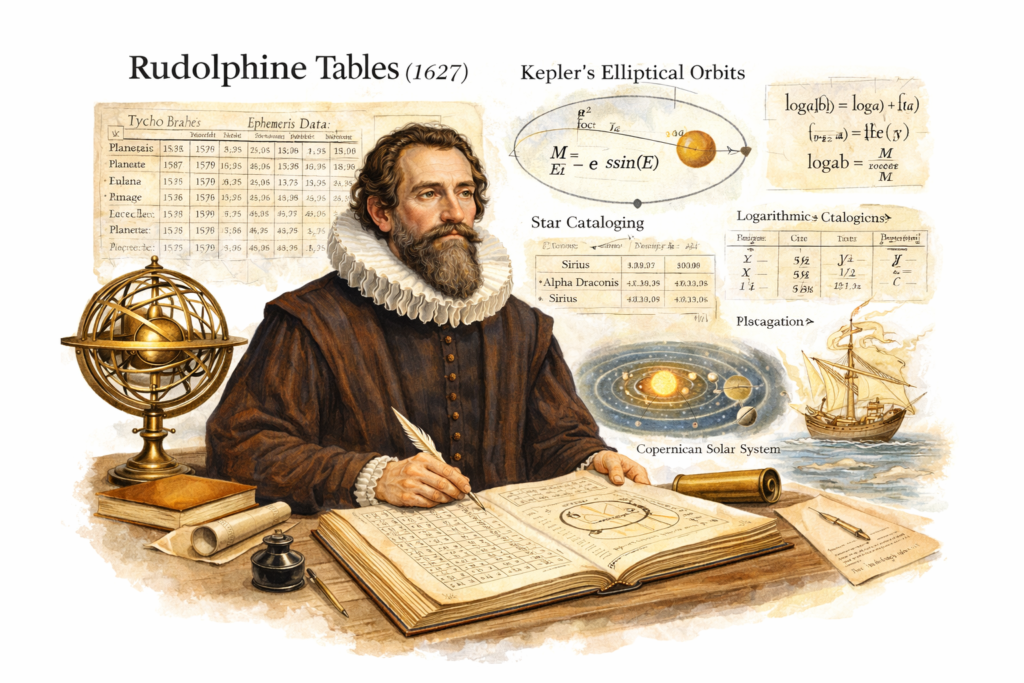
The story of rudolphine tables kepler represents one of the most revolutionary achievements in the history of astronomy. During the early 17th century, astronomers faced a major challenge: predicting the positions of planets accurately. Existing astronomical tables were outdated and based on incorrect theories of planetary motion.
Johannes Kepler solved this problem with an extraordinary mathematical breakthrough. By combining the detailed observations of Tycho Brahe with his own groundbreaking understanding of planetary motion, Kepler created a new system for planetary position prediction.
The result was the Rudolphine Tables, a powerful astronomical tool that dramatically improved calculations of planetary longitude, celestial positions, and ephemeris data.
The importance of rudolphine tables kepler cannot be overstated. For nearly a century, these tables became the foundation of 17th-century astronomy, navigation, and scientific research.
This monumental work by johannes kepler transformed astronomy from a theoretical discipline into a precise mathematical science.
What Were the Rudolphine Tables?
The Rudolphine Tables were a detailed set of astronomical tables that allowed astronomers to predict planetary positions with remarkable accuracy.
Published in 1627, the tables were officially known as Tabulae Rudolphinae, named after Emperor Rudolf II. The emperor had supported Kepler’s research during his time in Prague, and his Rudolph II patronage made this scientific achievement possible.
Before the creation of rudolphine tables kepler, astronomers relied on earlier ephemeris data that were based on circular orbit theories. These older systems often produced large errors when predicting planetary motion.
Kepler’s tables corrected these problems by incorporating the mathematical laws of planetary motion. These laws are explained in detail in kepler’s three laws of planetary motion.
By using this new scientific framework, rudolphine tables kepler provided astronomers with an unprecedented level of accuracy in celestial predictions.
The Transition from Tychonic Data to Keplerian Math
The success of rudolphine tables kepler began with the extraordinary observational work of Tycho Brahe.
Tycho Brahe had spent decades collecting highly precise measurements of planetary positions. His observatory produced the most accurate astronomical observations available before the invention of telescopes.
After Brahe’s death, Kepler inherited this massive dataset.
However, raw observational data alone could not explain planetary motion. Kepler needed a mathematical system capable of interpreting these observations.
Through years of painstaking work, Kepler solved the famous Mars orbital problem and discovered that planets move in elliptical paths rather than perfect circles.
This breakthrough is explained in kepler’s discovery of elliptical orbits.
Once Kepler understood the true geometry of planetary motion, he could transform Brahe’s data into a new computational system.
This combination of precise observations and mathematical insight formed the foundation of rudolphine tables kepler.
How the Rudolphine Tables Improved Planetary Calculations
The greatest advantage of rudolphine tables kepler was their accuracy.
Earlier astronomical tables relied on complex circular models with epicycles. These models often produced errors in planetary longitude predictions.
Kepler replaced these outdated methods with a mathematical system based on elliptical motion.
The position of a planet in its orbit can be calculated using Kepler’s equation:Where:
- M = mean anomaly
- E = eccentric anomaly
- e = orbital eccentricity
By solving this equation, astronomers could determine the position of a planet along its elliptical orbit.
Because rudolphine tables kepler incorporated this mathematical method, they dramatically improved planetary position prediction.
These tables also included star cataloging information for over 1,000 stars, making them extremely valuable for astronomers studying celestial navigation.
Incorporating Elliptical Orbits into Practical Data
One of the greatest achievements of rudolphine tables kepler was turning theoretical astronomy into practical computational tools.
Before Kepler’s work, astronomers struggled to apply theoretical models to real observations.
Kepler solved this problem by converting elliptical orbit theory into numerical tables that could be used directly by astronomers.
Using these tables, scientists could calculate:
- planetary longitude
- planetary conjunctions
- eclipse predictions
- planetary alignments
The ability to calculate these phenomena with high accuracy made rudolphine tables kepler essential for astronomical research.
Kepler’s work also supported earlier heliocentric ideas from the copernicus solar system model, providing mathematical confirmation that planets revolve around the Sun.
The Use of Logarithms to Simplify Astronomy
Another powerful innovation within rudolphine tables kepler was the use of logarithmic calculation.
During Kepler’s time, complex multiplications required enormous amounts of manual computation. Logarithms simplified these calculations dramatically.
The basic logarithmic rule can be expressed as:This allowed astronomers to replace complicated multiplication with simple addition.
The use of astronomical log tables significantly reduced the time required to perform celestial calculations.
Because of this efficiency, rudolphine tables kepler became widely adopted throughout Europe.
The integration of logarithmic methods was one of the reasons the tables remained useful for generations of astronomers
The Impact of the Tables on 17th-Century Navigation
The influence of rudolphine tables kepler extended far beyond academic astronomy.
One of the most important applications of these tables was maritime navigation history.
During the 17th century, sailors relied heavily on astronomical observations to determine their position at sea.
Accurate planetary position prediction allowed navigators to calculate longitude and latitude with greater precision.
With the improved accuracy of rudolphine tables kepler, navigation became safer and more reliable.
The tables helped guide ships across the oceans and supported global exploration during the Age of Discovery.
In addition, the tables improved astronomical observations used in scientific research.
For example, Kepler’s studies of celestial events including kepler’s observation of the 1604 supernova relied on precise astronomical calculations.
Why the Rudolphine Tables Remained the Standard for a Century
The remarkable accuracy of rudolphine tables kepler ensured their dominance for nearly one hundred years.
Astronomers across Europe relied on these tables because they produced far better predictions than earlier systems.
The success of the tables came from three key innovations:
- precise observational data from Tycho Brahe
- mathematical laws of planetary motion
- logarithmic calculation techniques
Together, these elements created the most powerful astronomical computational tool of the 17th century.
Kepler’s broader scientific contributions extended beyond astronomy. His work in optics, explored in kepler’s contributions to optics, helped scientists understand vision and telescope design.
Because of these achievements, rudolphine tables kepler became a cornerstone of the scientific revolution.
Frequently Asked Questions (FAQs)
What are the Rudolphine Tables?
The Rudolphine Tables were astronomical tables created by Johannes Kepler in 1627 to predict planetary positions with high accuracy.
Why were the Rudolphine Tables important?
They dramatically improved planetary position prediction and became the standard reference for astronomers for nearly a century.
What data were used to create the Rudolphine Tables?
Kepler used the highly accurate observations collected by Tycho Brahe.
Why are the tables called “Rudolphine”?
They were named after Emperor Rudolf II, who supported Kepler’s research.
Did the tables help navigation?
Yes. The improved accuracy of planetary calculations helped sailors determine their position at sea.
Conclusion
The creation of rudolphine tables kepler marked one of the most powerful turning points in the history of astronomy. By combining precise observational data with mathematical innovation, Kepler transformed planetary calculations into an accurate scientific system.
His work strengthened the heliocentric model first proposed by the copernicus solar system model, while providing practical tools that revolutionized navigation and astronomical research.
The Rudolphine Tables demonstrated how mathematical insight could unlock the secrets of celestial motion.
Ultimately, this achievement also reflects a deeper intellectual tradition showing how ancient greek scientists changed modern science, inspiring centuries of exploration into the mysteries of the cosmos.