In the digital age, data is the most valuable resource, driving the innovations that power our everyday lives. However, as data collection has scaled, so have concerns around user privacy, data security, and regulatory compliance. Enter a groundbreaking paradigm shift: federated learning in artificial intelligence. As we look back at the Evolution of Machine Learning Algorithms, we can see a clear trajectory moving from centralized data silos toward decentralized, secure frameworks. Today, federated learning AI is completely redefining how machines learn from user data without ever compromising personal privacy.
If you are curious about how privacy-preserving machine learning actually works under the hood, this comprehensive guide will walk you through its mechanics, types, applications, and what the future holds for this transformative technology.
What is federated learning in artificial intelligence?
Historically, to train a robust AI model, data scientists had to gather vast amounts of raw data from user devices and pool it into a single, centralized server. While this approach contributed to The Rise of Neural Networks, it also created massive privacy risks and single points of failure for cyberattacks.
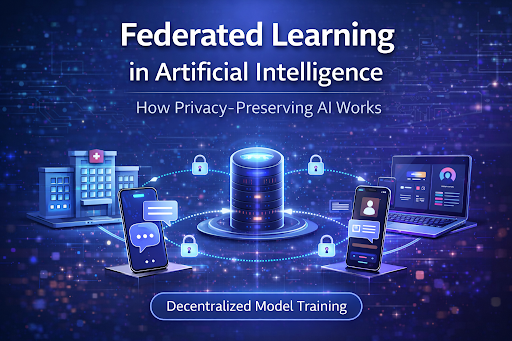
Today, federated learning in artificial intelligence provides a brilliant alternative. It is a decentralized machine learning technique where the model is trained across multiple edge devices or servers holding local data samples, without ever exchanging the actual raw data. Instead of bringing the data to the model, distributed AI model training brings the model to the data. This means your personal photos, text messages, and health metrics stay securely on your device, while the global model still benefits from the patterns hidden within your data.
How federated learning works
The mechanics of federated learning in AI involve a beautifully orchestrated dance between a central server and countless remote devices. The process of keeping data on-device while still improving global intelligence relies on a few critical steps:
- Initialization: A central server creates a baseline, global AI model.
- Distribution: This global model is sent out to thousands (or millions) of user devices, such as smartphones or IoT endpoints. This brings the intelligence directly to the realm of edge AI.
- Local Model Training: Each device trains its local copy of the model using the raw data available on that specific device. The actual data never moves.
- Sending Updates: Instead of sending data back to the server, the devices only send back the learnings—specifically, the cryptographic weights and model gradients.
- Model Aggregation: The central server collects these mathematical updates from all participating devices. Using algorithms like FedAvg (Federated Averaging), the server securely compiles these updates to improve the global model.
- Iteration: The improved global model is then sent back to the devices, and the cycle repeats.
By relying on local model training and secure model aggregation, this system ensures that sensitive information never leaves the local environment.
Why federated learning matters
The necessity for federated learning in artificial intelligence cannot be overstated in today’s regulatory climate. With sweeping data protection laws like GDPR in Europe and CCPA in California, tech companies are under immense pressure to ensure data privacy in AI.
When you pool data centrally, you create a massive target for hackers. Furthermore, moving petabytes of data from global users to a central server requires astronomical bandwidth and storage costs. By adopting a decentralized approach, organizations can build smarter, highly personalized tools while strictly adhering to data sovereignty laws. It bridges the gap between the insatiable need for data to train better algorithms and the fundamental human right to privacy.
Types of federated learning
Not all federated architectures are built the same way. Depending on the participating entities and how data is partitioned, the framework can be divided into a few distinct categories:
- Cross-Device Federated Learning: This involves millions of end-user devices, like smartphones or tablets. A common example is predictive text on mobile keyboards, where the devices come online, participate in a round of training, and drop off randomly.
- Cross-Silo Federated Learning: This occurs between a smaller number of reliable, institutional clients, such as multiple hospitals or financial institutions. These entities have robust computing power and stay connected continuously, making the training process faster and highly reliable.
- Vertical vs. Horizontal Federated Learning: Horizontal training happens when devices share the same feature space but different data samples (e.g., two regional banks). Vertical training happens when organizations share the same user base but have different feature sets (e.g., a bank and an e-commerce site collaborating).
Additionally, concepts like federated analytics are emerging alongside these types, allowing data scientists to glean statistical insights from decentralized data pools without directly accessing the raw numbers.
Applications of federated learning in AI
The practical applications of this technology are vast and rapidly expanding. When looking at Modern Artificial Intelligence Applications, privacy-preserving frameworks are quickly becoming the gold standard across multiple industries.
One of the most critical sectors benefiting from this is healthcare. Because medical records are highly sensitive and heavily regulated by laws like HIPAA, hospitals traditionally struggled to share data to build better diagnostic tools. Today, healthcare federated learning allows multiple medical institutions to collaboratively train tumor-detecting models or disease-predicting algorithms without ever exposing a single patient’s private medical history to the outside world.
Beyond healthcare, financial institutions use federated learning in artificial intelligence to detect credit card fraud across different banking networks without sharing proprietary customer financial data. On a consumer level, companies like Apple and Google use it to improve voice assistants, facial recognition, and predictive typing, ensuring your most personal daily interactions remain entirely private.
Benefits of federated learning
The shift toward decentralized architectures brings numerous advantages. The most significant of the federated learning benefits is, naturally, privacy. But the advantages extend much further:
- Enhanced Data Security: Because the raw data remains on the host device, the risk of a massive centralized data breach is heavily mitigated.
- Reduced Latency: By processing data on the edge device, AI models can make faster, real-time predictions without waiting for server communication.
- Lower Bandwidth Consumption: Sending small mathematical updates (model weights) requires significantly less network bandwidth than transferring high-resolution images or large raw datasets to a cloud server.
- Personalization: Local models become highly attuned to the specific user’s habits and behaviors, providing a bespoke user experience.
Furthermore, integrating self supervised learning in artificial intelligence into federated networks allows devices to learn continuously from unlabeled data, vastly improving the system’s efficiency and autonomy without requiring manual data tagging. The combination of these technologies makes federated learning in artificial intelligence incredibly powerful.
Challenges of federated learning
Despite its incredible potential, there are notable federated learning challenges that researchers are actively working to solve.
First, communication bottlenecks are a reality. Sending millions of model updates back and forth across unstable mobile networks can be slow and expensive in terms of device battery life. Second, the data is highly heterogeneous—meaning the data on your phone is vastly different in volume and quality than the data on my phone. This non-IID (non-independent and identically distributed) data can make it difficult for the central server to balance and converge the global model accurately.
Additionally, while raw data isn’t shared, reverse-engineering attacks can sometimes deduce sensitive information from the shared model weights. To combat this, data scientists frequently employ differential privacy—adding “noise” to the model updates so that no individual’s contribution can be distinctly identified.
Future of federated learning in artificial intelligence
As we look toward the horizon, the trajectory of federated learning in artificial intelligence is incredibly promising. We are moving toward a reality where collaborative AI is the default, not the exception. Advances in edge computing, 5G networks, and specialized hardware will dramatically reduce the communication friction that currently hinders distributed systems.
We can expect to see deeper integration with blockchain technology to create fully trustless, decentralized AI networks. As we continuously shape the Future of artificial intelligence technology, the emphasis will shift from merely building larger models to building smarter, more secure, and highly efficient distributed frameworks. The true potential of AI will be unlocked when global cooperation can happen without compromising local security.
FAQs
Does federated learning in artificial intelligence share user data?
No. The foundational principle of this technology is that raw user data never leaves the local device. Only the mathematical learnings (model parameters and gradients) are encrypted and shared with the central server to improve the global model.
What are the most common federated learning applications?
Common applications include improving smartphone predictive keyboards, training autonomous driving models across different vehicle fleets, and collaborative healthcare diagnostics where hospitals train AI on patient data without sharing the actual medical records.
Is federated learning in artificial intelligence completely secure from hackers?
While it is vastly more secure than centralized data storage, it is not completely immune to attacks. Sophisticated adversaries can sometimes attempt to reverse-engineer data from model updates. Therefore, it is usually combined with cryptographic techniques like differential privacy and secure multiparty computation to ensure ironclad protection.
Conclusion
The era of choosing between powerful technology and personal privacy is coming to an end. Federated learning in artificial intelligence represents a profound leap forward, allowing humanity to build incredibly sophisticated, personalized, and global AI systems while leaving individual data precisely where it belongs—in the hands of the user.
By decentralizing the training process, adopting edge AI, and prioritizing robust privacy-preserving techniques, developers are laying the groundwork for a safer digital ecosystem. As edge devices become more powerful and algorithms become more efficient, federated learning in artificial intelligence will undoubtedly become the standard backbone of tomorrow’s technological innovations, ensuring a future where artificial intelligence respects and protects our digital boundaries