Introduction to AI in Healthcare
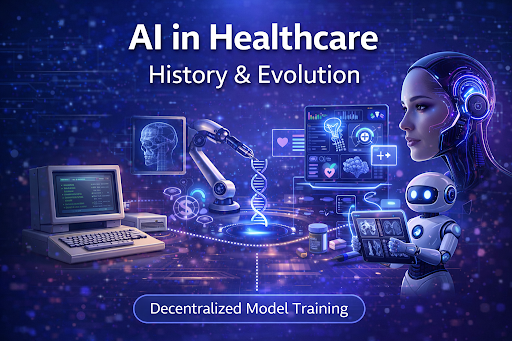
When we trace the incredible AI in healthcare history and evolution, we uncover a fascinating journey of technological triumph. What began as theoretical concepts in mid-century computer science labs has blossomed into life-saving technologies deployed in hospitals worldwide. The history of AI in healthcare is not just a timeline of computers getting faster; it is the story of how human ingenuity has continuously sought to reduce medical errors, accelerate diagnoses, and improve patient outcomes through computational power.
Understanding the artificial intelligence in healthcare history provides vital context for the digital health technologies we rely on today. From the earliest rule-based programs to the highly sophisticated neural networks of the modern era, the evolution of AI in healthcare has been driven by the dual explosion of medical data and computing capabilities. This article delves deep into the ai in healthcare history and evolution, charting the monumental milestones that have redefined modern medicine.
Early AI Systems in Healthcare (1960s–1980s)
The foundation of AI in healthcare history and evolution was laid during the 1960s and 1970s. During this era, the AI healthcare technology history was heavily defined by the development of early problem-solving programs. One of the first major breakthroughs was DENDRAL, developed at Stanford University in the 1960s. While primarily used for organic chemistry, it set the structural groundwork for future medical programs.
By the 1970s, the development of medical AI systems took a massive leap forward with the creation of MYCIN. Also developed at Stanford, MYCIN was an early backward-chaining expert system designed to identify bacteria causing severe infections and recommend antibiotics. Though MYCIN was never actually deployed in clinical practice due to ethical and legal liabilities, it demonstrated that machines could perform at a level comparable to human experts. These early decades established the basic logic frameworks that would later evolve into modern clinical decision support systems.
Rise of Medical Expert Systems (1980s–1990s)
Moving into the 1980s and 1990s, the AI in healthcare history and evolution entered a new phase characterized by the Expert Systems in Artificial Intelligence. During this period, developers moved away from purely experimental academic environments and attempted to integrate AI into actual hospital workflows. The medical artificial intelligence evolution during these decades focused on “If-Then” logic architectures.
Programs like DXplain, introduced by Massachusetts General Hospital in 1986, acted as diagnostic decision support tools. By inputting a set of clinical findings, the system could generate a ranked list of possible diagnoses. This era proved the viability of predictive healthcare AI in assisting physicians. However, these systems eventually hit a computational wall; they required manual updating of medical knowledge and struggled to scale as medical literature expanded exponentially. Despite these limitations, the growth of AI in healthcare during the 90s established a permanent appetite for digital assistance in the clinical setting.
Deep Learning Breakthroughs in the AI in Healthcare History and Evolution (2010s)
The 2010s marked a monumental paradigm shift. The limitations of manual rule-based systems were completely shattered by The Rise of Neural Networks and deep learning algorithms. This chapter of the AI in healthcare history and evolution was catalyzed by the digitization of medical records and massive advancements in graphical processing units (GPUs).
Healthcare machine learning transitioned from systems that needed to be explicitly programmed to systems that could learn from raw data. In 2012, deep learning began conquering image-based recognition tasks, which immediately translated to AI medical imaging breakthroughs. Algorithms could suddenly identify diabetic retinopathy in eye scans or spot malignant tumors in radiology reports with astonishing accuracy. Furthermore, researchers began experimenting with self supervised learning in artificial intelligence, allowing medical models to identify hidden patterns in massive amounts of unlabelled health data, vastly accelerating AI healthcare development.
Modern Applications of AI in Healthcare
Today, we are witnessing the golden age of Modern Artificial Intelligence Applications in medicine. The AI in healthcare history and evolution has brought us to a point where algorithms are deeply embedded in nearly every facet of the medical lifecycle.
Medical Diagnosis
Modern medical diagnosis AI has achieved unprecedented levels of accuracy. Instead of relying solely on human intuition, doctors now use AI tools that cross-reference patient symptoms against millions of clinical cases in seconds. This ensures that rare diseases are not overlooked and that common ailments are diagnosed with supreme confidence, significantly reducing fatal diagnostic errors.
Medical Imaging
The most visible success in AI in healthcare history and evolution is arguably within radiology and pathology. AI medical imaging tools act as a second pair of tireless eyes. Algorithms trained on millions of X-rays, MRIs, and CT scans can detect micro-calcifications in breast tissue or tiny anomalies in brain scans long before a human radiologist might spot them, enabling life-saving early interventions.
Drug Discovery
Historically, bringing a new drug to market took billions of dollars and over a decade of research. AI drug discovery has revolutionized this pipeline. Machine learning models can simulate how different chemical compounds will bind to target proteins, predicting efficacy and toxicity before a physical experiment ever takes place. This was notably evident during the rapid development of treatments during recent global health crises.
Personalized Medicine
Predictive healthcare AI has ushered in the era of personalized medicine. Rather than a one-size-fits-all approach, AI analyzes a patient’s genetic makeup, lifestyle data, and metabolic profile to tailor highly specific treatment plans. This ensures higher efficacy of treatments—particularly in oncology, where chemotherapy regimens can be customized for the highest survival probability.
Healthcare Management
Beyond the clinical side, healthcare data analytics driven by AI is streamlining hospital operations. Algorithms predict patient admission rates, optimize bed allocations, and manage supply chains. By automating administrative tasks and billing, healthcare machine learning reduces physician burnout and allows medical staff to focus entirely on patient care.
Challenges of AI in Healthcare
Despite the incredible progress charted in AI in healthcare history and evolution, the industry still faces significant hurdles. Data privacy remains a paramount concern; training robust AI models requires massive datasets of highly sensitive patient information. Maintaining HIPAA compliance while fostering AI healthcare development is a delicate balancing act.
Furthermore, there is the challenge of algorithmic bias. If medical artificial intelligence evolution relies on historical data that lacks diversity, the resulting AI can perform poorly for underrepresented demographics. Finally, the “black box” nature of deep learning means that AI systems sometimes provide correct diagnoses without being able to explain how they arrived at that conclusion, which can hinder trust among medical professionals.
Future of AI in Healthcare
Looking forward, the next chapter in the ai in healthcare history and evolution will focus on seamless integration, ethical transparency, and proactive care. We will likely see the widespread adoption of continuous health monitoring through wearable digital health technologies that feed real-time data directly into predictive algorithms.
As we anticipate the broader Future of artificial intelligence technology, the goal in healthcare is to transition from reactive treatment to proactive prevention. AI will eventually be able to predict a patient’s likelihood of experiencing a critical health event, like a stroke or heart attack, weeks or even months before it occurs, fundamentally changing the nature of human longevity.
FAQs
What was the first major program in AI in healthcare history and evolution?
While DENDRAL in the 1960s was an early predecessor, MYCIN, developed in the 1970s at Stanford University, is widely considered one of the first major medical expert systems designed to identify bacterial infections.
How does AI improve medical imaging?
AI medical imaging utilizes deep learning algorithms to analyze scans (like X-rays or MRIs) at a pixel level. It can detect microscopic anomalies and patterns that indicate diseases like cancer, often earlier and more accurately than the human eye.
Will AI replace human doctors in the future?
No. The entire trajectory of the AI in healthcare history and evolution points toward augmentation, not replacement. AI acts as a powerful clinical decision support system, handling data-heavy tasks so doctors can focus on empathy, complex decision-making, and direct patient care.
Conclusion
The ai in healthcare history and evolution is a testament to humanity’s relentless pursuit of better health and extended longevity. From the clunky, rule-based expert systems of the 1970s to the lightning-fast, deep learning neural networks of today, the development of medical AI systems has continuously broken down barriers in diagnostics, pharmacology, and patient care.
As we stand on the brink of new breakthroughs in predictive healthcare AI and personalized medicine, one thing is certain: artificial intelligence is no longer just an experimental tool in the medical field. It is the beating heart of modern clinical innovation, promising a future where healthcare is more accessible, more accurate, and profoundly more effective for everyone.