The discovery known as galileo law of falling bodies marks one of the most powerful turning points in the history of science. Before the seventeenth century most scholars believed that heavy objects fall faster than lighter ones. This belief came from the teachings of Aristotle whose authority dominated natural philosophy for nearly two thousand years.
Galileo Galilei challenged this long standing belief through careful experiments and mathematical reasoning. His work demonstrated that objects fall with the same acceleration regardless of their mass when air resistance is removed. This revolutionary insight formed the basis of modern physics and motion analysis.
The importance of galileo law of falling bodies goes far beyond a simple experiment. It introduced a new way of understanding nature through measurement mathematics and observation.
The scientific influence of this discovery is closely connected to earlier galileo galilei discoveries that transformed astronomy and physics during the scientific revolution.
Today the principles behind galileo law of falling bodies are still used in modern physics engineering and space exploration.
Introduction to Galileo Law of Falling Bodies
During the Renaissance period natural philosophers relied heavily on Aristotelian physics. According to Aristotle heavier objects should fall faster because they possess greater natural weight.
However Galileo began questioning this idea.
By carefully observing falling objects and conducting controlled experiments he realized that mass does not determine falling speed.
The discovery of galileo law of falling bodies revealed that gravity accelerates all objects equally when external forces such as air resistance are negligible.
The mathematical relationship describing free fall motion can be expressed asWhere:
d represents distance fallen
g represents acceleration due to gravity
t represents time.
This equation became one of the earliest examples of free fall mathematics and a central part of galileo law of falling bodies.
Challenging Aristotle Does Heavier Mean Faster
For centuries Aristotelian physics claimed that the rate of fall depends on weight. According to this belief a heavy stone should fall faster than a small pebble.
Galileo suspected this idea was incorrect.
He argued that if a heavy object falls faster than a lighter one then tying them together should create a contradiction. The lighter object should slow the heavier one yet together they would form a heavier combined mass.
This logical argument suggested that the traditional theory was flawed.
Through experiments Galileo demonstrated that the rate of fall discovery depends primarily on gravitational acceleration rather than mass.
This insight became a cornerstone of galileo law of falling bodies.
The Inclined Plane Experiments Slowing Down Gravity
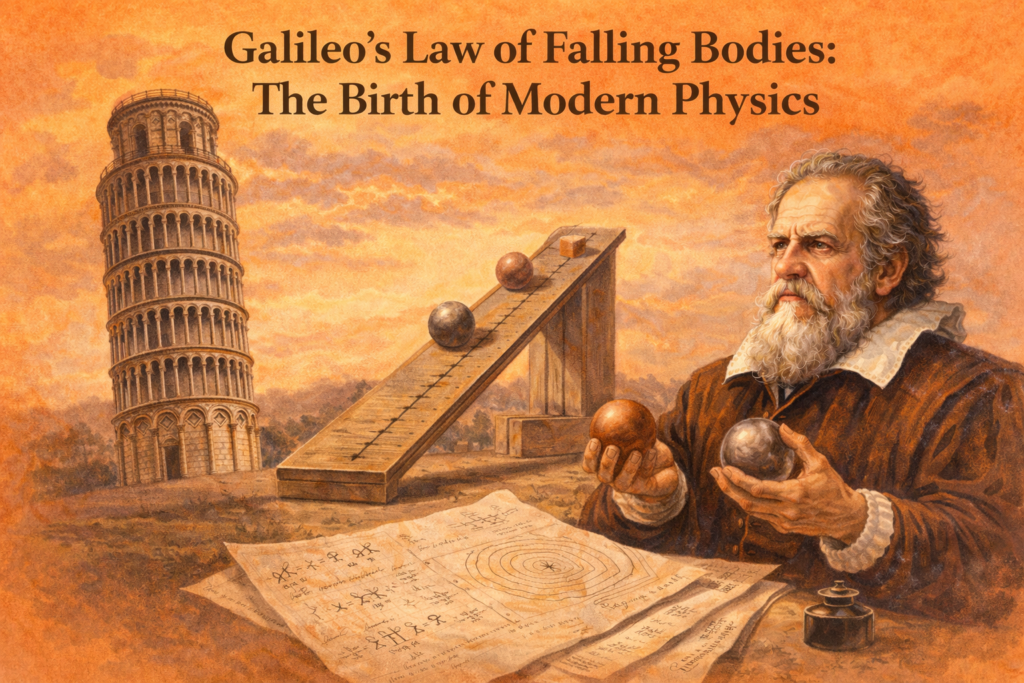
Studying falling objects directly was difficult because objects fall too quickly to measure accurately. To overcome this problem Galileo developed inclined plane experiments.
An inclined plane allowed objects such as spheres to roll downward slowly under the influence of gravity.
By reducing the angle of the slope Galileo effectively slowed the acceleration caused by gravity which allowed him to measure motion more precisely.
These experiments played a central role in the development of Galilean kinematics.
They also provided strong experimental evidence supporting galileo law of falling bodies.
Measuring Time and Distance with Precision
To measure time Galileo used water clocks and pendulum timing methods. These simple devices allowed him to record the motion of spheres rolling down inclined planes.
By marking equal time intervals he could measure the distance traveled during each interval.
His measurements revealed that the motion of spheres followed a clear mathematical pattern.
The distance traveled increased rapidly with time which suggested a relationship between time squared and distance.
This observation became a fundamental element of galileo law of falling bodies.
The Relationship Between Time Squared and Distance
Galileo discovered that the distance traveled by a falling object is proportional to the square of the elapsed time.
This relationship can be written asWhen combined with gravitational acceleration the relationship becomesThis equation explains why falling objects accelerate as they move downward.
It also forms one of the earliest kinematic equations used in physics.
The discovery that distance increases with time squared was a powerful confirmation of galileo law of falling bodies.
Understanding Uniform Acceleration and Inertia
Another important insight from galileo law of falling bodies involved the concept of uniform acceleration.
Galileo realized that gravity produces a constant acceleration rather than a constant speed.
Acceleration describes how quickly velocity changes with time.
In mathematical form acceleration is defined asWhere:
a represents acceleration
v represents velocity
t represents time.
Through experiments Galileo demonstrated that falling objects experience uniform acceleration due to gravity.
He also developed the concept of inertia which states that objects continue moving unless acted upon by an external force.
These principles later influenced Isaac Newton when developing classical mechanics.
The Myth and Reality of the Leaning Tower of Pisa
One of the most famous stories associated with galileo law of falling bodies involves the Leaning Tower of Pisa.
According to legend Galileo dropped two spheres of different masses from the tower to demonstrate that they would hit the ground at the same time.
Although historical evidence for this exact experiment is uncertain the story captures the essence of Galileo ideas.
Modern experiments confirm that in vacuum conditions objects fall at the same rate regardless of mass.
The difference observed in everyday life is caused by gravity and air resistance.
This concept known as mass independence in gravity remains a key feature of galileo law of falling bodies.
Impact From Galileo Kinematics to Newton Gravity
The scientific influence of galileo law of falling bodies extended far beyond Galileo lifetime.
His work on motion laid the foundation of classical mechanics which was later expanded by Isaac Newton.
Newton laws of motion and universal gravitation built directly upon Galileo studies of acceleration inertia and falling bodies.
Galileo discoveries also complemented his astronomical research such as Galileo’s Jupiter Moon Discoveries which demonstrated that planets could have orbiting satellites.
His telescopic research described in Sidereus Nuncius Discoveries also revolutionized our understanding of the heavens.
Meanwhile observations described in Galileo and the Phases of Venus helped confirm the heliocentric structure of the solar system.
Despite his groundbreaking achievements Galileo later faced opposition from religious authorities in the famous case known as Galileo’s Trial and Conflict with the Church.
Nevertheless the principles discovered through galileo law of falling bodies remain central to modern science.
Frequently Asked Questions (FAQs)
What is Galileo law of falling bodies?
It states that objects fall with the same acceleration regardless of their mass when air resistance is negligible.
Why was Galileo discovery important?
The discovery replaced Aristotelian physics and helped establish modern scientific methods.
What experiment proved Galileo theory?
Inclined plane experiments allowed Galileo to measure acceleration and confirm the relationship between time squared and distance.
What is the free fall equation discovered by Galileo?
The motion of a falling object follows the equation
Did Galileo really drop objects from the Leaning Tower of Pisa?
The famous experiment may be partly legendary but it illustrates Galileo argument about mass independence in gravity.
Conclusion
The discovery of galileo law of falling bodies represents one of the most important breakthroughs in the history of physics. By carefully observing motion and using mathematical reasoning Galileo demonstrated that gravity accelerates objects equally regardless of their mass.
This insight overturned centuries of Aristotelian physics and opened the door to modern scientific thinking.
His work laid the foundation for classical mechanics and influenced generations of scientists including Isaac Newton.
The story of Galileo achievements also reflects a long intellectual journey showing how ancient greek scientists changed modern science while inspiring future scientists to investigate the laws governing the universe.