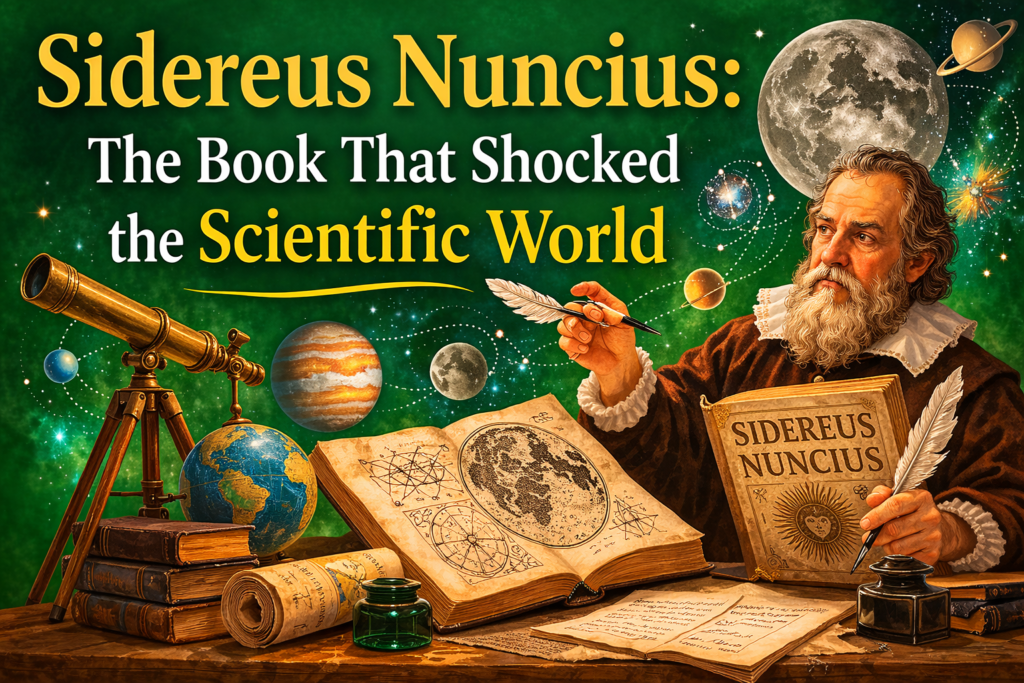
The publication known as sidereus nuncius book marks one of the most powerful moments in the history of science. In the year 1610 Galileo Galilei published a short Latin text that would permanently transform astronomy and scientific thinking. This work which translates as Starry Messenger introduced the world to discoveries made using the newly improved telescope.
Before the appearance of the sidereus nuncius book, most people believed that the heavens were perfect and unchanging. Ancient philosophers taught that celestial bodies were smooth spheres moving in perfect circles around Earth.
Galileo observations proved that the universe was far more complex than anyone had imagined.
Within this remarkable publication Galileo described mountains on the Moon thousands of stars hidden within the Milky Way and the discovery of four moons orbiting Jupiter.
These revolutionary claims placed the sidereus nuncius book at the center of the scientific revolution and established Galileo as one of the most influential thinkers in early modern science.
The discoveries described in this book also became part of broader galileo galilei discoveries that reshaped scientific knowledge.
Sidereus Nuncius The Dawn of Observational Astronomy
The sidereus nuncius book represents the birth of observational astronomy using telescopes. For centuries astronomers studied the sky with the naked eye. While they could track planetary motion they could not observe detailed structures on celestial bodies.
Galileo changed this forever.
Using an improved refractor telescope design he pointed his instrument toward the Moon planets and star clusters.
His careful celestial observations revealed details that had never been seen before.
These observations marked a dramatic intellectual revolution because they provided direct visual evidence that the universe contained physical landscapes similar to Earth.
The observational proof presented in the sidereus nuncius book forced scholars to reconsider long standing beliefs about the heavens.
The Publication of 1610 A Scientific Bestseller
When the sidereus nuncius book was published in Venice in 1610 it spread quickly across Europe. Printing press technology allowed the book to circulate among scholars universities and royal courts.
Despite being only a short Latin scientific text the work became a scientific bestseller of its time.
The book contained detailed descriptions of telescope observations accompanied by astronomical illustrations and lunar topography drawings.
Readers were amazed to learn that the Moon possessed mountains and valleys rather than a perfectly smooth surface.
The printing press impact helped transform the sidereus nuncius book into one of the most influential pieces of 1610 scientific literature.
Through Venetian publishing networks Galileo discoveries rapidly reached scientists throughout Europe.
Decoding the Sketches The Moon as a Physical World
One of the most remarkable aspects of the sidereus nuncius book was Galileo use of sketches to represent what he saw through the telescope.
These astronomical illustrations provided visual evidence that the Moon contained real geological features.
Galileo observed the changing patterns of light and shadow on the lunar surface. These shadows revealed irregular terrain including mountains craters and plains.
His lunar topography drawings challenged the Aristotelian idea that heavenly bodies were perfect spheres.
Using simple geometry Galileo estimated the height of lunar mountains.
The approximate height of a mountain can be calculated withWhere:
h represents mountain height
L represents length of the shadow
alpha represents the solar illumination angle.
These calculations allowed Galileo to show that lunar mountains could reach several kilometers in height.
The scientific explanations included in the sidereus nuncius book transformed the Moon from a mysterious object into a physical world.
Identifying Craters Mountains and Plains
Through repeated observations Galileo began mapping the Moon in greater detail.
He identified dark plains which we now call maria along with elevated mountain ranges and crater formations.
This discovery demonstrated that celestial bodies share physical similarities with Earth.
The idea that heavenly bodies could possess landscapes helped inspire later planetary science research.
It also showed that the heavens were not fundamentally different from the Earth.
This realization became one of the most powerful messages of the sidereus nuncius book.
Revealing the Unseen The Pleiades and the Milky Way
Another astonishing revelation described in the sidereus nuncius book involved the Milky Way.
To the naked eye the Milky Way appears as a faint luminous band across the night sky.
When Galileo observed it through his telescope he discovered that it consisted of thousands of individual stars.
This discovery dramatically expanded humanity understanding of the universe.
Galileo also studied the Pleiades star cluster. While ancient astronomers recorded only a few visible stars Galileo telescope revealed dozens more.
These fixed stars observations demonstrated that the universe was far more populated than previously believed.
The nebula resolution achieved with Galileo telescope opened the door to modern sky mapping and deep space astronomy.
Strategic Dedication The Medicean Stars and Political Power
One of the most important discoveries described in the sidereus nuncius book involved four small bodies orbiting Jupiter.
Galileo observed these objects moving around Jupiter night after night which indicated they were satellites of the planet.
This discovery proved that not everything revolved around Earth.
The finding later became known as Galileo’s Jupiter Moon Discoveries.
Galileo named these satellites the Medicean stars in honor of the powerful Medici family who ruled Florence.
This strategic dedication secured political support and financial patronage for Galileo research.
The Medici patronage played a crucial role in allowing Galileo to continue his scientific work.
How the Starry Messenger Permanently Altered Modern Thought
The influence of the sidereus nuncius book extended far beyond astronomy.
The book demonstrated that careful observation combined with mathematics could overturn centuries of philosophical tradition.
The discoveries within the book supported the copernicus solar system model which placed the Sun at the center of planetary motion.
This idea was further supported by later observations described in Galileo and the Phases of Venus.
Galileo scientific work also included groundbreaking studies of motion described in Galileo’s Law of Falling Bodies.
However the revolutionary ideas presented in the sidereus nuncius book eventually contributed to tensions with religious authorities that culminated in Galileo’s Trial and Conflict with the Church.
Despite this opposition the intellectual impact of the book could not be reversed.
It marked a turning point in scientific communication history and helped launch the era of early modern science.
Frequently Asked Questions (FAQs)
What is the Sidereus Nuncius book?
The sidereus nuncius book is a scientific publication written by Galileo Galilei in 1610 describing his telescope observations of the Moon Jupiter satellites and the Milky Way.
Why was Sidereus Nuncius important?
The book introduced telescopic astronomy and provided evidence that the universe contained complex celestial structures.
What discoveries were included in Sidereus Nuncius?
The book described lunar mountains Jupiter satellites and thousands of previously unseen stars.
Why did the book shock the scientific world?
It challenged the traditional belief that the heavens were perfect and unchanging.
How did the book influence modern science?
It promoted observation based science and helped advance the heliocentric view of the solar system.
Conclusion
The publication of the sidereus nuncius book represents one of the most powerful moments in the history of human knowledge. Through careful telescope observations Galileo revealed a universe filled with mountains moons and countless stars.
These discoveries shattered ancient ideas about perfect celestial spheres and helped establish observation based science.
The intellectual revolution sparked by the sidereus nuncius book transformed astronomy physics and philosophy.
Its influence reflects a long scientific journey showing how ancient greek scientists changed modern science while inspiring generations of thinkers to explore the mysteries of the cosmos.