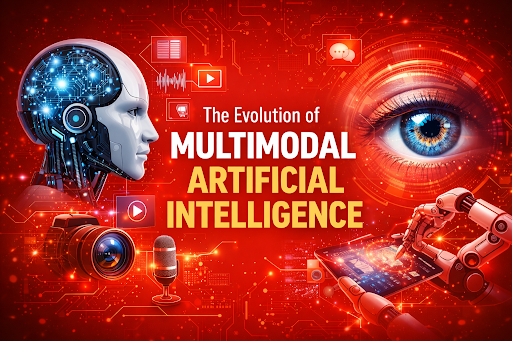
The multimodal artificial intelligence evolution represents one of the most remarkable breakthroughs in modern technology. Artificial intelligence systems were once limited to understanding only a single type of data such as text, images, or audio. Today, however, AI models can simultaneously interpret multiple forms of information—just as humans naturally do.
Early artificial intelligence systems focused on narrow tasks. Some models specialized in Natural Language Processing (NLP) to analyze text, while others focused solely on computer vision or speech recognition. While these unimodal systems achieved impressive progress, they struggled to understand complex real-world environments where multiple signals occur simultaneously.
The multimodal artificial intelligence evolution marks a powerful shift from these isolated capabilities toward integrated intelligence systems capable of processing text, images, audio, and video together. This transformation has been driven by advances in deep learning, transformer architecture, large language models (LLMs), and generative AI.
Today’s advanced models—such as GPT-4 and Gemini—demonstrate how far this transformation has progressed. These systems combine multiple data modalities, enabling machines to reason about complex environments, interpret visual information, and generate content in ways that were unimaginable just a decade ago.
Understanding the Multimodal AI Paradigm Shift
The shift toward multimodal systems represents a critical milestone in the multimodal artificial intelligence evolution. Instead of processing only one type of information, modern AI systems are designed to interpret multiple data sources simultaneously.
This capability dramatically expands the range of problems that AI can solve and allows machines to interact with the world in more natural ways.
What is Multimodal Machine Learning?
Multimodal machine learning refers to AI models that combine and analyze multiple forms of data simultaneously. These data types, known as modalities, include:
Text
Images
Audio
Video
Sensor signals
Traditional AI systems typically processed only one of these modalities. For example, Natural Language Processing models could analyze text but could not understand images. Computer vision systems could detect objects in photos but lacked the ability to interpret language.
The multimodal artificial intelligence evolution changed this paradigm by introducing models capable of connecting these different forms of information.
For example, a modern multimodal system can:
Generate images from text prompts
Answer questions about photographs
Interpret video scenes
Transcribe and analyze speech
Many of these capabilities emerged from advances described in Evolution of Machine Learning Algorithms and The Rise of Neural Networks, which introduced increasingly sophisticated neural architectures capable of handling complex datasets.
These developments helped shape the Timeline of multimodal neural networks and paved the way for modern generative AI systems.
The Limitations of Traditional Unimodal AI Systems
Before the multimodal artificial intelligence evolution began, most AI systems were limited to narrow capabilities.
For example:
Text-based models could generate language but could not understand visual information.
Computer vision systems could detect objects but lacked contextual reasoning.
Speech recognition systems could convert audio into text but did not interpret deeper meaning.
These limitations created barriers for real-world AI applications.
Many industries required systems capable of integrating information from multiple sources. Autonomous vehicles, robotics, healthcare diagnostics, and virtual assistants all depend on understanding multiple signals simultaneously.
Researchers therefore began developing cross-modal machine learning development techniques to merge these separate modalities into unified AI systems.
This shift marked the beginning of the multimodal artificial intelligence evolution.
The Early Stages of Multimodal Systems
Although modern multimodal AI seems like a recent innovation, its roots stretch back decades.
Early researchers already recognized that true artificial intelligence would require combining different types of sensory data.
The foundations for this work were established during early AI research periods following the Dartmouth Conference, which formally introduced artificial intelligence as a scientific field.
Early Attempts at Combining Text and Image Processing
In the 1990s and early 2000s, researchers began experimenting with systems capable of linking text and visual information.
These early models attempted to generate captions for images or identify objects described in written text.
However, progress was limited due to computational constraints and insufficient training data.
At the same time, breakthroughs in areas such as Image Recognition in Artificial Intelligence History and Speech Recognition Artificial Intelligence History helped build the technical foundations required for multimodal systems.
These early experiments represent the first steps in the multimodal artificial intelligence evolution.
Historical Challenges in Cross-Modal Alignment
One of the most difficult challenges in the multimodal artificial intelligence evolution involved aligning different types of data.
Text and images are fundamentally different forms of information. Words represent symbolic language, while images consist of pixel-based numerical data.
Teaching AI systems to connect these two representations required massive datasets and powerful neural networks.
Researchers faced several major obstacles:
Cross-modal representation learning
Large training data requirements
Computational limitations
Difficulty synchronizing different modalities
Advances discussed in Reinforcement Learning History and History of Computer Vision in Artificial Intelligence helped address these challenges.
As neural networks improved, researchers began developing more sophisticated models capable of linking visual and textual information effectively.
The Deep Learning and Transformer Breakthrough
The multimodal artificial intelligence evolution accelerated dramatically with the emergence of deep learning and transformer architecture.
These innovations allowed AI models to process vast datasets and uncover relationships between different data modalities.
How Transformer Architectures Changed the Game
Transformer models fundamentally changed the way AI systems analyze information.
Originally designed for Natural Language Processing tasks, transformers introduced attention mechanisms that allow models to understand relationships between data elements.
These architectures quickly became the backbone of modern AI development.
Their impact is widely discussed in Transformer Models in Artificial Intelligence, where they enabled the creation of powerful generative AI systems.
Transformers made it possible to perform large-scale data modality fusion, allowing models to integrate language and visual information.
This breakthrough significantly accelerated the multimodal artificial intelligence evolution.
The Introduction of CLIP and Foundation Vision-Language Models
One of the most important milestones in the multimodal artificial intelligence evolution occurred with the introduction of OpenAI’s CLIP model.
CLIP demonstrated how AI could learn associations between images and natural language descriptions by training on large datasets of image-text pairs.
Instead of relying on manual labeling, the model learned visual concepts directly from natural language descriptions.
This approach helped establish a new generation of vision-language models and accelerated the development of multimodal neural networks.
The success of CLIP also influenced research discussed in Generative AI History and modern Modern Artificial Intelligence Applications, where text prompts can generate images, videos, and other media.
Modern Multimodal Marvels: Gemini, GPT-4, and Beyond
Today, the multimodal artificial intelligence evolution has entered a powerful new phase.
Modern generative AI systems can process multiple forms of input simultaneously. Large language models now integrate computer vision, speech recognition, and video analysis capabilities.
These multimodal systems represent a new generation of AI technologies capable of understanding complex environments.
Integrating Audio, Video, and Real-Time Perception Seamlessly
Modern multimodal models can interpret and generate information across several modalities simultaneously.
For example, advanced AI systems can:
Analyze images while answering text questions
Interpret video scenes and generate descriptions
Process audio commands and visual context
Understand real-time sensory data
These capabilities are made possible through improvements in big data processing and large-scale training.
Breakthroughs explored in Big Data and Artificial Intelligence Evolution and Edge AI Technology Evolution have played a crucial role in scaling these systems.
Researchers are also exploring training techniques such as self supervised learning in artificial intelligence to improve the efficiency of multimodal models.
These developments continue pushing the boundaries of the multimodal artificial intelligence evolution.
Real-World Applications: Healthcare, Content Creation, and Robotics
Multimodal AI systems are already transforming industries worldwide.
Healthcare uses multimodal models to analyze medical images alongside patient records. These advances connect closely with AI in Healthcare History and Evolution, where AI assists doctors in diagnosing diseases.
Content creation platforms rely on generative AI to produce images, music, and video from text prompts.
Robotics systems integrate vision, language, and motion sensors to interpret physical environments and interact with humans.
These applications demonstrate how the multimodal artificial intelligence evolution is reshaping modern technology across many sectors.
What is Next for Multimodal Evolution?
The future of AI will likely involve even deeper integration between digital intelligence and the physical world.
Researchers believe the next phase of the multimodal artificial intelligence evolution will involve embodied AI and spatial computing technologies.
Moving Toward Embodied AI and Advanced Spatial Awareness
Embodied AI refers to systems capable of interacting directly with the physical environment through robotic bodies or sensors.
Future multimodal models may integrate:
Vision
Language
Movement
Environmental awareness
These systems could power advanced robots, smart assistants, and immersive spatial computing environments.
Progress in History of Robotics and Artificial Intelligence suggests that AI is steadily moving toward more interactive forms of intelligence.
Experts believe the next major breakthroughs will emerge through the Future of Artificial Intelligence Technology, where multimodal systems become central to everyday human-machine interactions.
Frequently Asked Questions (FAQs)
What is multimodal artificial intelligence?
Multimodal artificial intelligence refers to AI systems that can process and understand multiple types of data simultaneously, including text, images, audio, and video.
Why is the multimodal artificial intelligence evolution important?
The multimodal artificial intelligence evolution enables machines to interpret complex environments by combining different forms of information, making AI more useful in real-world applications.
What are examples of multimodal AI models?
Examples include GPT-4, Google Gemini, OpenAI CLIP, and other vision-language models that combine Natural Language Processing, computer vision, and audio analysis.
How do transformers enable multimodal AI?
Transformer architecture allows AI models to analyze relationships between different types of data using attention mechanisms, enabling effective integration of multiple modalities.
Which industries benefit from multimodal AI?
Industries such as healthcare, robotics, education, entertainment, and content creation are already benefiting from multimodal AI technologies.
Conclusion
The multimodal artificial intelligence evolution represents a powerful step toward more human-like artificial intelligence. By combining language, images, audio, and video into unified models, researchers are enabling machines to understand the world in richer and more meaningful ways.
From early experiments in machine learning to modern transformer-powered foundation models, the journey toward multimodal intelligence has been extraordinary.
As advances in spatial computing, embodied AI, and generative AI continue, multimodal systems will likely shape the next generation of artificial intelligence.
The coming years may witness AI systems capable of understanding and interacting with the world across multiple senses—unlocking entirely new possibilities for innovation and human-machine collaboration.