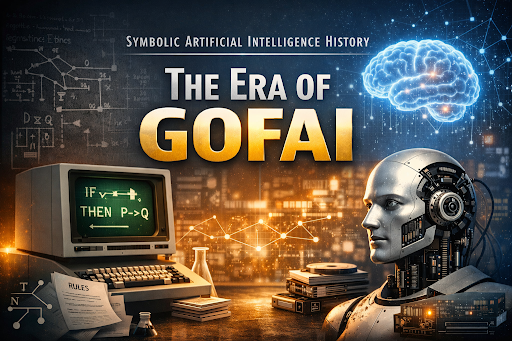
Artificial intelligence has evolved through several dramatic phases, but few periods were as influential as the era of symbolic reasoning. The Symbolic Artificial Intelligence History traces a fascinating journey where researchers believed intelligence could be replicated using logic, rules, and structured symbols. During this time, AI systems were built to mimic human reasoning through carefully designed rules rather than learning from data.
This approach, often called Good Old-Fashioned AI (GOFAI), dominated research from the 1950s to the late 1980s. Scientists believed that if human reasoning could be expressed through symbols and logical statements, computers could solve complex problems like language translation, medical diagnosis, and planning.
Understanding Symbolic Artificial Intelligence History is essential because many of today’s advanced technologies still rely on ideas first introduced during this era. Even modern hybrid systems combine machine learning with symbolic reasoning, proving that the foundations of GOFAI still matter in the evolving Future of artificial intelligence technology.
What is Symbolic AI? Understanding the Foundations
Symbolic AI refers to a branch of artificial intelligence where knowledge is represented using symbols, logical rules, and structured reasoning systems. Instead of learning patterns from large datasets, symbolic AI systems rely on human-defined rules and knowledge bases.
In the early years of Symbolic Artificial Intelligence History, researchers believed intelligence could be achieved through symbolic manipulation. The computer would store facts and rules, then use logical reasoning to infer new information.
This approach became the cornerstone of Good Old-Fashioned AI (GOFAI), where scientists focused on building systems capable of reasoning and problem-solving rather than statistical learning.
The Core Concept: Logic, Rules, and Symbols
At the heart of symbolic AI lies the concept of representing knowledge in a structured format. Instead of numbers or statistical probabilities, information is stored as symbols representing real-world concepts.
For example:
- Facts represent knowledge about the world
- Rules describe relationships between facts
- Inference engines apply logical reasoning
This framework allowed early AI programs to simulate reasoning processes similar to human decision-making. Techniques like heuristic search were developed to guide problem-solving efficiently.
However, as the field progressed, researchers discovered limitations such as combinatorial explosion, where the number of possible solutions grows too quickly for computers to handle efficiently.
The development of symbolic reasoning also influenced the Evolution of Machine Learning Algorithms, as later systems attempted to combine logical reasoning with statistical methods.
The Physical Symbol System Hypothesis Explained
One of the most important ideas in Symbolic Artificial Intelligence History is the Physical Symbol System Hypothesis. Proposed by Allen Newell and Herbert A. Simon in 1976, the hypothesis argued that a physical symbol system has the necessary and sufficient means for general intelligent action.
In simpler terms, they believed intelligence emerges from the manipulation of symbols according to formal rules.
This idea drove decades of research in logic programming and knowledge representation. Many early AI researchers strongly believed this hypothesis would eventually lead to artificial general intelligence.
Although modern AI often relies on data-driven learning, symbolic reasoning continues to influence fields like knowledge graphs, automated reasoning, and decision-support systems.
The Golden Age of Symbolic AI (1950s – 1980s)
The golden age of symbolic AI was marked by optimism and ambitious research projects. Governments, universities, and corporations invested heavily in artificial intelligence, believing machines capable of human-like reasoning were just around the corner.
This period represents one of the most influential chapters in Symbolic Artificial Intelligence History, shaping the direction of computer science for decades.
The Dartmouth Workshop and Early Optimism
The Dartmouth Conference in 1956 is widely considered the birth of artificial intelligence as a scientific field. Organized by John McCarthy, Marvin Minsky, Claude Shannon, and Nathaniel Rochester, the workshop brought together researchers interested in machine intelligence.
The event introduced the term “artificial intelligence” and sparked global research interest.
The conference built on earlier ideas such as Alan Turing Artificial Intelligence, which proposed the famous Turing Test as a measure of machine intelligence.
Early programs developed during this period included problem-solving systems capable of playing games, solving puzzles, and proving mathematical theorems. These systems relied heavily on symbolic reasoning and heuristic search methods.
The Creation of LISP and Logic-Based Programming
A major milestone in Symbolic Artificial Intelligence History was the creation of the LISP programming language by John McCarthy in 1958. LISP quickly became the primary language for AI research.
The LISP programming language was designed specifically for symbolic computation, making it ideal for building AI systems that manipulated logical expressions and symbolic data.
Alongside LISP, researchers also developed logic programming languages that allowed computers to reason using formal logic.
This programming revolution enabled the creation of advanced rule-based systems and laid the groundwork for many expert systems that would emerge in the following decades.
The Rise and Commercialization of Expert Systems
By the late 1970s and early 1980s, symbolic AI entered a new phase of commercialization. Companies realized that rule-based systems could capture expert knowledge and automate complex decision-making processes.
This phase became one of the most practical applications in Symbolic Artificial Intelligence History.
Pioneering Programs: DENDRAL and MYCIN
Two of the most influential systems were DENDRAL and MYCIN.
DENDRAL was developed at Stanford University to help chemists identify molecular structures. The system used symbolic rules and heuristic search to analyze chemical data.
MYCIN was a medical diagnosis system that helped doctors identify bacterial infections and recommend treatments. The system relied on hundreds of expert-defined rules to reach conclusions.
These systems demonstrated the real-world potential of expert systems and significantly influenced the Expert Systems in Artificial Intelligence industry during the 1980s.
Companies began investing millions of dollars in rule-based systems to support business decisions, financial planning, and manufacturing operations.
How Corporate America Embraced Rule-Based Logic in the 1980s
During the 1980s, expert systems became a commercial phenomenon. Businesses adopted rule-based systems to automate knowledge-intensive tasks.
Industries using expert systems included:
- Healthcare
- Engineering
- Banking
- Manufacturing
Large corporations believed symbolic reasoning could capture human expertise and scale it across organizations.
However, maintaining these rule systems required constant updates. As the number of rules grew, managing them became increasingly difficult, exposing weaknesses in the symbolic AI approach.
The Fall of Symbolic AI and the First “AI Winter”
Despite its early success, symbolic AI eventually faced serious challenges. The limitations of rule-based systems became increasingly apparent, leading to reduced funding and declining optimism.
This period marked one of the most difficult phases in Symbolic Artificial Intelligence History.
The Brittleness Problem: Why Rules Failed in the Real World
One of the biggest issues with symbolic AI systems was brittleness. These systems performed well in narrow environments but failed when facing unexpected situations.
Since the systems relied entirely on predefined rules, they struggled to adapt to new or uncertain data.
Additionally, many symbolic systems suffered from combinatorial explosion, where the number of possible solutions became too large for practical computation.
These challenges slowed progress and contributed to the first AI Winters, a period of reduced research funding and skepticism about AI.
The Lighthill Report and the Collapse of AI Funding
In 1973, the Lighthill Report delivered a devastating critique of AI research in the United Kingdom. The report argued that most AI research had failed to achieve meaningful results.
As a result, many governments significantly reduced AI funding.
The impact spread globally, leading to widespread skepticism about symbolic AI approaches. This period became known as The AI Winter, when enthusiasm for artificial intelligence sharply declined.
However, the field eventually recovered with the emergence of new techniques and the Revival of Artificial Intelligence in the 1990s.
The Legacy of Symbolic AI Today
Although symbolic AI lost dominance in the late 1980s, its influence continues to shape modern technology.
Understanding Symbolic Artificial Intelligence History helps explain why many modern AI systems still integrate logical reasoning with statistical learning.
How Symbolic Logic Operates Behind the Scenes in Modern Tech
Today, symbolic logic remains essential in several technologies:
- Knowledge graphs
- Rule engines
- Semantic web technologies
- Automated theorem proving
These systems rely on symbolic reasoning to organize knowledge and draw logical conclusions.
Modern research increasingly explores hybrid approaches that combine symbolic reasoning with deep learning. For example, researchers are investigating connections between symbolic reasoning and self supervised learning in artificial intelligence to improve AI reasoning abilities.
The Future: Neuro-Symbolic AI Bridging Logic and Deep Learning
One of the most exciting developments in AI today is neuro-symbolic AI. This approach combines neural networks with symbolic reasoning to create systems capable of both learning from data and reasoning logically.
Neuro-symbolic AI attempts to solve long-standing problems in artificial intelligence, including interpretability, reasoning, and generalization.
Many experts believe these hybrid systems may represent the next stage in the evolution of AI.
As the field continues to evolve, the lessons learned from Symbolic Artificial Intelligence History remain invaluable. The symbolic AI era proved that reasoning, knowledge representation, and logical structure are essential components of intelligent systems.
Frequently Asked Questions (FAQs)
What is Symbolic Artificial Intelligence?
Symbolic AI is an approach to artificial intelligence where knowledge is represented using symbols, logic rules, and structured reasoning rather than statistical learning.
What does GOFAI mean in AI?
GOFAI stands for Good Old-Fashioned AI. It refers to early AI research focused on symbolic reasoning and rule-based systems.
Why did symbolic AI decline?
Symbolic AI declined mainly due to scalability issues, brittleness, and combinatorial explosion, which made it difficult for rule-based systems to handle real-world complexity.
Are expert systems still used today?
Yes. While not as dominant as before, expert systems are still used in fields like healthcare, finance, and industrial diagnostics.
What is neuro-symbolic AI?
Neuro-symbolic AI is a hybrid approach that combines neural networks with symbolic reasoning to improve AI learning and reasoning capabilities.
Conclusion
The story of Symbolic Artificial Intelligence History represents one of the most fascinating chapters in AI development. From the ambitious optimism of the Dartmouth Conference to the rise of expert systems and the harsh lessons of the AI Winter, symbolic AI shaped the foundations of modern artificial intelligence.
Although data-driven machine learning dominates today, symbolic reasoning continues to influence knowledge representation, rule engines, and hybrid AI models.
As researchers continue exploring new paradigms, the insights gained from the symbolic AI era will remain essential in shaping the Future of artificial intelligence technology.