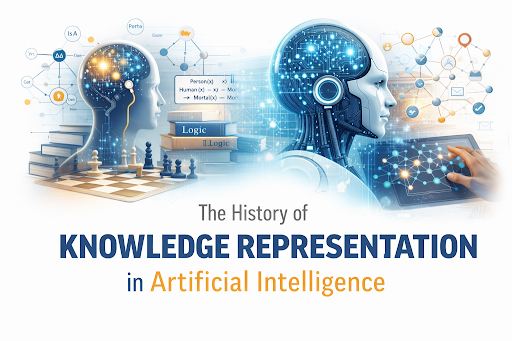
The Knowledge Representation in Artificial Intelligence History is one of the most important and intellectually challenging chapters in the development of AI. From the earliest days of computing, scientists realized that creating intelligent machines required more than just processing numbers or executing instructions. Machines needed a way to represent knowledge about the world.
Human intelligence relies heavily on knowledge structures such as concepts, relationships, and experiences. Teaching machines to store and reason with this type of knowledge has been a central challenge throughout the Knowledge Representation in Artificial Intelligence History.
Over decades, researchers have experimented with multiple methods to encode information—from semantic networks and symbolic logic to ontologies and modern knowledge graphs. Each approach aimed to solve the fundamental problem of how machines can interpret meaning rather than merely process data.
Understanding this journey reveals how AI evolved from simple rule-based programs into systems capable of reasoning, learning, and interacting with complex environments.
The Core Problem: How Do Machines “Know” Things?
One of the earliest questions in the Knowledge Representation in Artificial Intelligence History was deceptively simple: how can machines actually know something?
Humans use language, context, and common sense to interpret the world. Machines, however, rely entirely on encoded structures that represent facts, relationships, and reasoning rules.
Researchers quickly realized that building intelligent systems required clear distinctions between data, information, and knowledge.
The Difference Between Processing Data and Understanding Knowledge
Data alone does not produce intelligence. Raw numbers or symbols must be organized into meaningful structures before machines can use them effectively.
In AI research, this distinction is often described as:
Data → Information → Knowledge
Data refers to raw facts, while information organizes those facts into useful patterns. Knowledge goes one step further by linking information with reasoning and context.
The Knowledge Representation in Artificial Intelligence History focused on designing systems capable of transforming raw data into meaningful knowledge structures.
Early AI pioneers explored these ideas in projects described in First AI Programs, where symbolic reasoning systems attempted to represent logical relationships between concepts.
These early attempts laid the groundwork for later developments in knowledge bases and intelligent reasoning systems.
Early Challenges in Codifying “Common Sense”
One of the most difficult problems in the Knowledge Representation in Artificial Intelligence History has been capturing common sense.
Humans effortlessly understand concepts such as gravity, time, and cause-and-effect relationships. For machines, however, encoding this type of knowledge requires explicit representation.
For example, humans know that if someone drops a glass, it will likely fall and break. Teaching a machine to understand such everyday knowledge requires massive collections of rules and relationships.
This challenge became one of the central motivations behind many AI research projects.
The difficulty of codifying common sense knowledge would later inspire ambitious initiatives like the Cyc Project.
Pioneering Approaches in the 1960s and 1970s
During the early decades of artificial intelligence research, scientists explored several groundbreaking approaches to represent knowledge.
These methods attempted to capture relationships between concepts in ways that machines could interpret and reason about.
Semantic Networks: Mapping Relationships Between Concepts
One of the earliest and most influential knowledge representation models was the semantic network.
Semantic networks represented knowledge as interconnected nodes and links, where nodes represented concepts and links described relationships between them.
For example:
Dog → is a → Animal
Bird → can → Fly
Car → has → Engine
This approach allowed AI systems to store relational knowledge and perform logical inference.
Semantic networks became an important milestone in the Knowledge Representation in Artificial Intelligence History and remain influential in modern knowledge graphs.
These early experiments also helped shape ideas explored in Evolution of Machine Learning Algorithms, where researchers began investigating how machines could learn patterns from structured data.
Marvin Minsky’s “Frames” and Roger Schank’s “Scripts”
Another significant development in the Knowledge Representation in Artificial Intelligence History came from Marvin Minsky’s frames theory.
Frames provided structured templates representing typical situations or objects.
For example, a “restaurant frame” might include elements such as:
Customer
Menu
Waiter
Food
Bill
Similarly, Roger Schank introduced scripts—structured descriptions of common event sequences.
A script might describe the steps involved in visiting a restaurant:
Enter restaurant
Order food
Eat meal
Pay bill
These approaches allowed AI systems to model everyday situations using scripts and schemas.
Frames and scripts played an important role in developing cognitive architectures capable of representing real-world knowledge.
The Era of Logic and Rules (1980s)
During the 1980s, the Knowledge Representation in Artificial Intelligence History shifted toward formal logic-based systems.
Researchers believed that human reasoning could be modeled using logical rules and mathematical structures.
First-Order Logic as the Language of AI
First-order logic became the dominant language for representing knowledge in many AI systems.
This formal system allowed researchers to express facts, relationships, and reasoning rules in mathematical form.
For example:
All humans are mortal
Socrates is human
Therefore Socrates is mortal
Using first-order logic, AI systems could perform automated reasoning and derive conclusions from stored knowledge.
Logical representation systems became the backbone of many early knowledge bases and reasoning engines.
These methods were closely connected to developments in Expert Systems in Artificial Intelligence, where rule-based reasoning allowed machines to assist experts in fields such as medicine and engineering.
Building the Backbones of Expert Systems
Expert systems became one of the most commercially successful applications of early AI research.
These systems relied on knowledge bases containing thousands of rules encoded by human experts.
For example, a medical expert system might use rules like:
IF patient has fever AND cough → possible infection
Although expert systems achieved impressive results, they also revealed limitations in knowledge representation methods.
Maintaining and updating rule-based systems required extensive manual effort.
As a result, many projects struggled during the AI Winters, when funding declined due to slow progress and unmet expectations.
The Ambition (and Struggles) of the Cyc Project
One of the most ambitious efforts in the Knowledge Representation in Artificial Intelligence History was the Cyc Project.
Launched in the 1980s by Doug Lenat, Cyc aimed to create a massive knowledge base containing common sense knowledge about the world.
Doug Lenat’s Decades-Long Quest to Teach AI Common Sense
Doug Lenat believed that AI systems needed vast amounts of background knowledge to reason effectively.
The Cyc Project attempted to encode millions of facts and rules describing everyday human knowledge.
For example:
Water is liquid at room temperature
People eat when they are hungry
Objects fall downward due to gravity
The project aimed to build one of the largest knowledge bases ever created.
Its goal was to accelerate progress in the Knowledge Representation in Artificial Intelligence History by giving machines the common sense humans take for granted.
Lessons Learned from Manual Data Entry
Despite its ambitious vision, the Cyc Project revealed the difficulty of manually encoding knowledge.
Human experts spent decades entering facts into the system.
However, the scale of human knowledge proved enormous, making the process slow and labor-intensive.
These challenges demonstrated that manual rule creation was not sufficient for building truly intelligent systems.
Later AI research shifted toward automated learning methods that allow machines to learn knowledge directly from data.
Advances described in The Rise of Neural Networks helped transform the field by enabling AI systems to learn patterns without explicit rule encoding.
Modern Knowledge Representation
Today, the Knowledge Representation in Artificial Intelligence History has entered a new era powered by machine learning, large datasets, and advanced computational architectures.
Modern AI systems combine symbolic reasoning with statistical learning to build dynamic knowledge structures.
Ontologies and the Vision of the Semantic Web
One important development is ontology engineering in AI.
Ontologies define structured vocabularies and relationships used to describe knowledge domains.
For example, an ontology might define relationships such as:
Person → works for → Company
Disease → treated by → Medicine
These structured knowledge frameworks play a critical role in the Semantic Web.
The Semantic Web aims to make internet data understandable by machines through standardized knowledge structures.
Ontologies therefore represent a major milestone in the Knowledge Representation in Artificial Intelligence History.
From Manual Rules to Dynamic Knowledge Graphs
Modern AI systems increasingly rely on knowledge graphs instead of static rule-based systems.
Knowledge graphs represent entities and relationships as interconnected networks.
Companies like Google use massive knowledge graphs to improve search results and provide contextual information.
These systems continuously update themselves using machine learning algorithms.
Breakthroughs discussed in Big Data and Artificial Intelligence Evolution have made it possible to build extremely large knowledge graphs containing billions of relationships.
Researchers are also exploring techniques such as self supervised learning in artificial intelligence to allow machines to learn knowledge structures automatically.
Knowledge graphs now support many applications, including recommendation systems, virtual assistants, and medical research.
Frequently Asked Questions (FAQs)
What is knowledge representation in artificial intelligence?
Knowledge representation refers to methods used by AI systems to store and organize information so machines can reason and make decisions.
Why is knowledge representation important in AI?
Knowledge representation enables machines to interpret meaning, understand relationships, and perform logical reasoning rather than simply processing raw data.
What are semantic networks in AI?
Semantic networks represent knowledge as nodes and relationships between concepts, allowing machines to reason about connections between entities.
What was the Cyc Project?
The Cyc Project was an ambitious initiative launched by Doug Lenat to build a massive knowledge base containing common sense knowledge about the world.
How do modern AI systems represent knowledge?
Modern systems use ontologies, knowledge graphs, and machine learning models to represent and reason about information dynamically.
Conclusion
The Knowledge Representation in Artificial Intelligence History reveals the remarkable evolution of how machines store, organize, and reason about knowledge.
From early semantic networks and symbolic logic to modern knowledge graphs and machine learning systems, researchers have continuously sought better ways to represent the complexity of the real world.
Although challenges remain—especially in encoding human common sense—advances in AI architectures, data processing, and learning techniques continue to expand what machines can understand.
As AI technologies advance further, knowledge representation will remain a cornerstone of intelligent systems and a key driver shaping the Future of Artificial Intelligence Technology.