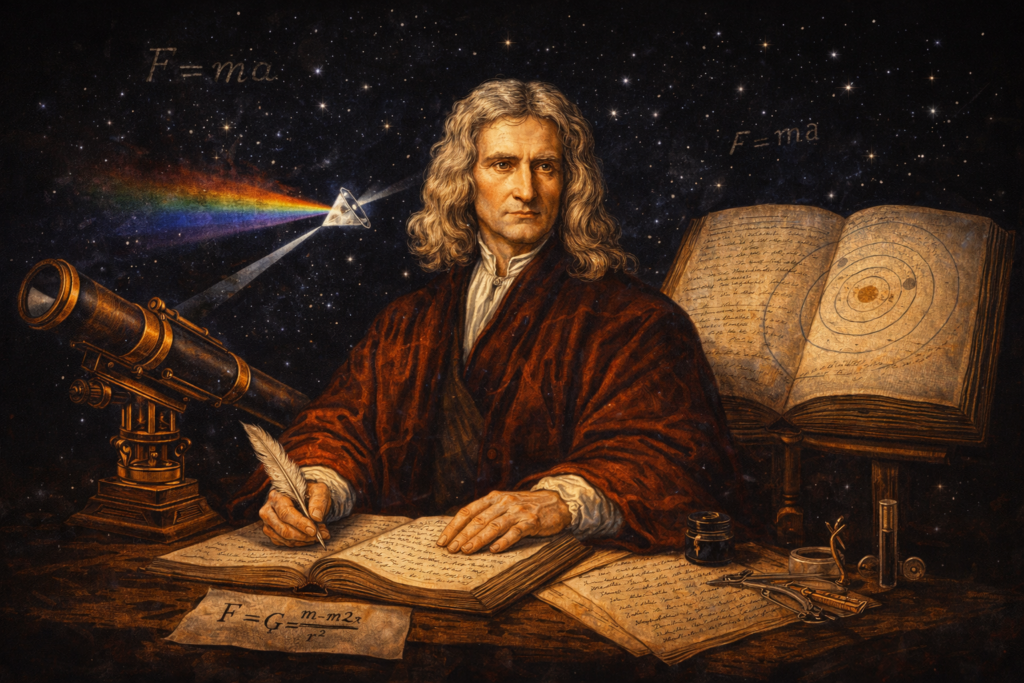
The story of isaac newton discoveries represents one of the most extraordinary chapters in the history of science. During the seventeenth century the scientific revolution was rapidly transforming human understanding of nature and the cosmos. Astronomers such as Copernicus Kepler and Galileo had already begun challenging ancient ideas about the universe. However it was Isaac Newton who united these discoveries into a powerful mathematical framework that explained the laws governing motion gravity and light.
The influence of isaac newton discoveries extends across physics mathematics astronomy and engineering. His work revealed that the same natural laws operate both on Earth and throughout the universe. Falling objects planetary motion and the behavior of light could all be explained using mathematical principles.
Because of these achievements Newton is often considered one of the greatest scientific minds in human history. The impact of isaac newton discoveries continues to shape modern science space exploration and technology.
Early Life of Isaac Newton
Isaac Newton was born on January 4 1643 in Woolsthorpe England. He was born prematurely and was not expected to survive infancy. His father a farmer named Isaac Newton had died before he was born.
Newton childhood was shaped by intellectual curiosity and independence. Although he grew up on a rural farm he showed early interest in mechanical devices and natural phenomena. He built small windmills water clocks and simple machines that demonstrated his fascination with engineering and mathematics.
During his youth Newton attended the King School in Grantham where he studied classical languages mathematics and natural philosophy.
The intellectual curiosity that emerged during these early years would later lead to the groundbreaking isaac newton discoveries that transformed science.
Education at Cambridge University
Newton entered Trinity College Cambridge in 1661 where he studied mathematics philosophy and astronomy.
At the time university education was still heavily influenced by Aristotle and medieval philosophy. However Newton became deeply interested in newer ideas emerging during the scientific revolution.
He studied the works of Galileo Kepler and René Descartes while also exploring mathematical techniques that could describe physical motion.
The university years played an essential role in shaping the foundations of isaac newton discoveries.
During this period Newton began developing new mathematical tools that later became part of calculus.
The Plague Years and Newton Greatest Insights
In 1665 a devastating plague forced Cambridge University to close temporarily. Newton returned to his family home in Woolsthorpe where he spent nearly two years studying independently.
These years became one of the most productive periods in scientific history.
During this time Newton developed ideas about gravity motion optics and calculus that would later become the foundation of classical physics.
Historians sometimes call this period Newton year of wonders because several revolutionary isaac newton discoveries emerged simultaneously.
Among the ideas he developed during these years were the principles that later became Newton’s Law of Universal Gravitation.
Newton Study of Motion and Mechanics
One of Newton most influential achievements involved the study of motion. Earlier scientists such as Galileo had begun analyzing how objects move under the influence of forces.
Newton expanded these ideas into a complete mathematical system describing motion.
This system became known as Newton’s Three Laws of Motion.
The three principles describe how objects move when forces act upon them.
The basic mathematical relationship connecting force mass and acceleration can be written as
F = ma
Where:
F represents force
m represents mass
a represents acceleration.
This equation became one of the most famous formulas in physics and forms an essential component of isaac newton discoveries.
These principles explain everything from falling objects to planetary motion.
Discovering the Universal Force of Gravity
Another revolutionary achievement among isaac newton discoveries was the understanding of gravity as a universal force.
Before Newton scientists understood that objects fall toward Earth but they did not know why.
Newton proposed that gravity acts between all objects with mass.
The mathematical expression for gravitational attraction can be written asWhere:
F represents gravitational force
G represents gravitational constant
m1 and m2 represent masses
r represents distance between objects.
This equation demonstrated that the same force causing an apple to fall also governs the motion of planets.
The idea became known as newton’s law of universal gravitation.
This discovery unified celestial mechanics and terrestrial physics into a single theory.
Newton Work on Light and Optics
Another important field shaped by isaac newton discoveries was optics.
Newton performed experiments using glass prisms to study how light behaves when it passes through transparent materials.
He discovered that white light is actually composed of multiple colors that spread out into a spectrum.
This observation became part of Newton’s Prism Experiments.
The prism experiments revealed that different wavelengths of light bend at slightly different angles when passing through glass.
Newton also invented the reflecting telescope which improved astronomical observation by using mirrors instead of lenses.
These contributions significantly advanced optical science and astronomy.
The Mathematical Revolution Calculus
In addition to physics Newton also developed new mathematical methods capable of describing changing quantities.
These techniques eventually became known as calculus.
Calculus allows scientists to analyze motion acceleration and changing systems with remarkable precision.
Although Newton developed calculus independently another mathematician Gottfried Wilhelm Leibniz also created similar methods.
This disagreement eventually led to a famous intellectual dispute known as Newton Calculus Controversy.
Despite the controversy calculus became one of the most powerful mathematical tools in modern science.
Many scientific fields today depend on mathematical techniques originally developed through isaac newton discoveries.
Principia Mathematica The Book That Changed Science
In 1687 Newton published one of the most important scientific books ever written.
The work titled Philosophiae Naturalis Principia Mathematica presented a complete mathematical explanation of motion gravity and planetary dynamics.
The publication known as Newton’s Principia Mathematica transformed physics and astronomy.
Within this book Newton demonstrated that planetary motion follows mathematical laws governed by gravitational forces.
The principles presented in this book influenced science for centuries and remain essential to modern physics.
Many historians consider the Principia the greatest scientific book ever written.
Later Life and Scientific Recognition
Newton achievements eventually brought him enormous recognition.
He became president of the Royal Society one of the most important scientific institutions in Europe.
Newton also served as Warden and later Master of the Royal Mint where he reformed the English currency system.
In 1705 Queen Anne knighted him making him Sir Isaac Newton.
Throughout his later life Newton continued studying natural philosophy theology and alchemy.
The reputation of isaac newton discoveries spread throughout Europe and established him as the central figure of classical science.
The Scientific Legacy of Isaac Newton
The influence of isaac newton discoveries continues to shape modern science.
Newton work created the foundation of classical mechanics which remained the dominant scientific framework for more than two centuries.
Engineers astronomers and physicists used Newton equations to predict planetary motion design bridges calculate spacecraft trajectories and analyze mechanical systems.
Even modern theories such as Einstein relativity were built upon Newton earlier discoveries.
Today scientists still rely on Newton laws when studying motion gravity and mechanics.
Frequently Asked Questions (FAQs)
Who was Isaac Newton?
Isaac Newton was an English mathematician physicist and astronomer who developed the laws of motion gravity and calculus.
What are Isaac Newton most important discoveries?
His major discoveries include the laws of motion universal gravitation calculus and the nature of light.
What is Newton law of universal gravitation?
It describes the gravitational attraction between objects with mass using the equation relating mass and distance.
What is Newton Principia Mathematica?
It is the book in which Newton explained the mathematical principles of motion and gravity.
Why is Isaac Newton important in science?
Newton discoveries created the foundation of classical mechanics and influenced nearly every branch of modern science.
Conclusion
The remarkable achievements of isaac newton discoveries transformed human understanding of the universe. Through mathematics observation and experimentation Newton unified the laws of motion gravity and light into a powerful scientific framework.
His work connected earlier scientific breakthroughs and provided explanations for planetary motion falling objects and the behavior of light.
The discoveries of Newton built upon earlier insights such as the copernicus solar system model and continued the intellectual journey of how ancient greek scientists changed modern science.
The legacy of Newton remains one of the greatest achievements in the history of human knowledge and continues to inspire scientists exploring the mysteries of the cosmos.