The discovery known as newton three laws of motion represents one of the most powerful foundations in the history of science. These laws explain how objects move when forces act upon them and they remain central to physics engineering and space exploration today.
Before Isaac Newton developed this theory scientists could observe motion but lacked a clear mathematical explanation. Objects moved across surfaces planets traveled through space and projectiles flew through the air yet the physical rules governing these movements were not fully understood.
Newton solved this mystery through a set of three principles that describe motion with extraordinary precision. These principles known as newton three laws of motion form the basis of classical mechanics and Newtonian dynamics.
The importance of newton three laws of motion extends far beyond academic physics. Engineers use these laws to design machines rockets automobiles bridges and spacecraft. Astronomers use them to calculate planetary movement and orbital motion.
The theory of motion developed by Newton also emerged from broader isaac newton discoveries that revolutionized scientific thought during the scientific revolution.
The Three Laws of Motion The Bedrock of Modern Physics
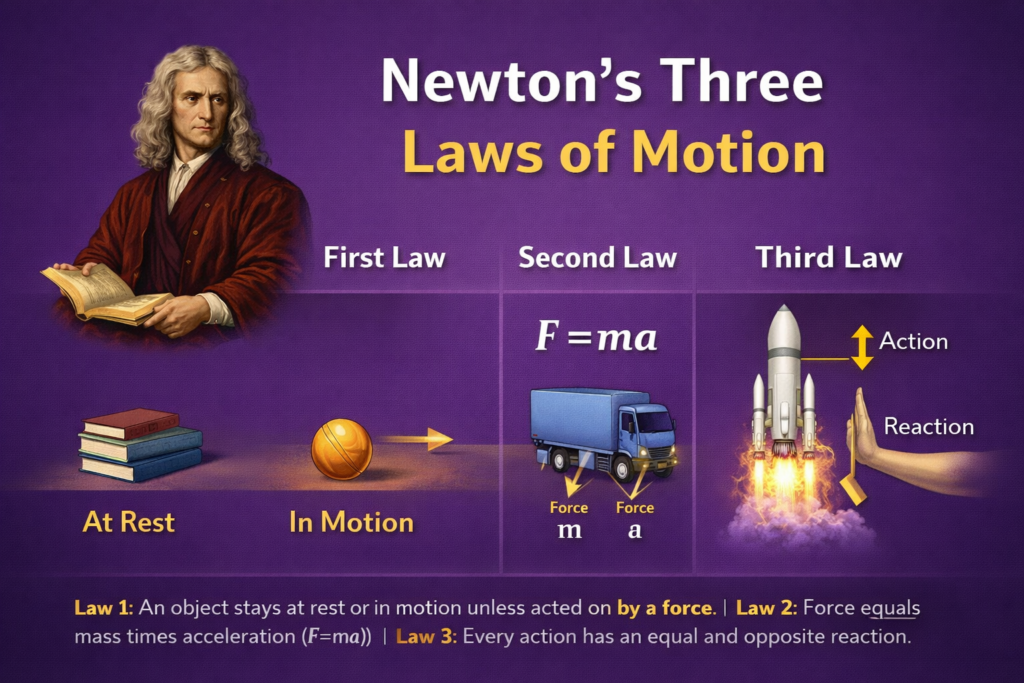
The three principles known as newton three laws of motion explain how forces influence the motion of objects.
These laws form the foundation of classical mechanics foundation and describe the physics of movement in a clear mathematical way.
Newton presented these laws in his famous scientific work newton’s principia mathematica, which remains one of the most influential books in scientific history.
Together the three principles explain inertia acceleration and action reaction forces.
By applying newton three laws of motion scientists can analyze everything from the movement of a falling apple to the motion of spacecraft traveling across the solar system.
The First Law Inertia and the Resistance to Change
The first principle of newton three laws of motion is often called the law of inertia.
This law states that an object will remain at rest or continue moving with constant velocity unless acted upon by an external force.
In other words objects resist changes in motion.
If no net force acts on an object its velocity remains constant.
This concept explains why passengers move forward when a vehicle suddenly stops. Their bodies continue moving due to inertia.
The law also explains why objects floating in space continue traveling indefinitely unless acted upon by gravitational forces or collisions.
In physics this condition is called static equilibrium or uniform motion.
The law of inertia remains one of the most fundamental ideas within newton three laws of motion.
Objects at Rest and Objects in Motion
According to newton three laws of motion an object at rest stays at rest and an object in motion continues moving in a straight line at constant speed unless a force acts upon it.
For example a hockey puck sliding on smooth ice continues moving because friction and resistance are minimal.
In space where motion in a vacuum occurs spacecraft can travel for long distances without engines firing because no opposing forces slow them down.
The concept of balanced vs unbalanced forces helps explain this principle.
Balanced forces result in no change in motion while unbalanced forces cause acceleration.
The Second Law The Relationship Between Force and Acceleration
The second principle of newton three laws of motion describes how forces influence motion.
This law states that the acceleration of an object depends on the net force applied to it and its mass.
In simple terms stronger forces produce greater acceleration while larger masses resist acceleration.
The relationship between force mass and acceleration forms one of the most famous equations in physics.
Calculating Force with F equals m a
The mathematical expression of newton three laws of motion appears asWhere:
F represents net force
m represents mass
a represents acceleration.
This equation explains how forces produce changes in velocity and displacement.
For example if a force of ten newtons acts on an object with mass two kilograms the acceleration becomesThis means the object accelerates at five meters per second squared.
The equation is used in engineering applications of Newton laws such as vehicle design aircraft motion and robotics.
The relationship between force equals mass times acceleration forms the central mathematical principle of newton three laws of motion.
The Third Law Action and Reaction Pairs
The third principle of newton three laws of motion describes how forces occur in pairs.
This law states that for every action there is an equal and opposite reaction.
Whenever one object exerts a force on another object the second object exerts an equal force in the opposite direction.
This action and reaction principle explains many everyday phenomena.
For example when a person pushes against a wall the wall pushes back with equal force.
This law also explains momentum conservation and recoil force in physical systems.
Real World Examples Rockets and Recoil
A dramatic example of newton three laws of motion appears in rocket propulsion.
When rocket engines expel high speed gases downward the rocket experiences an equal and opposite upward force.
This reaction force pushes the rocket into space.
Another example occurs in firearms. When a bullet moves forward the gun experiences recoil force backward.
Both examples illustrate how action and reaction forces operate simultaneously.
These principles play a critical role in aerospace engineering and mechanical design.
Additional Applications of Newton Laws
The influence of newton three laws of motion appears in nearly every area of physics and engineering.
These laws explain how cars accelerate how airplanes fly and how satellites remain in orbit.
They also work together with newton’s law of universal gravitation to explain planetary motion and orbital mechanics.
The laws of motion help scientists understand kinetic energy momentum and linear momentum in moving systems.
They also play a major role in analyzing friction and resistance in real world environments.
Through these applications newton three laws of motion continue shaping modern technology.
Why Newton Laws Still Govern Modern Engineering
Despite the development of modern physics theories such as relativity and quantum mechanics the principles of newton three laws of motion remain extremely useful.
Engineers rely on Newton laws when designing machines bridges transportation systems and spacecraft.
These laws describe motion accurately for most everyday conditions involving moderate speeds and gravitational fields.
The success of these laws demonstrates the brilliance of Newton insights.
His discoveries in mechanics combined with research in optics including newton’s prism experiments created a comprehensive understanding of natural forces.
His work also led to mathematical innovations that sparked debates such as newton calculus controversy.
Together these ideas helped establish the foundation of classical mechanics.
Frequently Asked Questions (FAQs)
What are Newton three laws of motion?
Newton three laws of motion are three principles describing how forces affect motion including inertia acceleration and action reaction forces.
Why are Newton laws important in physics?
They provide the fundamental framework for classical mechanics and help explain motion of objects in everyday life and engineering.
What does the formula F equals ma represent?
The equation shows that force equals mass multiplied by acceleration which describes how forces change motion.
Where are Newton laws used today?
They are used in engineering aerospace technology vehicle design robotics and many scientific calculations.
Do Newton laws still apply in modern physics?
Yes they remain extremely accurate for most situations although relativistic physics applies at extremely high speeds or strong gravity.
Conclusion
The scientific principles known as newton three laws of motion represent one of the most important achievements in the history of physics. By explaining how forces influence motion Newton created a mathematical framework that allowed scientists to understand movement throughout the universe.
These laws combined with insights from newton’s law of universal gravitation and the work described in newton’s principia mathematica formed the backbone of classical mechanics.
Newton discoveries built upon earlier scientific ideas including the copernicus solar system model and continued the long intellectual journey of how ancient greek scientists changed modern science.
Through these remarkable contributions Newton revealed the physical laws that govern motion on Earth and throughout the cosmos.