The story of newton light spectrum prism discovery represents one of the most remarkable moments in the history of optics and physics. Before Isaac Newton performed his prism experiments scientists believed that white light was pure and colorless. According to earlier theories colors appeared when light interacted with materials or objects.
Newton completely transformed this understanding.
Through a series of careful experiments conducted during the 1660s Newton demonstrated that white light is actually composed of many different colors. These colors become visible when light passes through a glass prism and spreads into a spectrum.
This discovery known as newton light spectrum prism discovery laid the foundation of modern optics and color science. It also helped scientists understand the composition of light and the nature of rainbows.
The significance of newton light spectrum prism discovery extends across physics astronomy engineering and visual technology. The principles behind this discovery remain essential for modern spectroscopy cameras telescopes and optical instruments.
Newton and the Discovery of Light Spectrum Shattering the Dark
The beginning of newton light spectrum prism discovery occurred during the years when Isaac Newton returned home from Cambridge because of the plague outbreak of 1665.
During this period Newton began studying optics and the behavior of light.
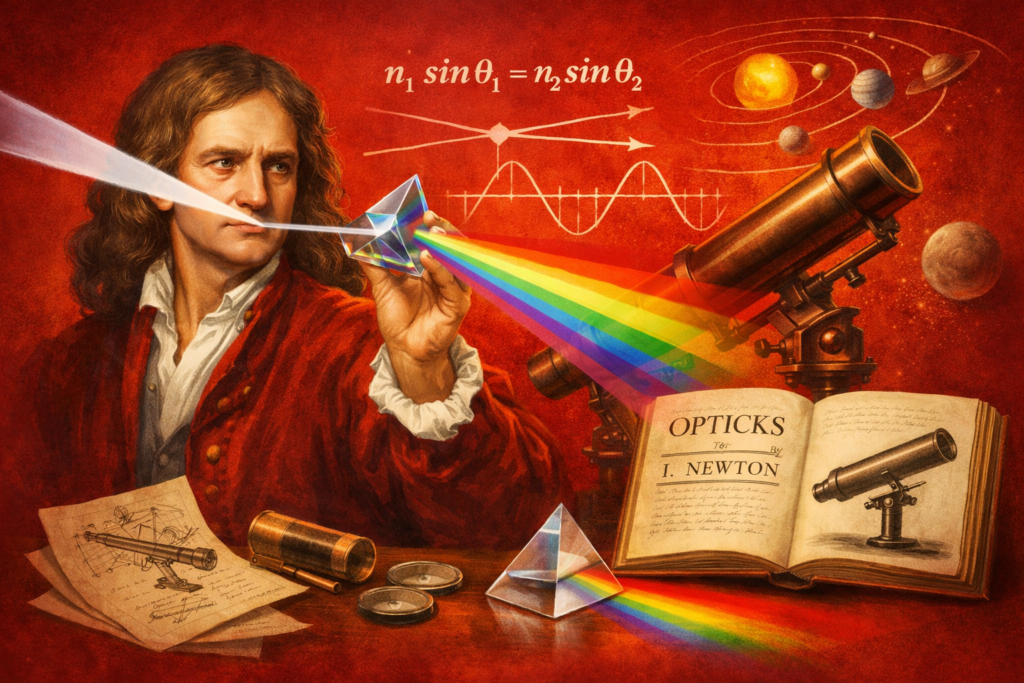
He allowed a narrow beam of sunlight to pass through a small hole in a window shutter into a dark room. When the beam encountered a triangular glass prism the light spread into a beautiful band of colors.
The colors appeared in a fixed order now remembered as ROYGBIV
red
orange
yellow
green
blue
indigo
violet.
This observation demonstrated that white light contains multiple colors.
The discovery became a central part of isaac newton discoveries, which transformed physics and astronomy.
The Experimentum Crucis The Critical Prism Test
Newton conducted many experiments to confirm newton light spectrum prism discovery. The most famous of these tests was called experimentum crucis which means the critical experiment.
In this experiment Newton passed sunlight through a prism to produce a spectrum. Then he selected a single color from the spectrum and passed it through a second prism.
If colors were created by the prism itself the second prism would generate additional colors.
However Newton observed something different.
The single color remained unchanged when passing through the second prism.
This result proved that colors are already present within white light.
The critical experiment became one of the strongest demonstrations supporting newton light spectrum prism discovery.
Proving White Light is a Mixture of Colors
Through repeated experiments Newton demonstrated that white light contains many wavelengths of light.
Each color bends differently when traveling through glass due to variations in refractive index.
Red light bends less while violet light bends more strongly.
The relationship between refraction and wavelength explains how the visible spectrum forms when light passes through a prism.
Newton also discovered that combining all colors of the spectrum recreates white light.
This proved that white light is a mixture of colors rather than a pure substance.
The idea that light dispersion through glass produces the visible spectrum became a cornerstone of newton light spectrum prism discovery.
How Light Bends The Science of Refraction
Another key concept in newton light spectrum prism discovery is refraction.
Refraction occurs when light changes direction while moving between materials with different optical properties.
The amount of bending depends on the refractive index of the material.
Mathematically refraction follows Snell lawWhere:
n₁ represents refractive index of the first medium
n₂ represents refractive index of the second medium
θ₁ represents angle of incidence
θ₂ represents angle of refraction.
Because different wavelengths of light have slightly different refractive indices they bend by different amounts.
This phenomenon produces the color separation seen in newton light spectrum prism discovery.
Newton Opticks vs Modern Wave Theory
Newton explained light using a particle based theory often called corpuscular theory. According to this idea light consists of tiny particles emitted by luminous objects.
This interpretation helped explain reflection refraction and color separation.
Newton published these ideas in his famous optics treatise titled Opticks.
However later scientists such as Thomas Young and James Clerk Maxwell developed wave theory of light.
Modern physics now describes light as electromagnetic waves composed of photons.
Despite these later developments the experiments behind newton light spectrum prism discovery remain fundamental to optical science.
The Invention of the Reflecting Telescope
Newton work on optics also led to the invention of a new astronomical instrument.
Early telescopes used lenses to magnify distant objects. Unfortunately these lenses produced color distortions called chromatic aberration.
Because of newton light spectrum prism discovery Newton realized that lenses separate colors due to refraction.
To solve this problem he designed a reflecting telescope that used mirrors instead of lenses.
Mirrors reflect light rather than refract it so they do not create chromatic aberration.
This innovation greatly improved telescope performance and influenced the development of modern astronomy.
The reflecting telescope remains one of the most important achievements resulting from newton light spectrum prism discovery.
Solving Chromatic Aberration with Mirrors
Chromatic aberration occurs because different wavelengths focus at slightly different points after passing through a lens.
Newton mirror based telescope eliminated this problem by using a curved mirror to collect light and focus it into an eyepiece.
This design became known as the Newtonian telescope.
Today many large astronomical observatories still use mirror based telescopes derived from Newton original design.
The connection between newton light spectrum prism discovery and telescope design illustrates the practical impact of Newton optical research.
How Newton Changed the Way We See the World
The influence of newton light spectrum prism discovery extends far beyond the study of rainbows.
Newton work laid the foundation for spectroscopy which allows scientists to analyze light emitted by stars and galaxies.
Spectral analysis reveals chemical composition temperature and motion of celestial objects.
Newton research also complemented other groundbreaking work including newton’s three laws of motion and newton’s law of universal gravitation.
Together these discoveries formed a unified scientific framework later described in newton’s principia mathematica.
Newton mathematical innovations also contributed to calculus which sparked intellectual debates known as newton calculus controversy.
The influence of Newton optical experiments therefore extends across physics astronomy chemistry and engineering.
Frequently Asked Questions (FAQs)
What is newton light spectrum prism discovery?
It refers to Isaac Newton experiment showing that white light contains many colors which appear when light passes through a prism.
Why was the prism experiment important?
The experiment proved that colors exist within white light rather than being created by glass or materials.
What colors did Newton observe in the spectrum?
Newton identified seven colors red orange yellow green blue indigo and violet.
How did Newton discovery influence science?
It laid the foundation for modern optics color science spectroscopy and telescope design.
What book explained Newton theory of light?
Newton described many optical ideas in his book Opticks which became one of the most influential works in optics.
Conclusion
The revolutionary newton light spectrum prism discovery transformed humanity understanding of light and color. By demonstrating that white light contains a mixture of colors Newton revealed the hidden structure of visible light.
This discovery helped establish modern optics and influenced many areas of science including astronomy chemistry and engineering.
Newton work built upon earlier scientific progress including the copernicus solar system model and continued the long intellectual tradition showing how ancient greek scientists changed modern science.
Through the brilliance of Newton experiments the invisible secrets of light were revealed and the foundations of modern optical science were born.