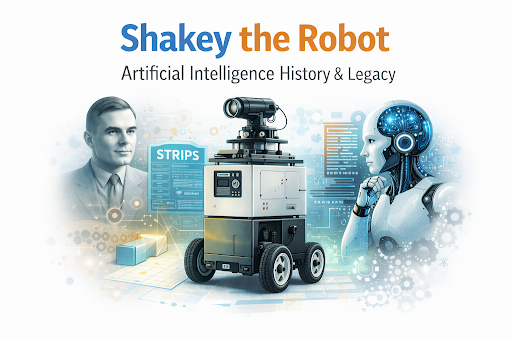
The Shakey the Robot Artificial Intelligence History represents one of the most important milestones in the development of intelligent machines. Long before modern robots, autonomous vehicles, or AI-powered assistants existed, researchers built Shakey—the first robot capable of perceiving its environment, reasoning about it, and taking actions independently.
Developed in the late 1960s at SRI International, Shakey became the first general-purpose mobile robot that combined computer vision, logical reasoning, and planning algorithms. While it may appear primitive by today’s standards, Shakey introduced ideas that would shape the future of robotics and artificial intelligence for decades.
The Shakey the Robot Artificial Intelligence History reflects the early robotics timeline when scientists attempted to combine symbolic AI, perception, and planning into a single system. This robot did not merely follow instructions—it could analyze its surroundings, make decisions, and execute plans.
Understanding Shakey’s legacy helps explain how modern robotics, AI planning systems, and intelligent automation evolved.
The Origins of Shakey the Robot
The Shakey the Robot Artificial Intelligence History began during a period when researchers were exploring ways to combine artificial intelligence with physical machines.
Until that time, most AI systems existed only as software programs running on computers. Shakey represented a bold attempt to bring AI into the physical world.
SRI International’s Vision for AI Research
Shakey was developed at SRI International in the late 1960s under the leadership of Charles Rosen. The goal was ambitious: build a robot capable of autonomous reasoning and navigation.
Unlike earlier machines that simply followed predetermined instructions, Shakey could observe its surroundings and determine the best course of action.
This breakthrough made Shakey the first general-purpose mobile robot in the history of artificial intelligence.
Researchers combined several emerging technologies to make this possible:
Computer vision systems
Planning algorithms
Logical reasoning systems
Navigation systems
These innovations contributed to the Shakey the Robot Artificial Intelligence History and helped establish foundational ideas explored in History of Robotics and Artificial Intelligence.
The project was also influenced by earlier research milestones such as the Dartmouth Conference, where scientists first envisioned intelligent machines capable of reasoning.
Although Shakey moved slowly and required significant computational power, it demonstrated that robots could integrate perception and decision-making.
How Shakey Navigated the World
One of the most remarkable aspects of the Shakey the Robot Artificial Intelligence History was the robot’s ability to perceive and navigate its environment.
Shakey operated in specially designed indoor environments where it could analyze objects, obstacles, and spatial relationships.
Hardware, Sensors, and Early Computer Vision
Shakey’s physical design was relatively simple but revolutionary for its time.
The robot was equipped with:
A television camera for visual perception
Range sensors to detect obstacles
Bump sensors for collision detection
A radio link to communicate with a remote computer
These sensors allowed Shakey to collect information about its environment.
However, the robot itself did not perform all computations. Instead, images and data were transmitted to a large computer system that processed the information and generated commands.
This early form of computer vision represented a major milestone in computer vision history.
These advances helped lay the groundwork for research explored in History of Computer Vision in Artificial Intelligence, where machines gradually learned to interpret visual data.
Although primitive compared to modern systems, Shakey’s vision system allowed it to identify walls, doors, and blocks.
The STRIPS Planning System and A Algorithm*
Another critical innovation in the Shakey the Robot Artificial Intelligence History was the development of the STRIPS planning system.
STRIPS (Stanford Research Institute Problem Solver) was a revolutionary AI planning algorithm designed to help Shakey determine sequences of actions required to achieve a goal.
For example, if Shakey needed to move a block across a room, it would:
Analyze the environment
Identify obstacles
Create a sequence of steps
Execute actions in the correct order
This planning process allowed the robot to reason about tasks rather than simply executing commands.
The project also contributed to the development of the A* search algorithm, which became one of the most widely used pathfinding algorithms in computer science.
These breakthroughs significantly influenced the Evolution of Machine Learning Algorithms, where intelligent systems increasingly relied on search and optimization techniques.
Why Shakey Was a Breakthrough in AI
The Shakey the Robot Artificial Intelligence History is considered groundbreaking because Shakey was the first robot to combine multiple aspects of artificial intelligence into a unified system.
Earlier machines could perform isolated tasks, but Shakey integrated perception, reasoning, and action.
Blending Physical Robotics with Logical Reasoning
One of Shakey’s most important contributions was demonstrating that logical reasoning systems could control physical robots.
The robot used symbolic representations of the environment to plan its actions.
For example, Shakey could reason about statements like:
“The block is on the platform.”
“The robot must move the block to the goal area.”
This approach combined symbolic AI with real-world interaction.
The significance of this achievement is reflected in developments described in Expert Systems in Artificial Intelligence, where logical reasoning systems were used to solve complex problems.
Shakey also helped inspire research in autonomous navigation and intelligent robotics.
Although the robot moved slowly—sometimes taking minutes to process a single command—it proved that robots could reason about actions and goals.
The Shakey the Robot Artificial Intelligence History therefore represents a crucial step toward modern autonomous machines.
Shakey’s Lasting Impact on Modern Robotics
Even decades after its creation, Shakey continues to influence robotics research.
Many technologies used in modern AI systems trace their origins back to this pioneering robot.
The Shakey the Robot Artificial Intelligence History illustrates how foundational ideas from early robotics experiments shaped modern innovations.
For example:
Autonomous navigation systems used in robots and self-driving vehicles rely on algorithms similar to A*.
AI planning systems used in logistics and automation build upon concepts developed in STRIPS.
Computer vision techniques used in robotics and automation evolved from early experiments like Shakey’s vision system.
The influence of Shakey can also be seen in modern AI technologies discussed in Modern Artificial Intelligence Applications, where robotics and intelligent systems operate in real-world environments.
Today’s robots benefit from enormous advances in computing power, machine learning, and sensor technologies.
Research techniques such as self supervised learning in artificial intelligence now allow robots to learn directly from large datasets rather than relying solely on manual programming.
These advances represent a continuation of the ideas first explored during the Shakey the Robot Artificial Intelligence History.
As robotics continues evolving, innovations in AI hardware and machine learning—such as those discussed in Edge AI Technology Evolution—are enabling robots to operate more efficiently and autonomously.
Experts believe these developments will shape the Future of Artificial Intelligence Technology, where intelligent robots may become common in homes, hospitals, and workplaces.
Frequently Asked Questions (FAQs)
What was Shakey the Robot?
Shakey was the first general-purpose mobile robot capable of reasoning about its environment and planning actions. It was developed at SRI International in the late 1960s.
Why is Shakey important in AI history?
The Shakey the Robot Artificial Intelligence History represents the first successful integration of perception, reasoning, and planning in a robotic system.
Who developed Shakey the Robot?
Shakey was developed by researchers at SRI International under the leadership of Charles Rosen.
What technologies did Shakey introduce?
Shakey contributed to the development of the STRIPS planning system, the A* search algorithm, and early computer vision techniques.
How did Shakey influence modern robotics?
Shakey introduced fundamental concepts used in autonomous navigation, robotics planning systems, and intelligent machines.
Conclusion
The Shakey the Robot Artificial Intelligence History represents one of the most important milestones in the evolution of intelligent machines.
Although Shakey’s hardware may appear primitive today, its contributions to robotics and artificial intelligence were revolutionary.
By combining perception, planning, and reasoning into a single system, Shakey demonstrated that machines could interact intelligently with the physical world.
Many of the algorithms and ideas developed during the Shakey project continue to influence modern robotics, autonomous systems, and artificial intelligence research.
As technology continues advancing, Shakey’s legacy remains a powerful reminder of how early experiments in AI helped shape the intelligent machines we are building today.