
Introduction
The question who invented the first programming language is one of the most fascinating topics in the history of computing. Programming languages are the foundation of modern software development because they allow humans to communicate with computers using structured instructions. Without programming languages there would be no applications, operating systems, or digital platforms.
Understanding who invented the first programming language requires exploring the earliest attempts to instruct machines using symbolic logic and structured commands. In the early days of computing machines operated using binary instructions that were extremely difficult for humans to understand.
As computing systems evolved engineers realized the need for more human readable ways to write instructions. This led to the development of programming languages that could translate human logic into machine code.
The development of programming languages is closely related to the history of programming languages, which explains how coding evolved from simple instructions to complex software systems.
The journey of who invented the first programming language reveals how visionary thinkers created the foundation for modern computing and software engineering.
Who Invented It
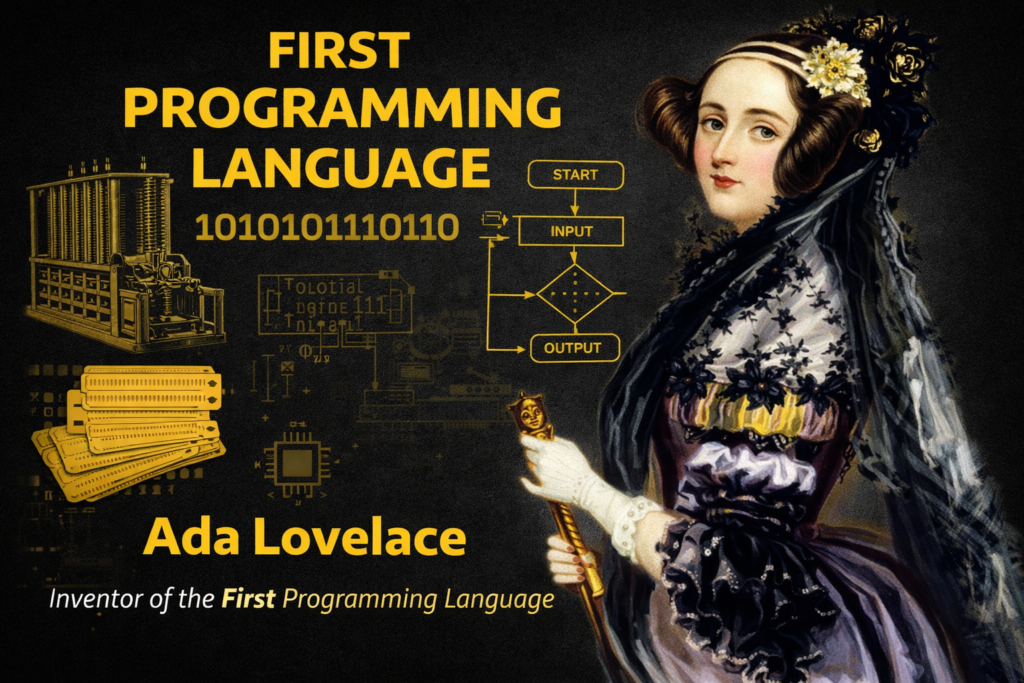
When discussing who invented the first programming language, one of the earliest and most important names is Ada Lovelace. She is widely regarded as the first computer programmer.
Ada Lovelace worked with Charles Babbage on the Analytical Engine, a mechanical computing machine designed in the nineteenth century. She developed a set of instructions that described how the machine could perform calculations.
These instructions are considered the first algorithm designed for a machine, making Ada Lovelace a pioneer in programming.
Another important contributor to who invented the first programming language is Konrad Zuse, who created Plankalkül in the nineteen forties. Plankalkül is often considered the first high level programming language.
Later innovations such as Fortran developed by John Backus and COBOL developed with contributions from Grace Hopper helped shape modern programming languages.
These contributions form an essential part of the history of computers and highlight the evolution of programming concepts.
When It Was Invented
The origins of programming languages can be traced back to 1843 when Ada Lovelace wrote her algorithm for the Analytical Engine.
The year 1843 is often considered the beginning of programming because it introduced the concept of writing instructions for a machine.
Later developments occurred in the nineteen forties when Konrad Zuse created Plankalkül, one of the first formal programming languages.
The development of assembly language and machine code during this period allowed computers to execute instructions more efficiently.
The invention of compilers in the nineteen fifties made it possible to translate high level languages into machine code.
These milestones represent key moments in understanding who invented the first programming language.
How It Worked
To understand who invented the first programming language, it is important to understand how early programming languages worked.
Early programming relied on binary code and machine instructions. These instructions were difficult to write and required deep understanding of hardware.
Programming languages introduced abstraction layers that allowed developers to write code using symbols and structured syntax.
Compilers translated high level code into machine code that computers could execute. Interpreters provided another method by executing code line by line.
Programming languages used algorithms and subroutines to organize logic and improve efficiency.
Flowcharts were used to design program logic before writing code.
These innovations made programming more accessible and allowed developers to build complex systems.
The development of programming languages shows how the concept behind who invented the first programming language transformed computing
Why It Was Important
Programming languages revolutionized computing by making it possible to write software efficiently.
Before programming languages existed developers had to write instructions in binary or machine code. This was time consuming and error prone.
Understanding who invented the first programming language highlights how these languages simplified software development.
Programming languages allowed developers to focus on logic rather than hardware details.
They also enabled the creation of operating systems, databases, and applications.
The importance of programming languages extends to modern technologies such as artificial intelligence and cloud computing.
Programming languages also played a key role in the development of modern systems described in the who invented software engineering field.
How It Evolved Today
Programming languages have evolved significantly since their early beginnings.
Modern languages such as Python, Java, and C support advanced features such as object oriented programming and functional programming.
The development of modern languages is closely related to advancements in hardware and computing systems.
The growth of high performance computing supported by the Evolution of GPUs has enabled advanced programming techniques and applications.
Modern programming languages also support distributed systems and cloud computing.
In the final stage of evolution improvements in hardware driven by the evolution of transistors and advancements in data management through the rise of storage technology have made programming more powerful and efficient.
The journey of who invented the first programming language continues to influence modern software development.
Frequently Asked Questions (FAQs)
Who invented the first programming language?
Ada Lovelace is widely considered the first programmer who created the earliest algorithm for a machine.
What was the first high level programming language?
Plankalkül created by Konrad Zuse is often considered the first high level programming language.
Why are programming languages important?
Programming languages allow humans to communicate with computers and build software applications.
What is a compiler?
A compiler translates high level programming code into machine code that computers can execute.
How have programming languages evolved?
Programming languages evolved from binary instructions to advanced languages that support complex software systems.
The Programming Language Revolution and Modern Coding Systems 1843 to Present
The story behind who invented the first programming language represents one of the most important breakthroughs in computing history. From the early work of Ada Lovelace to modern programming languages the field has evolved dramatically.
Programming languages enabled the development of software systems that power modern technology.
The contributions of pioneers such as Ada Lovelace in 1843 created a foundation for decades of innovation.
Today programming languages continue to evolve with new technologies and methodologies.
The legacy of who invented the first programming language reminds us that innovation and creativity are essential for building the future of computing.