Introduction
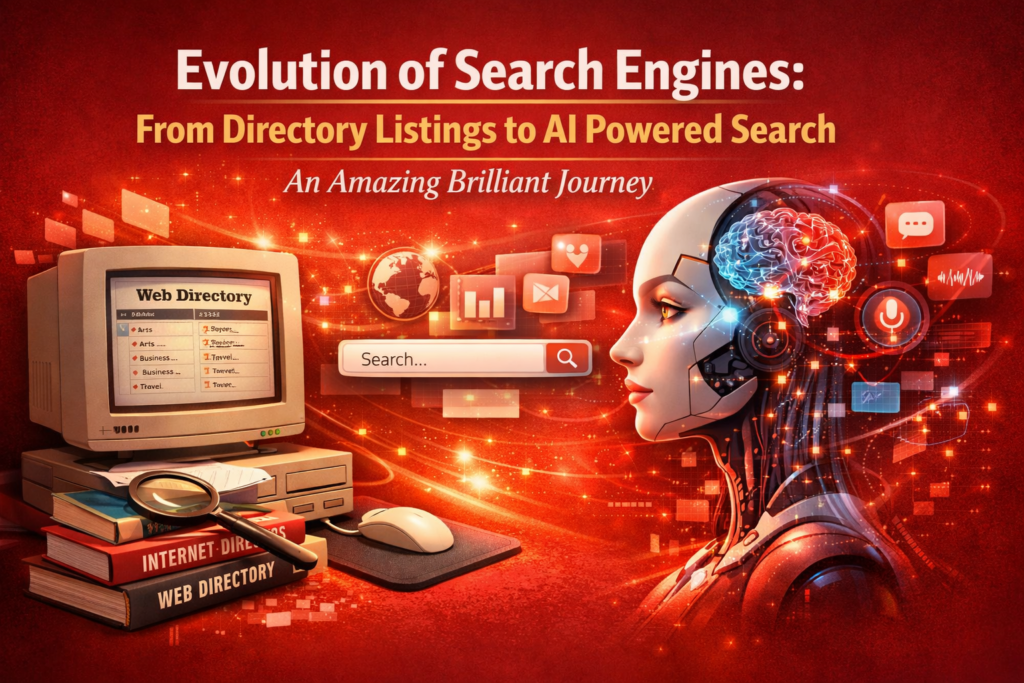
Before Google became a verb, finding information on the internet was a frustrating treasure hunt. The evolution of search engines represents one of the most amazing technological transformations of the digital age. What began as human curated directories has evolved into brilliant AI systems that understand questions, context, and even intent. Today, we ask chatbots for answers and receive conversational responses. Tomorrow, search may anticipate our needs before we type a single word. This remarkable journey from simple keyword matching to Large Language Models (LLM) has reshaped how humanity accesses information. Understanding the evolution of search engines helps us appreciate the brilliant engineering that makes the world’s knowledge instantly accessible.
Before Search Engines: The Primitive Web (1989 – 1993)
The history of the Internet was still young when the World Wide Web emerged in 1989. Tim Berners Lee invented HTML, HTTP, and the first web browser. But finding websites was nearly impossible. The only way to discover new pages was through word of mouth or manually maintained lists. CERN’s website had a page called “Other World Wide Web servers” that listed a handful of sites. This approach worked when the web had a few dozen servers. It failed miserably as the web exploded. The evolution of search engines began as a direct response to this discovery crisis. Without automated Web indexing, the growing web was becoming an unsearchable mess.
The Directory Era: Humans vs. The Web (1994 – 1996)
The first practical solution to web discovery was the human powered directory. In 1994, two Stanford PhD students named Jerry Yang and David Filo created a website called “Jerry and David’s Guide to the World Wide Web.” They renamed it Yahoo! The Yahoo! Directory organized websites into hierarchical categories. Entertainment, Business, Science, and so on. Human editors reviewed submissions and decided which sites belonged where. This approach produced high quality results. A Yahoo editor would reject spammy or low value sites. But the evolution of search engines quickly hit a scalability wall. The web grew faster than any human team could categorize.
Also in 1994, Brian Pinkerton launched WebCrawler, the first search engine to index entire pages rather than just titles and headers. In 1995, AltaVista and Lycos emerged. AltaVista, created by Digital Equipment Corporation researchers, was revolutionary. It indexed over 20 million pages and allowed complex search queries using natural language operators. AltaVista could search for phrases, exclude words, and specify date ranges. For a brief moment, AltaVista was the king of search. Lycos, named after a wolf spider (a Web crawlers (Spiders) reference), similarly automated indexing. But these early engines had a fatal flaw. They ranked results primarily by Keyword matching. Type “Java” and get results about the island, the coffee, and the programming language all mixed together. The evolution of search engines needed a better way to determine relevance.
The PageRank Breakthrough (1996 – 1998)
At Stanford University in 1996, two PhD students named Larry Page and Sergey Brin began working on a research project called BackRub. They recognized that traditional Keyword matching produced poor results. They asked a brilliant question: What if the web itself voted on authority? Their insight was that links from one page to another represented a citation. A page with many backlinks was likely more valuable than a page with few backlinks. Furthermore, links from authoritative sites counted more than links from unknown sites. This mathematical concept became Google PageRank. The name PageRank combined Larry Page’s last name with the concept of ranking web pages.
The evolution of search engines changed forever in September 1998 when Google incorporated. Google’s search results were dramatically better than AltaVista or Yahoo. Information retrieval became a science of link analysis rather than simple word counting. Google also maintained a clean, minimalist homepage. No flashy graphics. No directory categories. Just a search box and a button. This simplicity was a radical statement of confidence. Google believed its algorithm was so good that users needed nothing else. The evolution of search engines had found its dominant player, though nobody knew it yet. Yahoo would later license Google’s technology while trying to build its own. AltaVista would fade into obscurity. The PageRank patent became one of the most valuable assets in internet history.
The Rise of Search Engine Optimization (1998 – 2005)
As Google’s popularity exploded, website owners noticed something important. Ranking highly in Google drove massive traffic. This created a new discipline called Search Engine Optimization (SEO) . SEO practitioners studied Google’s ranking factors and optimized websites accordingly. Some techniques were legitimate, like improving site speed and writing quality content. Other techniques were manipulative, like keyword stuffing (repeating the same word hundreds of times) and link farming (buying backlinks from low quality sites). The evolution of search engines became an arms race between Google’s algorithms and SEO spammers.
Google responded with continuous algorithm updates. In 2000, Google released the Google Toolbar, which collected browsing data to improve results. In 2003, the Florida update targeted keyword stuffing. In 2005, the Jagger update fought paid links. The history of software engineering shows that maintaining search quality at web scale is enormously difficult. Spammers constantly invent new techniques. Google’s search quality team must stay ahead. The evolution of search engines required not just brilliant initial algorithms but constant adaptation. PageRank remained important, but Google added hundreds of additional ranking factors over the years.
Semantic Search and User Intent (2005 – 2015)
The next major phase in the evolution of search engines focused on understanding meaning rather than just matching keywords. Semantic Search attempts to comprehend the intent behind a query. When a user types “apple,” does she want the fruit, the technology company, or the record label? Search engines learned to use context. Previous searches, location, time of day, and device type all provide clues. If a user searched for “iPhone” previously and now searches “apple store,” the engine knows she means the company.
In 2012, Google introduced the Knowledge Graph. This database contained over 500 million entities and 3.5 billion relationships between them. The Knowledge Graph allowed Google to understand that “Franklin D. Roosevelt” is a person, who was a US president, who served during World War II, who was related to Eleanor Roosevelt. Instead of just returning blue links to web pages, Google could now answer questions directly. Search for “height of Mount Everest” and Google displays the answer (8,848 meters) at the top of the results. The evolution of search engines had shifted from document retrieval to question answering.
Natural Language Processing (NLP) advanced rapidly during this period. Search engines learned to understand conversational queries like “best pizza near me open now” or “movies starring Tom Hanks from 1994.” The history of programming languages contributed to this progress, as languages like Python and libraries like NLTK and spaCy made NLP accessible. User intent classification became a core competency. Search engines could distinguish informational queries (how to tie a tie), navigational queries (Facebook login), and transactional queries (buy running shoes). Each type required different result presentation.
Mobile and Voice Change Everything (2010 – 2018)
The smartphone revolution forced another adaptation in the evolution of search engines. In 2010, mobile searches were a niche. By 2015, mobile searches exceeded desktop searches in many countries. Mobile users behave differently. They type less and tap more. They want local results. They need fast loading pages. Google responded by creating the mobile first index, meaning Google primarily uses the mobile version of a website for ranking and indexing. In 2018, Google began mobile first indexing for all new websites.
Voice search exploded with the launch of virtual assistants. Apple’s Siri (2011), Google Assistant (2016), Amazon’s Alexa (2014), and Microsoft’s Cortana (2014) brought Conversational AI to mainstream consumers. Voice queries are longer and more natural than typed queries. Someone typing might enter “weather Chicago.” Someone speaking asks “What’s the weather going to be like in Chicago this weekend?” The evolution of search engines had to accommodate this shift. Search engines learned to parse longer queries, understand pronouns, and maintain conversation context. The history of mobile technology and the history of computer networking both contributed to making real time voice search possible.
AI and Machine Learning Take Over (2015 – 2020)
By 2015, machine learning was transforming every aspect of the evolution of search engines. Google announced RankBrain in 2015, a machine learning system that processes a significant fraction of search queries. RankBrain learns from search logs. When it encounters a query it hasn’t seen before, it makes an educated guess about related concepts and returns results accordingly. If users click on those results and don’t immediately return to search, RankBrain learns that its guess was correct. Over time, RankBrain became one of Google’s top three ranking factors.
In 2018, Google introduced BERT (Bidirectional Encoder Representations from Transformers). The BERT and MUM algorithms represented a breakthrough in understanding the relationships between words. Previous models processed text left to right. BERT processed text in both directions simultaneously. This allowed BERT to understand context much better. Consider the query “2019 brazil traveler to usa need a visa.” The word “to” changes the meaning entirely. BERT understands that the traveler is going from Brazil to the USA, not the opposite. The evolution of search engines had reached near human levels of language understanding for many tasks.
In 2021, Google announced MUM (Multitask Unified Model). MUM is 1000 times more powerful than BERT. It can understand and generate language across different modalities including text, images, and video. MUM can answer complex questions that require multiple steps. For example, “I’ve climbed Mount Adams and want to climb Mount Fuji next. What should I do differently to prepare?” MUM understands that the user is comparing two mountains, needs training advice, and may need gear recommendations. The Large Language Models (LLM) revolution was accelerating.
The Generative AI Disruption (2022 – Present)
In November 2022, OpenAI released ChatGPT to the public. The response was unprecedented. ChatGPT gained 100 million users in two months. For the first time, people could have natural conversations with an AI that remembered context, answered follow up questions, and even admitted mistakes. The Perplexity and ChatGPT phenomenon forced every search company to rethink their approach. Generative AI search (SGE) became the new frontier.
Google responded with Search Generative Experience (SGE), which places AI generated answers at the top of search results. Instead of listing blue links, SGE synthesizes information from multiple sources and writes a coherent answer. Microsoft integrated ChatGPT into Bing, creating a search experience that could converse, write emails, and plan trips. Perplexity AI emerged as a pure generative search engine that cites sources and avoids hallucinations. The evolution of search engines entered its most dramatic phase since PageRank.
These new systems use Large Language Models (LLM) trained on massive text corpora. GPT 4, Claude, Gemini, and LLaMA understand context, generate human like text, and even perform reasoning tasks. However, they have limitations. LLMs can “hallucinate” or confidently produce false information. They cannot truly reason about the physical world. They reflect the biases in their training data. The evolution of search engines will need to address these challenges. Hybrid approaches that combine generative AI with traditional retrieval systems may provide the best balance of creativity and accuracy.
The Role of Web Crawlers and Indexing
Throughout the evolution of search engines, the foundation has always been Web crawlers (Spiders) . These automated programs browse the web like a human would but at massive scale. A crawler starts with a list of seed URLs. It downloads each page, extracts the links, and adds those links to its queue. This process continues recursively. Google’s crawler, called Googlebot, processes billions of pages. It respects robots.txt files, which tell crawlers which pages to ignore. It also respects crawl delays to avoid overwhelming servers.
Once a page is crawled, it enters the index. Web indexing is the process of storing and organizing page content so it can be retrieved quickly. Search engines use inverted indexes, which map each word to the list of pages containing that word. When you search for “cat videos,” the engine looks up “cat” and “videos” in the index, finds the intersection, and ranks those pages. The evolution of search engines has optimized indexing for speed, scale, and freshness. Google’s Caffeine indexing system, introduced in 2010, processes hundreds of thousands of pages simultaneously and updates the index in near real time.
Meta Search Engines and Privacy Alternatives
Not everyone embraced Google’s dominance. Meta search engines emerged as alternatives that aggregate results from multiple search engines. Dogpile, launched in 1996, showed combined results from Google, Yahoo, and other engines. Meta search engines never achieved mainstream success because Google’s results were simply better. But privacy concerns have created a new market for alternatives. DuckDuckGo, launched in 2008, does not track users or personalize results. Startpage uses Google’s results but strips out identifying information.
The evolution of search engines includes a growing awareness of Digital Privacy Evolution. Google tracks every search, click, and subsequent website visit to improve personalization. This data is immensely valuable for advertising but concerning for privacy advocates. DuckDuckGo’s annual searches grew from 4 billion in 2016 to over 20 billion in 2022. The history of cybersecurity shows that users increasingly demand control over their data. Future search engines may need to balance personalization with privacy.
The Future: Multimodal and Agentic Search
The next phase in the evolution of search engines will likely be multimodal and agentic. Multimodal search accepts queries in multiple formats. Upload a photo of a plant and ask “what species is this and how do I care for it?” Upload a video of a strange noise from your car engine and ask “what could be causing this sound?” Google Lens already provides some of this functionality. Future systems will integrate text, image, video, and audio seamlessly.
Agentic search refers to AI agents that can execute tasks, not just find information. Instead of searching for “best flight to Tokyo,” you might tell your search agent “book me a flight to Tokyo that leaves after 2pm, arrives before 10am local time, and costs under $1000.” The agent would search across airline websites, compare prices, consider your loyalty programs, and present a recommendation. It might even complete the purchase. The evolution of search engines is becoming the evolution of digital assistants.
The evolution of the first digital computer from room sized calculators to pocket sized supercomputers shows how technology compounds. Similarly, search engines have evolved from human edited directories to AI systems that understand language, intent, and context. The history of databases and history of cloud computing have both contributed to making instant global search possible. The evolution of search engines continues to accelerate. What comes next may be as transformative as Google itself.
Frequently Asked Questions (FAQs)
Q1: What was the first search engine ever created?
The first search engine was Archie, created in 1990 by Alan Emtage at McGill University. Archie indexed FTP archives, not the web. The first web search engine was WebCrawler, launched in 1994, which indexed entire web pages.
Q2: How does Google PageRank work?
Google PageRank works by counting the number and quality of links pointing to a page. Each link counts as a vote. Links from highly ranked pages count more. The algorithm simulates a random surfer who clicks links indefinitely, and PageRank represents the probability that the surfer lands on a given page.
Q3: What is the difference between semantic search and keyword search?
Keyword search matches the exact words in your query to words in documents. Semantic Search understands the meaning and intent behind your query. For example, keyword search for “heart doctor” returns pages containing those two words. Semantic search understands you want a cardiologist and returns relevant results even if those pages don’t contain the exact phrase.
Q4: Can generative AI replace traditional search engines?
Not completely, at least not yet. Generative AI search (SGE) excels at synthesizing information and answering complex questions. But traditional search provides source links, freshness, and control. The best approach is likely hybrid: generative AI for answers with traditional search for verification and exploration.
Q5: What are hallucinations in AI search?
Hallucinations occur when a Large Language Model (LLM) generates confident sounding but completely false information. The AI is not lying; it is simply producing text that matches statistical patterns in its training data, regardless of truth. Hallucinations remain a major challenge for generative search.
Q6: How do search engines handle different languages?
Search engines use language detection and multilingual models. Google processes over 150 languages. For rare languages, the engine may rely on translation. Natural Language Processing (NLP) techniques vary by language because grammatical structures differ. Some languages require specialized handling for features like word order, gender, and character sets.
Q7: What is the future of search beyond typing?
The future includes voice search, visual search, and gesture based search. Conversational AI will enable back and forth dialogue. Search will become proactive, anticipating needs based on context like location, time, and calendar. Eventually, brain computer interfaces may enable thought based search, though that is decades away.
Conclusion
The evolution of search engines from Yahoo’s human curated directories to Google’s PageRank to today’s generative AI systems is an amazing story of human ingenuity. Each generation solved the problems of the previous one while introducing new challenges. Directories were accurate but didn’t scale. Keyword matching scaled but lacked relevance. PageRank found authority but could be gamed. Semantic search understood intent but required massive computation. Generative AI answers questions but sometimes hallucinates. The brilliant engineers building search engines continue to push boundaries, just as the evolution of the first digital computer transformed calculating machines into general purpose computing platforms. As Large Language Models (LLM) improve and Conversational AI becomes more natural, the line between searching and asking will blur. One thing is certain. The evolution of search engines is far from over. The best search engine of 2035 may look nothing like what we use today..