The modern technology ecosystem is trapped in the grips of an unprecedented commercial crusade. Every week, multi-billion-dollar tech giants and hyper-funded machine learning startups roll out updates that completely rewrite the rules of human productivity. This hyper-competitive landscape, widely known as the modern tech race, has triggered immense capital migration and massive restructuring among the world’s most powerful enterprises. The underlying catalyst driving this phenomenon is simple: the fierce pursuit of artificial general intelligence (AGI).
As digital transformation accelerates across every industry, the balance of global technical power hangs on a razor-thin edge. At the absolute center of this historic struggle are a handful of dominant ai arms race companies that possess the capital, talent, and compute infrastructure necessary to build the future.
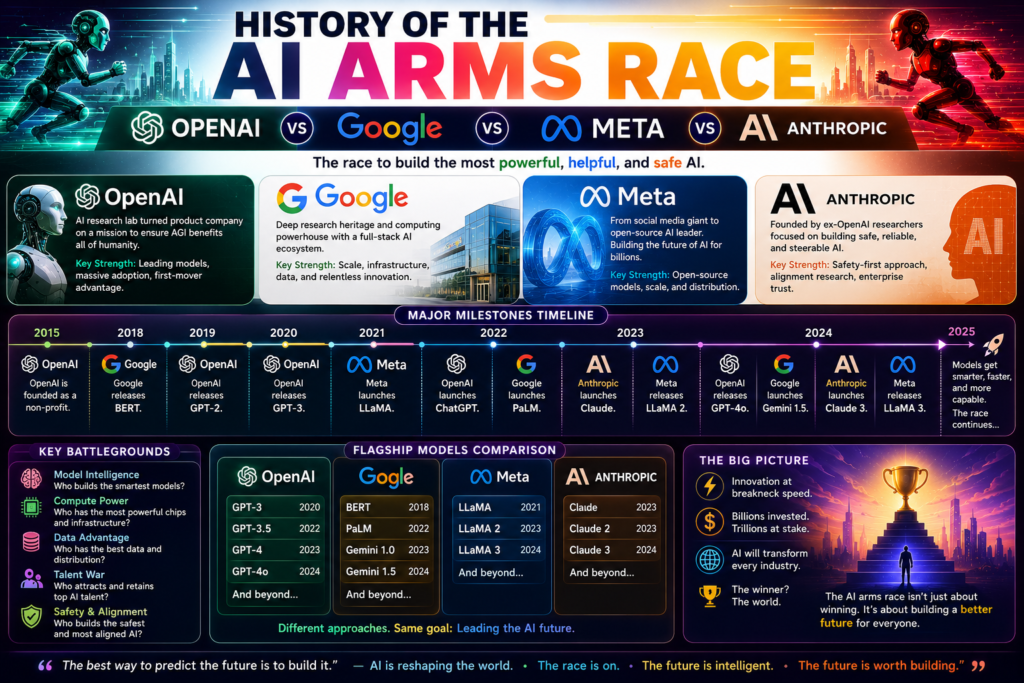
To truly appreciate the gravity of the current AI tech race, one must examine the fierce rivalries that shaped it. The battlefield is crowded, but the primary conflict boils down to a relentless four-way clash: OpenAI, Google, Meta, and Anthropic. This is the complete, unfiltered history of how these corporate entities turned cutting-edge research into an all-out global AI competition.
The Genesis of Modern Generative AI (2015 – 2022)
The foundation of today’s enterprise AI companies was not built overnight. For nearly a decade, the artificial intelligence ecosystem operated quietly inside elite academic circles and restricted corporate research labs. Tech industry competition initially centered on incremental advancements in image recognition, translation algorithms, and simple text prediction. However, a profound shift occurred in 2017 when Google researchers published a landmark paper introducing the Transformer architecture. This single breakthrough solved long-standing engineering bottlenecks and allowed neural networks to process vast amounts of language data simultaneously.
Seeing the immense paradigm shift on the horizon, visionary engineers and investors began organizing a new breed of AI research labs. OpenAI, initially founded as a non-profit organization, focused its early energy on developing large-scale generative models. The launch of early text-prediction engines showcased potential, but it was the quiet, relentless scaling of compute resources that set the stage for a massive disruption. During this period, deep cloud computing platforms began partnering closely with AI developers, turning raw processing hardware into the most valuable asset on Earth.
The public flashpoint arrived unexpectedly in late 2022. When OpenAI quietly released a conversational chat interface to the public, it triggered a tectonic shift in consumer software expectations. The product achieved an unprecedented chatgpt growth 100 million users in a matter of months, completely catching traditional Silicon Valley giants off guard. This explosive consumer adoption turned an underlying academic pursuit into a cutthroat corporate race, forcing legacy search monopolies and software conglomerates into an immediate defensive posture.
The Early Trajectory of OpenAI (2022 – 2023)
Following its historic consumer breakthrough, OpenAI rapidly transformed from an idealistic research lab into an aggressive commercial powerhouse. Backed by an intricate, multi-billion-dollar partnership with Microsoft, the startup secured a massive foundation of raw computational infrastructure. This allowed them to push the structural boundaries of machine learning far past their competitors. The corporate strategy focused entirely on rapid deployment, capturing market share before the rest of the tech industry competition could organize a coherent response.
In early 2023, the startup extended its technical lead by releasing its highly anticipated next-generation foundation model, gpt-4 history making it clear that generative text was only the beginning. This model showcased advanced reasoning, exceptional coding capabilities, and an uncanny ability to process complex standardized exams. By integrating this intelligence directly into enterprise software environments, OpenAI solidified its status as an undisputed market leader, forcing every major corporation to reconsider its long-term digital strategy.
However, this blistering pace of innovation brought significant internal friction. The tension between rapid commercialization and safe, aligned deployment caused a spectacular boardroom fracture late in the year. Although the executive leadership was quickly reinstated, the corporate drama highlighted a deeper, systematic issue plaguing all major ai arms race companies: the delicate, high-stakes balance between corporate profit, market dominance, and the ethical guardrails of transformative technology.
Google Awakens its Sleeping AI Giant (2023 – 2024)
For years, Google was viewed as the undisputed king of artificial intelligence, thanks to pioneering research out of its Google Brain and DeepMind divisions. However, the sudden, explosive popularity of consumer chatbots created an immediate existential crisis for the search giant. The public suddenly began comparing the static list of links provided by traditional search engines to the direct, synthesis-driven answers of conversational models. This sudden shift sparked intense chatgpt vs google search debates across Wall Street, threatening the core advertising revenue model that funded Google’s global empire.
Responding to this profound threat, the company declared an internal corporate emergency and consolidated its fragmented research divisions into a singular, unified unit known as Google DeepMind. The initial response was rocky, marred by hurried product announcements and public demonstrations that suffered from accuracy issues. Yet, critics severely underestimated the structural advantages built into Google’s vast corporate ecosystem. The tech giant possessed an unmatched repository of multimodal data, a massive consumer footprint via Android, and its own proprietary AI hardware tensor processing units.
By early 2024, Google successfully turned the tide with the full launch of its Gemini ecosystem. Rather than merely chasing text-based generation, Gemini was engineered from the ground up to be natively multimodal, effortlessly parsing text, audio, video, and code simultaneously. Google seamlessly injected these capabilities directly into its massive workspace applications, search results, and mobile operating systems. This aggressive integration proved that legacy technology giants could leverage their billions of existing users to counter the momentum of fast-moving startups.
Meta Disrupts the Market with Open Source (2023 – 2024)
While OpenAI and Google fought bitterly for control over proprietary, closed-source ecosystems, Meta adopted a completely different, highly disruptive strategy. Led by a firm belief that closed AI monopolies would stifle global innovation, Mark Zuckerberg positioned the social media giant as the ultimate champion of open science. By openly releasing the weights of its foundational models to the global developer community, Meta fundamentally altered the economics of the entire software sector.
The introduction of the Llama family of models sent shockwaves through the emerging AI startup competition. Suddenly, independent researchers, agile startups, and cost-conscious enterprise technology departments no longer needed to pay steep API access fees to proprietary providers. Instead, they could download, modify, and host world-class language models directly on their own private infrastructure. This brilliant counter-strategy effectively commoditized the underlying foundation models, shifting the primary competitive advantage away from the raw code and toward distribution, user context, and product execution.
Meta’s open-weights strategy was not merely an act of corporate altruism; it was a deeply calculated business maneuver. By crowdsourcing the optimization, security auditing, and fine-tuning of its models to millions of external developers, Meta drastically reduced its own engineering overhead. Furthermore, this approach ensured that the global artificial intelligence ecosystem grew natively compatible with Meta’s technical standards, safely neutralizing the risk of a closed ecosystem monopoly controlled by its primary Silicon Valley rivals.
Anthropic and the Safety Frontier (2023 – 2025)
As the primary ai arms race companies sprinted ahead to build increasingly massive models, a distinct intellectual counterweight emerged in the form of Anthropic. Founded by an elite group of former OpenAI safety researchers who departed over structural concerns regarding commercial acceleration, Anthropic built its entire identity around alignment, reliability, and corporate trust. The firm recognized that enterprise technology buyers were deeply hesitant to deploy generative models that suffered from unpredictable behavior, data leaks, or erratic outputs.
To address these corporate anxieties, Anthropic pioneered an innovative structural framework known as “Constitutional AI.” Instead of relying entirely on human feedback to correct bad behaviors, they trained their models to align themselves against a strict, written set of principles focused on helpfulness, harmlessness, and honesty. This meticulous focus on safety and predictable output rapidly attracted massive enterprise AI investment trends, securing multi-billion-dollar backing from cloud computing platforms like Amazon Web Services and Google Cloud.
Throughout 2024 and 2025, Anthropic proved that a safety-first ethos did not require sacrificing raw performance. Their Claude model series consistently set new industry benchmarks for advanced reasoning, masterful coding output, and complex long-context data analysis. By focusing heavily on the developer ecosystem and providing airtight security compliance, Anthropic successfully captured a massive share of the lucrative enterprise technology market, cementing its position as a primary pillar of the global AI competition.
The Landscape in 2026: Reasoning, Efficiency, and Global Rivals
By 2026, the tech industry competition moved completely past the era of simple conversational text chatbots. The frontier of artificial intelligence has shifted toward highly autonomous systems, test-time compute scaling, and hyper-efficient architecture paradigms. AI companies no longer compete solely on the sheer volume of data used during pre-training. Instead, the focus has pivoted to designing systems that can actively think, reason, and self-correct through complex multi-step problems before generating a single response.
The current landscape is defined by an absolute frenzy of model optimization and an intense battle over the foundational AI infrastructure providers. The financial stakes have grown so massive that the global technology race is closely tied to energy grids, semiconductor supply chains, and the construction of massive, nuclear-powered data centers. OpenAI has pushed hard into continuous reasoning frameworks with its latest model iterations, while Anthropic has vastly expanded its enterprise footprint by providing models capable of controlling computers directly to automate complex white-collar workflows. Simultaneously, Google has deeply embedded its advanced operating layer across billions of personal consumer devices worldwide.
The competitive landscape faced a massive geopolitical disruption in early 2025 and 2026 with the explosive rise of international open-weight challengers, most notably the China-based lab DeepSeek. By leveraging highly sophisticated Mixture-of-Experts (MoE) architectures and innovative reinforcement learning strategies, DeepSeek shocked the global AI funding landscape by training models that matched Western performance at a tiny fraction of the traditional hardware cost. This sudden development stripped away the assumption that sheer capital expenditure was the only path to the technical frontier, forcing American ai arms race companies to drastically lower their API pricing models and rapidly innovate on architectural efficiency to maintain their global innovation leadership.
Frequently Asked Questions (FAQs)
Which company is currently winning the AI arms race?
There is no single winner, as different companies dominate distinct sectors of the market. OpenAI leads in direct consumer mindshare and raw platform gravity through ChatGPT. Google dominates global scale, device integration, and multimodal data depth. Meta controls the open-weights developer ecosystem, while Anthropic leads in trusted enterprise applications and advanced reasoning capabilities.
What is the main difference between open-source and closed-source AI?
Closed-source AI models (like those from OpenAI and Google) are accessed exclusively via proprietary APIs, meaning the underlying code and architecture are hidden from the public. Open-source or open-weight models (like Meta’s Llama) allow developers to download, modify, run, and audit the model weights directly on their own private servers for free.
How do modern AI companies fund their massive infrastructure costs?
Frontier AI development requires billions of dollars for specialized hardware and energy. Startups like OpenAI and Anthropic fund these operations through massive equity investments and deeply integrated cloud partnerships with trillion-dollar tech giants like Microsoft and Amazon, who provide the necessary computational power in exchange for platform access and equity.
What are autonomous AI agents?
Autonomous AI agents represent the next major shift in technology, moving beyond simple text generation to active execution. These advanced systems can use external tools, browse the internet, write and execute code, and self-correct their mistakes over long periods to accomplish complex, open-ended tasks without constant human intervention.
Conclusion
The monumental clash between the primary ai arms race companies has permanently transformed the global technology sector. What began as a quiet, isolated academic pursuit inside specialized research labs has evolved into an unstoppable, multi-billion-dollar corporate crusade. The frantic competition between OpenAI, Google, Meta, and Anthropic has compressed a decade’s worth of software engineering into a few hyper-accelerated years, completely redefining how humanity interacts with computing infrastructure.
As these tech industry giants push further into the uncharted territory of autonomous agents and deep reasoning systems, the boundaries of human productivity will continue to expand. While the immense commercial rivalries will undoubtedly produce corporate winners and losers, the underlying technological breakthroughs will continue to radiate outward, permanently rewriting the economic realities of businesses worldwide and shaping the ultimate future of ai.