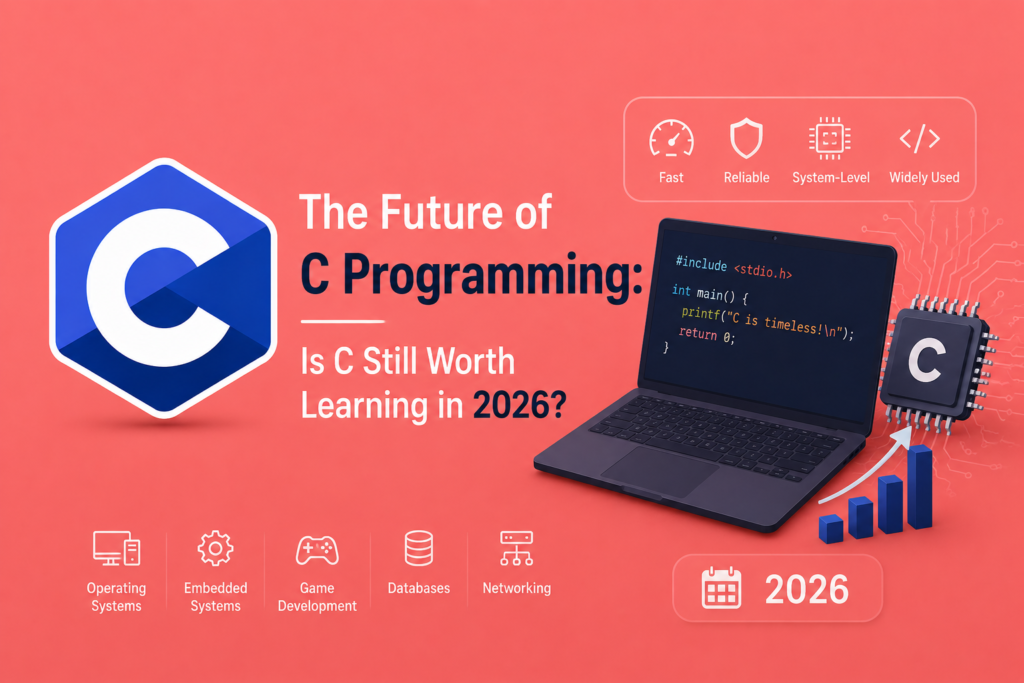
The future of c programming is a question that surfaces every few years with increasing urgency, and every time it does, the answer turns out to be the same: C is not going anywhere. In 2026, C remains one of the most actively used, most in-demand, and most foundational programming languages on the planet. The TIOBE index consistently ranks it among the top three languages worldwide. The Linux kernel, which powers the majority of the world’s servers, cloud infrastructure, and Android devices, is written in C. Every major embedded system from automotive controllers to aerospace computers runs C code. Every runtime engine for Python, Ruby, and PHP is implemented in C. The question is not whether C has a future. The question is why so many people keep expecting it not to, and what the real answer means for your programming career in 2026.
Why the Future of C Programming Keeps Getting Underestimated
The persistent prediction that C is about to die comes from a misunderstanding of what C actually does and why it occupies the specific niche it does. Critics point to memory safety vulnerabilities, the rise of Rust as a safer systems language, and the dominance of Python in new development as evidence that C’s days are numbered. These arguments sound compelling until you examine them carefully.
The future of c programming is secure not because programmers are nostalgic or resistant to change, but because C solves a specific category of problems better than any alternative: writing software that must run directly on hardware with no runtime overhead, no garbage collector, no virtual machine, and no dependency on any other software layer. That requirement has not diminished. It has expanded. The Internet of Things, robotics, autonomous vehicles, and satellite systems all create new demand for exactly the kind of software C specializes in.
The C programming legacy built by Dennis Ritchie at Bell Labs was not an accident. C was designed to solve real problems in a specific way, and that design has proven durable because the problems it solves are permanent features of computing, not temporary challenges that higher-level languages will eventually absorb.
The C23 Standard: C Is Actively Evolving
One of the most important facts about the future of c programming that critics consistently overlook is that C is not a frozen language maintained only for backward compatibility. The C23 standard, formally published as ISO/IEC 9899:2024, represents the most significant update to C in over two decades and demonstrates that the language is actively evolving to address modern concerns:
c:
/* C23 features: nullptr, typeof, and improved attributes */
#include <stdio.h>
#include <stddef.h>

[[nodiscard]] int compute_result(int input) {
    if (input < 0) return -1;
    return input * input;
}

int main(void) {
    /* nullptr replaces NULL with proper type safety */
    int *ptr = nullptr;

    /* typeof allows type deduction like modern languages */
    int x = 42;
    typeof(x) y = 100;   /* y is automatically int */

    /* constexpr for compile-time constants */
    constexpr int MAX_SIZE = 256;

    printf("y = %d, MAX_SIZE = %d\n", y, MAX_SIZE);

    /* Improved boolean - true and false are now keywords */
    bool flag = true;
    if (flag) {
        printf("Boolean keywords work without stdbool.h in C23\n");
    }

    /* The [[nodiscard]] attribute causes compiler warning if return ignored */
    int result = compute_result(5);
    printf("Result: %d\n", result);

    return 0;
}
C23 brings nullptr for type-safe null pointer initialization, typeof for type deduction, constexpr for compile-time constant evaluation, improved attribute syntax, built-in boolean keywords without requiring stdbool.h, and dozens of other additions that modernize the language while preserving complete backward compatibility. This is not the behavior of a dying language. It is the behavior of a language that takes its responsibilities to both innovation and stability seriously.
The Linux Kernel: The Ultimate Proof of C’s Longevity
No discussion of the future of c programming is complete without confronting the most powerful counterargument to every prediction of C’s demise: the Linux kernel. Linux is the most successful software project in computing history, running on the majority of the world’s servers, every Android device, most supercomputers, and an enormous portion of embedded and IoT infrastructure. It is written in C and has been for over thirty years:
c:
/* Simplified kernel-style data structure */
/* Linux uses linked lists extensively */
struct list_head {
    struct list_head *next;
    struct list_head *prev;
};

struct task_struct {
    int pid;
    int state;
    char comm[16];           /* Process name */
    struct list_head tasks;  /* Linked list of all processes */
    long priority;
    unsigned long flags;
};

/* Linux kernel list manipulation macros */
#define container_of(ptr, type, member) \
    ((type*)((char*)(ptr) - offsetof(type, member)))

/* Kernel-style initialization */
#define LIST_HEAD_INIT(name) { &(name), &(name) }
#define LIST_HEAD(name) struct list_head name = LIST_HEAD_INIT(name)
Linus Torvalds, who created Linux and continues to lead its development, has explicitly and repeatedly stated that the Linux kernel will not be rewritten in Rust or any other language. While some new Linux device drivers are being written in Rust experimentally, the core kernel infrastructure is C and will remain C because the cost and risk of replacement far exceed any theoretical benefit, and because C continues to do the job with exceptional effectiveness.
C vs Rust: Understanding the Real Relationship
The most sophisticated challenge to the future of c programming comes from Rust, a systems language that aims to provide C’s performance with compile-time memory safety guarantees. Understanding the real relationship between C and Rust reveals why Rust’s rise does not threaten C’s position:
c:
/* C: Direct memory management with developer responsibility */
#include <stdio.h>
#include <stdlib.h>
#include <string.h>

typedef struct Node {
    int value;
    struct Node *next;
} Node;

Node *create_node(int val) {
    Node *n = (Node*)malloc(sizeof(Node));
    if (n == NULL) return NULL;
    n->value = val;
    n->next = NULL;
    return n;
}

void free_list(Node *head) {
    while (head != NULL) {
        Node *temp = head;
        head = head->next;
        free(temp);
    }
}

int main(void) {
    Node *head = create_node(10);
    Node *second = create_node(20);
    Node *third = create_node(30);

    head->next = second;
    second->next = third;

    Node *current = head;
    while (current != NULL) {
        printf("%d ", current->value);
        current = current->next;
    }
    printf("\n");

    free_list(head);
    return 0;
}
Rust offers compelling advantages for new projects where memory safety is the primary concern and where the project has no existing C codebase to integrate with. But the future of c programming is not threatened by Rust for several concrete reasons. First, there are billions of lines of production C code in operating systems, embedded firmware, and infrastructure that will not be rewritten. Second, C’s toolchain ecosystem is far more mature, targeting every processor architecture including many that Rust does not support. Third, C’s learning resources, documentation, and community are vastly larger. Fourth, C compilers like GCC and Clang have become extraordinarily good at catching memory errors through sanitizers, static analysis, and warning flags.
C in Embedded Systems, IoT, and Robotics
The expanding universe of connected hardware represents one of the most exciting dimensions of the future of c programming. The Internet of Things is projected to connect tens of billions of devices by the end of the decade. Robotics is growing rapidly across manufacturing, logistics, healthcare, and exploration. Autonomous vehicles are becoming commercial reality. All of these domains depend fundamentally on C:
c:
/* IoT sensor node: reading and transmitting environmental data */
#include <stdint.h>
#include <stdbool.h>

/* Sensor data structure for IoT transmission */
typedef struct __attribute__((packed)) {
    uint32_t timestamp;
    int16_t  temperature_x10;   /* Temperature * 10 for 1 decimal place */
    uint16_t humidity_pct;       /* Humidity percentage */
    uint32_t pressure_pa;        /* Pressure in Pascals */
    uint8_t  battery_pct;        /* Battery percentage */
    uint8_t  flags;              /* Status flags */
} SensorPacket;

/* Bit manipulation for status flags */
#define FLAG_TEMP_VALID   (1 << 0)
#define FLAG_HUM_VALID    (1 << 1)
#define FLAG_PRESS_VALID  (1 << 2)
#define FLAG_LOW_BATTERY  (1 << 7)

SensorPacket build_packet(int16_t temp, uint16_t hum,
                          uint32_t press, uint8_t battery) {
    SensorPacket pkt = {0};
    pkt.temperature_x10 = temp;
    pkt.humidity_pct    = hum;
    pkt.pressure_pa     = press;
    pkt.battery_pct     = battery;

    pkt.flags |= FLAG_TEMP_VALID;
    pkt.flags |= FLAG_HUM_VALID;
    pkt.flags |= FLAG_PRESS_VALID;
    if (battery < 20) pkt.flags |= FLAG_LOW_BATTERY;

    return pkt;
}

int main(void) {
    /* Simulate sensor readings */
    SensorPacket packet = build_packet(
        235,        /* 23.5 degrees Celsius */
        65,         /* 65% humidity */
        101325,     /* Standard atmospheric pressure */
        85          /* 85% battery */
    );

    /* Verify packet size for transmission */
    printf("Packet size: %zu bytes\n", sizeof(SensorPacket));
    printf("Temperature: %.1f C\n", packet.temperature_x10 / 10.0);
    printf("Humidity: %d%%\n", packet.humidity_pct);
    printf("Battery: %d%%\n", packet.battery_pct);
    printf("Flags: 0x%02X\n", packet.flags);

    return 0;
}
This kind of compact, efficient, hardware-aware code is exactly what IoT devices require. A sensor node running on a coin battery for several years cannot afford Python’s memory overhead or Java’s runtime requirements. C gives it native execution speed, minimal memory footprint, and direct control over the radio transmission protocol. The future of c programming in IoT and robotics is not speculative. It is already the default choice and the demand is growing.
The Job Market for C Developers in 2026
The future of c programming in career terms is strong, specialized, and well-compensated. C developer positions in 2026 cluster in domains where the language is irreplaceable: embedded systems engineering, firmware development, automotive software, aerospace and defense, real-time operating systems, Linux kernel development, compiler engineering, and safety-critical systems.
These positions consistently command competitive salaries precisely because C expertise at a professional level is genuinely difficult to develop and the talent pool is smaller than for higher-level languages. A senior embedded C engineer or a Linux kernel developer with deep C expertise is not competing in a crowded market. They are competing in a specialized market where their skills are genuinely rare and genuinely necessary.
The TIOBE index, the industry-standard ranking of programming language popularity based on search engine data, consistently places C in the top two or three languages globally, alongside Python and Java. For a language that critics have been predicting would die for thirty years, this ranking reflects an extraordinary staying power rooted in genuine, ongoing demand.
Why Learning C in 2026 Makes You a Better Developer at Everything Else
One of the most powerful arguments for the future of c programming as a learning investment is the transferable depth it builds. Learning C forces you to confront computing realities that higher-level languages hide: how memory is actually allocated and freed, what a pointer really is, how data types map to hardware, what the processor is actually doing when it executes your code. This understanding is permanently useful:
c:
/* Understanding memory layout through C */
#include <stdio.h>
#include <string.h>

int main(void) {
    /* Stack vs heap demonstration */
    int stack_var = 42;            /* On the stack */
    int *heap_var = malloc(sizeof(int));  /* On the heap */
    *heap_var = 100;

    /* Pointer arithmetic reveals memory layout */
    int arr[5] = {10, 20, 30, 40, 50};
    int *p = arr;

    printf("Array traversal with pointers:\n");
    int i;
    for (i = 0; i < 5; i++) {
        printf("arr[%d] at %p = %d\n", i, (void*)(p + i), *(p + i));
    }

    /* String as char array - no magic */
    char greeting[] = "Hello, C!";
    printf("\nString as chars:\n");
    for (i = 0; greeting[i] != '\0'; i++) {
        printf("greeting[%d] = '%c' (ASCII %d)\n",
               i, greeting[i], (int)greeting[i]);
    }

    printf("\nStack var at: %p\n", (void*)&stack_var);
    printf("Heap var at:  %p\n", (void*)heap_var);
    printf("Array at:     %p\n", (void*)arr);

    free(heap_var);
    return 0;
}
Python developers who learn C understand why dictionary lookups are O(1) rather than O(n). Java developers who learn C understand why garbage collection pauses happen and how to minimize their impact. JavaScript developers who learn C understand why certain numerical operations produce unexpected results. C is the Rosetta Stone of computing that makes every other language more understandable.
The Argument Against Replacing C: Performance and Trust
A critical factor in the future of c programming that discussions of replacement languages frequently underweight is the trust dimension. C code that has been running in production for decades has been tested, debugged, profiled, and hardened against an enormous range of real-world conditions. The performance characteristics of mature C codebases are deeply understood.
Rewriting that code in any other language, Rust, Go, or anything else, introduces risk that organizations managing critical infrastructure are extremely reluctant to accept. Medical device firmware, aviation flight control software, nuclear plant monitoring systems, and financial trading infrastructure all run C code that has proven its reliability under real conditions. The argument for rewriting such systems must overcome not just the cost of rewriting but the demonstrated track record of the existing implementation.
c:
/* Real-time deadline monitoring - common in safety-critical C systems */
#include <stdio.h>
#include <time.h>

typedef struct {
    const char *task_name;
    long        deadline_us;    /* Deadline in microseconds */
    long        execution_us;   /* Actual execution time */
    int         missed;         /* Whether deadline was missed */
} TaskMetrics;

void evaluate_tasks(TaskMetrics *tasks, int count) {
    int i;
    int total_missed = 0;

    printf("%-20s %12s %12s %8s\n",
           "Task", "Deadline(us)", "Actual(us)", "Status");
    printf("%s\n",
           "------------------------------------------------------");

    for (i = 0; i < count; i++) {
        tasks[i].missed = tasks[i].execution_us > tasks[i].deadline_us;
        if (tasks[i].missed) total_missed++;

        printf("%-20s %12ld %12ld %8s\n",
               tasks[i].task_name,
               tasks[i].deadline_us,
               tasks[i].execution_us,
               tasks[i].missed ? "MISSED" : "OK");
    }

    printf("\nDeadlines met: %d/%d (%.1f%%)\n",
           count - total_missed, count,
           100.0 * (count - total_missed) / count);
}

int main(void) {
    TaskMetrics tasks[] = {
        {"Sensor Read",   500,  423, 0},
        {"Data Filter",  1000,  891, 0},
        {"PID Control",   250,  267, 0},   /* This one misses */
        {"CAN Transmit", 2000, 1756, 0},
        {"Fault Check",   100,   87, 0}
    };

    evaluate_tasks(tasks, 5);
    return 0;
}
Connecting the Future to the Foundation
Understanding the future of c programming is most meaningful when it connects to the complete knowledge base that C represents. Every advanced topic in modern C development, from the memory safety improvements in C23 to the real-time scheduling in embedded RTOS environments, builds on the fundamentals that make C what it is.
For those just beginning, C programming for beginners starts the journey at the right level, building the pointer and memory intuition that makes advanced concepts accessible. The progression through C syntax basics, control flow, functions, and pointers creates the foundation that professional C work requires.
The connection between C and the languages that followed it illuminates why C’s future is tied to software’s future as a whole. The comparison of C vs C++ reveals how C’s successor built directly on its strengths. C vs Python and C vs Java show how both of those massively popular languages depend on C infrastructure at their cores.
The C programming legacy is not simply historical context. It is the living foundation on which the digital infrastructure of 2026 operates. When you understand that foundation through studying and practicing C, you understand modern computing at a level that no higher-level language alone can provide. Dennis Ritchie’s creation has outlasted every prediction of its obsolescence because it solves real problems that have not gone away, and the future of c programming reflects that enduring reality.
Frequently Asked Questions
Is C Still Worth Learning in 2026?
Absolutely. C remains in the top three languages on the TIOBE index, powers the Linux kernel, dominates embedded systems and IoT development, and forms the runtime foundation for Python, Ruby, and PHP. Learning C builds fundamental programming understanding that transfers to every other language. For career paths in embedded systems, firmware, operating systems, automotive, aerospace, and safety-critical software, C is not just worth learning. It is essential.
Will Rust Replace C in the Future?
Rust is an impressive language with genuine memory safety advantages for new systems software projects. However, Rust will not replace C in the foreseeable future for several concrete reasons: billions of lines of production C code will not be rewritten, C’s toolchain targets every processor architecture including many Rust does not support, the Linux kernel continues to be developed in C with only limited Rust experiments for new drivers, and C’s fifty-year ecosystem of libraries, tools, and expertise cannot be replicated quickly. Rust and C will coexist, each serving contexts where their respective strengths matter most.
What Is the C23 Standard and Why Does It Matter?
C23, formally published as ISO/IEC 9899:2024, is the most significant update to the C standard since C99. It introduces nullptr for type-safe null pointers, typeof for type deduction, constexpr for compile-time constants, built-in boolean keywords without header inclusion, improved attribute syntax for compiler hints, and dozens of other modernizations. C23 demonstrates that C is actively maintained and evolving to address contemporary programming concerns while preserving the backward compatibility that its enormous installed base requires.
What Career Opportunities Exist for C Programmers in 2026?
C programmers in 2026 find strong demand in embedded systems engineering, firmware development, automotive and aerospace software, Linux kernel development, IoT device programming, robotics, real-time operating systems, compiler development, and safety-critical systems. These specialized positions typically offer competitive compensation because C expertise at a professional level is genuinely difficult to develop and the qualified talent pool is smaller than for higher-level languages. C skills are also highly valued in cybersecurity for vulnerability research, exploit development, and reverse engineering.
Does Learning C Before Other Languages Make You a Better Programmer?
Yes, and this is one of the most consistently reported experiences among experienced developers. Learning C forces direct engagement with memory management, type systems, pointer arithmetic, and hardware-level thinking that higher-level languages abstract away. Developers who learn C first or who add C to their skillset after learning other languages consistently report that their understanding of what their higher-level code is actually doing improves dramatically. Python developers understand CPython’s performance characteristics. Java developers understand garbage collection trade-offs. JavaScript developers understand numerical precision issues. C provides the explanatory foundation for all of these.
Conclusion
The future of c programming in 2026 and beyond is neither threatened nor uncertain. It is robust, active, and deeply embedded in the infrastructure of the modern digital world. C is being actively standardized with C23 bringing meaningful modernization. The Linux kernel, the world’s most successful software project, is written in C and will remain so. Embedded systems, IoT devices, robotics, automotive software, aerospace firmware, and safety-critical infrastructure all depend on C and that dependence is growing as these fields expand.
The competition from Rust is real and healthy. Rust will capture some portion of new systems software development, particularly where memory safety guarantees are the primary requirement and no existing C codebase is involved. But Rust is not replacing C any more than C++ replaced C over the past forty years. Both have coexisted and both will continue to.
The future of c programming is ultimately determined by the same factor that has always determined it: C solves a specific set of problems better than anything else. Direct hardware access, native execution speed, minimal runtime footprint, deterministic memory behavior, and portability across every processor architecture are capabilities that C provides uniquely well. As long as those capabilities are needed, which is to say as long as computers have hardware that software must control, the future of c programming is secure.
Learn C in 2026. Learn it not because it is trendy or because it will make your resume look impressive, although it will. Learn it because the understanding you gain will be permanent, foundational, and applicable to every programming challenge you will face for the rest of your career. The C programming legacy is not just history. It is the ground beneath every layer of software you have ever used.