Introduction
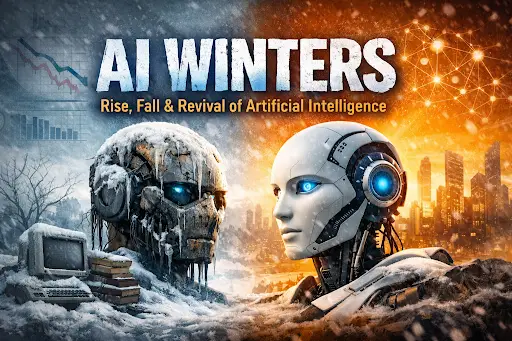
Artificial intelligence has experienced extraordinary progress in recent decades, but its development has not always been smooth. Throughout the history of computing, there have been periods when excitement around AI faded and research funding declined dramatically. These downturns are known as AI winters.
An AI winter describes a time when expectations about artificial intelligence exceed technological reality. When promised breakthroughs fail to appear, governments, universities, and companies begin reducing investment in AI research.
These periods of disappointment slowed the progress of artificial intelligence, yet they also played an important role in shaping the field. By forcing researchers to rethink their strategies, AI winters ultimately contributed to the development of modern machine learning systems.
Understanding these challenging periods helps explain why artificial intelligence took decades to reach the capabilities we see today.
What Is an AI Winter in Artificial Intelligence?
An AI winter refers to a period when enthusiasm, funding, and research activity in artificial intelligence decline significantly. These downturns usually occur when early optimism about AI capabilities fails to match real-world technological progress.
During an AI winter, organizations reduce financial support for research projects, academic institutions shift their focus to other areas of computer science, and public confidence in AI decreases.
Although these periods slow innovation, they often encourage researchers to explore new methods and rethink existing ideas. Many of the breakthroughs that revived AI in later decades were developed during or shortly after these difficult periods.
Early Optimism in AI Research
In the 1950s and 1960s, artificial intelligence was one of the most exciting new fields in computer science. Researchers believed machines could soon perform tasks that required human reasoning.
A pivotal moment occurred at the Dartmouth Conference in 1956, where scientists officially introduced the concept of artificial intelligence as a research discipline. Participants believed that computers might achieve human-level intelligence within a few decades.
Early AI programs appeared promising. Computers were able to solve mathematical problems, prove logical theorems, and play strategy games such as checkers.
These systems relied on symbolic reasoning, often called symbolic AI. Instead of learning from data, these programs used predefined rules to simulate intelligent behavior.
While these early demonstrations impressed researchers, they worked only under controlled conditions. When scientists attempted to apply them to complex real-world situations, serious limitations became clear.
Timeline of AI Winters
The development of artificial intelligence includes two major periods of declining interest and funding.
1956 — Dartmouth Conference sparks widespread enthusiasm about artificial intelligence research.
1974–1980 — The first AI winter begins after critical reports question the progress of AI projects.
1980–1987 — Expert systems temporarily revive interest in artificial intelligence.
1987–1993 — The second AI winter occurs following the collapse of commercial expert system investments.
2000s — Advances in computing power and machine learning begin restoring confidence in AI research.
This timeline illustrates how expectations and technological progress have repeatedly shaped the trajectory of AI development.
The First AI Winter (1974–1980)
The first AI winter began in the mid-1970s after several influential reports criticized the limited achievements of AI research.
One of the most notable evaluations was the Lighthill Report in the United Kingdom. It concluded that many AI systems could not scale beyond small demonstration problems.
As a result, government agencies reduced research funding. Universities redirected their resources toward other areas of computing, and enthusiasm for AI began to fade.
Causes of the First AI Winter
Several factors contributed to this decline.
Computers at the time lacked sufficient processing power for advanced AI systems.
Large datasets required for machine learning experiments were not available.
Researchers had made overly optimistic predictions about the speed of progress.
Symbolic AI programs struggled with tasks involving uncertainty and real-world complexity.
These limitations led many decision-makers to question whether artificial intelligence research was worth continued investment.
The Rise of Expert Systems
Despite the decline in funding, AI research did not stop. During the late 1970s and early 1980s, a new approach called expert systems brought renewed attention to the field.
Expert systems attempted to replicate the knowledge of human specialists by storing large collections of rules. These rules allowed computers to analyze problems and provide recommendations.
For example, medical expert systems helped doctors identify diseases by comparing symptoms with known diagnostic rules.
Businesses began adopting these systems for industrial troubleshooting, financial analysis, and medical support.
For a time, expert systems appeared to demonstrate the practical value of AI.
However, the technology soon revealed significant limitations.
The Second AI Winter (1987–1993)
The second AI winter began in the late 1980s when many expert system projects failed to deliver expected benefits.
Organizations discovered that maintaining large rule-based systems required extensive manual effort. Updating thousands of rules became expensive and time-consuming.
In addition, expert systems lacked flexibility. When circumstances changed, the systems often produced unreliable results.
Factors Behind the Second AI Winter
Several challenges contributed to the second downturn.
Expert systems were expensive to develop and maintain.
Rule-based systems could not easily adapt to new situations.
Many companies failed to see clear financial returns from AI investments.
Computing hardware still limited the scale of AI experimentation.
As businesses withdrew support, funding for artificial intelligence research declined once again.
The Gradual Recovery of AI
Although interest in AI declined during the early 1990s, research continued in universities and specialized laboratories.
Scientists began exploring new methods that allowed computers to learn patterns directly from data instead of relying solely on human-written rules.
This approach became known as machine learning. Researchers designed algorithms capable of improving their performance as they processed more information.
Important groundwork had already been established through research in early machine learning, which provided the theoretical basis for modern learning systems.
As digital data expanded and computational power increased, these techniques gradually became more practical.
Machine Learning and the End of AI Winters
By the early 2000s, machine learning began transforming the field of artificial intelligence.
Several technological developments played a key role in this revival.
Faster processors enabled researchers to train larger models.
The internet generated massive datasets that algorithms could analyze.
Improved statistical techniques allowed machines to recognize patterns in complex data.
These advances led to rapid progress in areas such as:
Speech Recognition
Image Classification
Recommendation Systems
Later breakthroughs in neural networks and deep learning further expanded these capabilities.
The success of modern AI systems demonstrated that many early ideas had been correct, but the technology needed decades to mature.
Why AI Winters Were Important
Although AI winters slowed progress, they also produced valuable lessons for researchers.
They highlighted the risks of unrealistic expectations about technological breakthroughs.
They encouraged scientists to explore alternative approaches beyond symbolic reasoning.
They demonstrated the importance of computational resources and large datasets for training intelligent systems.
Many ideas proposed in the early decades of AI only became practical once computing power and data availability improved.
These lessons helped shape the modern landscape of artificial intelligence research.
Lessons Learned from AI Winters
The history of AI winters provides important insights for future technological development.
One key lesson is the importance of managing expectations. Overly optimistic predictions can damage confidence in emerging technologies.
Another lesson involves the role of infrastructure. Many early AI concepts required computing power and data resources that simply did not exist at the time.
AI winters also encouraged innovation by pushing researchers to explore new directions such as statistical learning and neural networks.
These alternative approaches eventually led to the powerful machine learning systems used today.
Frequently Asked Questions (FAQs)
What is an AI winter?
An AI winter is a period when interest and funding for artificial intelligence research decline due to technological limitations or unmet expectations.
How many AI winters occurred?
Most historians identify two major AI winters. The first occurred between 1974 and 1980, and the second between 1987 and 1993.
What caused AI winters?
The main causes included unrealistic expectations, limited computing power, insufficient data, and the limitations of early AI systems.
Did AI research stop during AI winters?
No. Although funding decreased, research continued in universities and laboratories, eventually leading to breakthroughs in machine learning.
Why did artificial intelligence recover?
Advances in computing power, large datasets, and improved machine learning algorithms allowed researchers to overcome earlier technological limitations.
Conclusion
The history of AI winters shows that technological progress often follows cycles of excitement and skepticism. Early researchers believed intelligent machines would appear quickly, but real-world complexity slowed that progress.
These difficult periods forced the scientific community to rethink its assumptions and develop better approaches to building intelligent systems.
Today’s artificial intelligence technologies are the result of decades of experimentation, setbacks, and renewed innovation. The lessons learned during AI winters helped guide researchers toward the machine learning techniques that power modern AI applications.
Understanding these historical challenges provides valuable perspective on how artificial intelligence evolved and why its greatest breakthroughs arrived only after years of persistence and research.