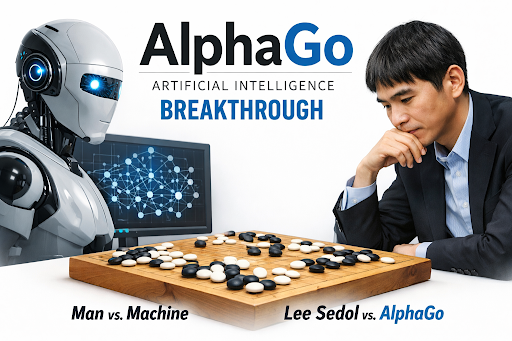
The AlphaGo Artificial Intelligence Breakthrough stands as one of the most revolutionary milestones in modern AI history. When Google DeepMind’s AlphaGo defeated world champion Lee Sedol in 2016, it stunned experts and redefined what machines could achieve.
Unlike earlier AI systems that relied on brute-force computing, AlphaGo introduced a new paradigm by combining neural networks with advanced search algorithms. This breakthrough proved that machines could learn intuition-like decision-making—something once believed to be uniquely human.
The AlphaGo Artificial Intelligence Breakthrough was not just about winning a game—it marked the arrival of a new era in artificial intelligence, where learning systems could tackle highly complex, real-world problems.
The Go Challenge: A Googol Times Harder Than Chess
The game of Go has long been considered one of the most challenging board games ever created. Its complexity made it the ultimate test for artificial intelligence.
The Complexity of 10 to the Power of 170 Configurations
Go has approximately 10^170 possible board configurations—far exceeding the number of atoms in the observable universe.
This immense complexity is why many experts believed AI would take decades longer to master Go compared to chess.
The AlphaGo Artificial Intelligence Breakthrough proved those predictions wrong, demonstrating that new AI approaches could handle even the most complex decision spaces.
Why Traditional Brute-Force Fails in the Game of Go
Unlike chess, where brute-force search can evaluate millions of moves, Go requires intuition and pattern recognition.
Traditional brute-force systems fail because:
The search space is too vast
Moves cannot be evaluated purely mathematically
Long-term strategy matters more than immediate gains
This challenge forced researchers to move beyond classical approaches and explore machine learning techniques.
These developments aligned with ideas discussed in the rise of neural networks, where learning-based systems began outperforming rule-based models.
The DeepMind Architecture: Merging Neural Networks with Search
The AlphaGo Artificial Intelligence Breakthrough was made possible by a unique architecture that combined neural networks with search algorithms.
Policy Networks: Learning Where to Move
Policy networks were designed to predict the most promising moves in a given position.
Instead of evaluating every possible move, the system learned from expert human games and improved through self-play.
This approach allowed AlphaGo to narrow down its choices efficiently.
The success of policy networks reflects advances in the evolution of machine learning algorithms, where systems learn patterns directly from data rather than relying on manual rules.
Value Networks: Predicting the Winner
Value networks were responsible for predicting the outcome of a game from a given board position.
This allowed AlphaGo to evaluate long-term strategies instead of focusing only on immediate gains.
Together with Monte Carlo Tree Search (MCTS), policy and value networks enabled AlphaGo to explore possible game scenarios effectively.
This combination was the core of the AlphaGo Artificial Intelligence Breakthrough.
The 2016 Match: AlphaGo vs. the Legendary Lee Sedol
The DeepMind AlphaGo vs Lee Sedol match in 2016 became a defining moment in AI history.
Lee Sedol, one of the greatest Go players of all time, was expected to defeat the AI.
Instead, AlphaGo won 4–1, shocking the world.
Move 37: The Moment AI Showed “Creativity”
In Game 2, AlphaGo played Move 37—a move so unconventional that it stunned professional players.
Experts initially believed the move was a mistake.
However, it turned out to be a brilliant strategic decision.
This moment became a symbol of the AlphaGo Artificial Intelligence Breakthrough, showing that AI could generate creative solutions beyond human expectations.
The Human Response: Lee Sedol’s “God’s Touch” in Game 4
Despite losing most of the match, Lee Sedol delivered a stunning move in Game 4, known as “God’s Touch” (Move 78).
This move caught AlphaGo off guard and secured Sedol’s only victory.
It demonstrated that human intuition still had unique strengths, even in the face of advanced AI systems.
The AlphaGo Artificial Intelligence Breakthrough was not just about machine dominance—it also highlighted the beauty of human creativity.
Beyond the Board: The Technical Legacy of AlphaGo
The AlphaGo Artificial Intelligence Breakthrough had far-reaching implications beyond the game of Go.
From AlphaGo to AlphaZero: Achieving General Mastery
DeepMind later developed AlphaZero, an advanced system capable of learning multiple games—including chess and Go—without human data.
AlphaZero trained entirely through self-play, achieving superhuman performance in a short time.
This evolution marked a major Reinforcement Learning breakthrough and demonstrated the potential for general AI systems.
The success of AlphaZero is closely tied to reinforcement learning history, where systems learn by interacting with environments and improving over time.
Real-World Applications: Protein Folding and Energy Efficiency
The techniques developed for AlphaGo have been applied to real-world problems.
DeepMind’s AlphaFold system uses similar approaches to predict protein structures, revolutionizing biology and medicine.
These advancements connect with AI in healthcare history and evolution, where AI is transforming medical research and diagnostics.
Additionally, AI systems inspired by AlphaGo are being used to optimize energy usage in data centers and solve complex optimization problems.
The AlphaGo Artificial Intelligence Breakthrough has therefore influenced multiple industries beyond gaming.
A New Paradigm: Learning Over Programming
One of the most important lessons from the AlphaGo Artificial Intelligence Breakthrough is the shift from programming to learning.
Instead of explicitly coding rules, researchers now build systems that learn from data and experience.
This shift is also reflected in modern techniques such as self supervised learning in artificial intelligence, where AI models train themselves using vast amounts of unlabeled data.
The success of AlphaGo reinforced the idea that intelligence can emerge from learning processes rather than predefined instructions.
Frequently Asked Questions (FAQs)
What is the AlphaGo Artificial Intelligence Breakthrough?
It refers to DeepMind’s AlphaGo defeating world champion Lee Sedol in 2016, demonstrating advanced AI capabilities using neural networks and reinforcement learning.
Why is Go harder than chess for AI?
Go has vastly more possible configurations, making brute-force search ineffective and requiring advanced learning-based approaches.
What made AlphaGo different from previous AI systems?
AlphaGo combined policy networks, value networks, and Monte Carlo Tree Search to learn strategies rather than relying purely on computation.
What is Move 37?
Move 37 was an unexpected and highly creative move played by AlphaGo during Game 2, surprising experts and demonstrating AI innovation.
How did AlphaGo influence modern AI?
It advanced reinforcement learning techniques and inspired applications in healthcare, optimization, and scientific research.
Conclusion
The AlphaGo Artificial Intelligence Breakthrough marked a historic turning point in artificial intelligence.
By mastering one of the most complex games ever created, AlphaGo proved that machines could learn, adapt, and even display creativity.
This achievement reshaped AI research, moving the field toward learning-based systems capable of solving real-world challenges.
Today, the legacy of AlphaGo continues to influence cutting-edge technologies and innovations, shaping the Future of Artificial Intelligence Technology and redefining what machines can achieve.