Introduction
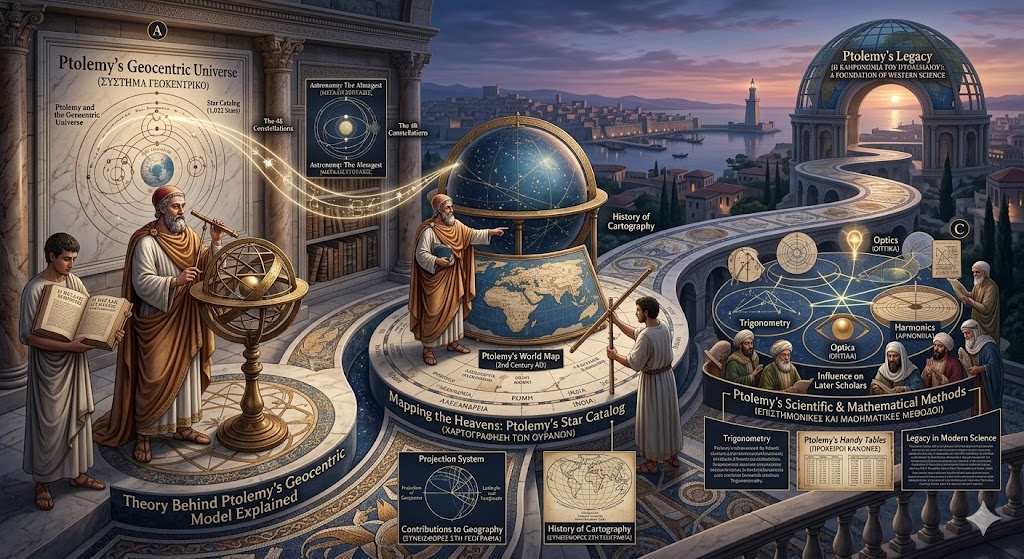
Ptolemy’s geocentric model is one of the most famous theories in the history of astronomy. Developed by Claudius Ptolemy during the second century CE, this model placed Earth at the center of the universe and explained how the Sun, Moon, planets, and stars move around it. For more than a thousand years, Ptolemy’s geocentric model was accepted as the correct description of the cosmos.
The idea of an Earth centered universe was not entirely new when Ptolemy developed his theory. However, what made Ptolemy’s geocentric model unique was the mathematical precision used to describe planetary motion. By combining observation and geometry, Ptolemy created a detailed system that could predict the movements of celestial bodies.
In the broader context of ancient Greek astronomy, this model became the dominant explanation for the structure of the universe. The Ptolemaic system shaped scientific thinking in Europe, the Islamic world, and many other regions for centuries.
Ptolemy’s work was part of a much larger body of research. Readers interested in his broader discoveries can explore Ptolemy Contributions to Astronomy, which highlights the full range of his scientific achievements.
The Origins of the Geocentric Idea
The concept behind Ptolemy’s geocentric model has roots in early Greek philosophy. Ancient thinkers such as Aristotle believed that Earth remained motionless at the center of the cosmos. This belief formed the basis of the history of geocentric theory.
According to this worldview, the heavens moved in perfect circular paths around Earth. This idea seemed logical because observers on Earth could see the Sun rise and set, stars move across the sky, and planets change positions over time.
When Claudius Ptolemy began studying astronomy in Alexandria, he built upon these earlier ideas. His goal was not simply to repeat earlier theories but to refine them mathematically.
Through careful calculations, Ptolemy’s geocentric model provided a structured explanation of the Ptolemaic universe structure, allowing astronomers to predict celestial motion more accurately than before.
Much of this research was described in his famous book discussed in Almagest: Mapping the Heavens, where the full mathematical system was presented.
Basic Structure of the Geocentric Model
At the center of Ptolemy’s geocentric model lies the belief that Earth remains stationary while all celestial bodies move around it. This structure created what is known as the Earth centered universe.
In the Ptolemy astronomy model, the Sun, Moon, and planets revolve around Earth in large circular paths. Surrounding these bodies are distant stars that form a celestial sphere.
This structure became known as the Ptolemaic system, and it dominated astronomical thought for centuries.
The simplicity of placing Earth at the center made the theory appealing to many scholars. However, the actual motion of planets turned out to be far more complicated than simple circular movement.
To solve these complications, Ptolemy’s geocentric model introduced additional mathematical tools that improved the accuracy of predictions.
The Problem of Planetary Motion
One of the biggest challenges for ancient astronomers was explaining the strange behavior of planets in the sky. Observers noticed that planets sometimes appeared to move backward relative to the stars.
This phenomenon is known as retrograde motion planets, and it puzzled astronomers for centuries.
If planets moved in simple circular orbits around Earth, such backward motion should not occur. Yet observations clearly showed that it did.
To solve this problem, Ptolemy’s geocentric model introduced a more complex mathematical explanation. By adjusting the geometry of planetary paths, the system could reproduce the unusual patterns seen in the sky.
This solution became one of the most important achievements of Claudius Ptolemy astronomy.
Epicycles and Deferents
The key to understanding Ptolemy’s geocentric model lies in the concepts of epicycle and deferent. These geometric tools allowed astronomers to describe planetary motion more accurately.
In the Ptolemaic system, each planet moved along a small circle called an epicycle. At the same time, the center of that epicycle traveled along a larger circle called a deferent around Earth.
This complex arrangement helped explain retrograde motion planets, which appeared to move backward when viewed from Earth.
The combination of epicycle and deferent became the foundation of the Ptolemy planetary motion model.
Even though this system seems complicated today, it allowed astronomers to predict planetary positions with remarkable precision.
Mathematical Precision in Ptolemy’s Model
One reason Ptolemy’s geocentric model remained influential for so long was its mathematical accuracy. Ptolemy used geometry and observations to calculate planetary positions across the sky.
His methods allowed astronomers to create detailed astronomical tables used for navigation and calendar calculations.
The system described in the Ptolemy Almagest geocentric model became the standard framework for studying astronomy for centuries.
Ptolemy’s work also included careful observations of stars and celestial bodies. These observations are explored further in Star Catalog and Its Impact, which describes how star mapping advanced astronomy.
The mathematical approach used in Ptolemy’s geocentric model helped transform astronomy into a predictive science.
Influence on Medieval and Islamic Astronomy
The impact of Ptolemy’s geocentric model extended far beyond the ancient Greek world. During the medieval period, scholars in the Islamic world translated Ptolemy’s works and expanded upon them.
This era, often associated with great advancements in astronomy, relied heavily on the Ptolemaic system.
Astronomers improved observational instruments and refined calculations based on Ptolemy’s geocentric model.
Later, these ideas spread into medieval Europe, where universities taught the Ptolemaic system as the standard explanation of the universe.
Readers interested in this historical transmission can explore Influence on Medieval Astronomy, which explains how Ptolemy’s ideas shaped global scientific traditions.
The Shift Toward a New Model
Despite its success, Ptolemy’s geocentric model eventually faced challenges. During the Renaissance, astronomers began questioning the idea of an Earth centered universe.
Nicolaus Copernicus proposed a revolutionary theory that placed the Sun at the center of the solar system. This new approach created the debate known as geocentric vs heliocentric model.
Although the heliocentric theory eventually replaced the Ptolemaic system, the earlier model remained historically important.
Even scientists who supported the new model often relied on mathematical techniques first developed in Ptolemy’s geocentric model.
Legacy of Ptolemy’s Geocentric Model
The long-lasting influence of Ptolemy’s geocentric model demonstrates its importance in the history of astronomy. For more than fourteen centuries, it shaped how scholars understood the structure of the universe.
The theory also contributed to other scientific fields. For example, Ptolemy’s work in geography helped develop mapping systems described in Contributions to Geography.
Because his ideas remained dominant for so long, many historians describe Ptolemy as an Authority for Centuries in astronomy.
Even though modern science has replaced the geocentric system, the intellectual legacy of Ptolemy’s geocentric model continues to influence how historians study the development of astronomy.
Frequently Asked Questions (FAQs)
What is Ptolemy’s geocentric model?
Ptolemy’s geocentric model is a theory that places Earth at the center of the universe while the Sun, Moon, planets, and stars orbit around it.
Who created the geocentric model?
Claudius Ptolemy developed the most detailed version of the geocentric theory during the second century CE.
What are epicycles in Ptolemy’s model?
Epicycles are small circular paths that planets follow while moving along larger orbits around Earth.
Why was the geocentric model accepted for so long?
The model could accurately predict planetary motion and matched everyday observations of the sky.
What replaced the geocentric model?
The heliocentric model proposed by Copernicus eventually replaced the geocentric theory.
Conclusion
The story of Ptolemy’s geocentric model represents one of the most fascinating chapters in the development of scientific thought. By combining observation with mathematical reasoning, Claudius Ptolemy created a detailed system that explained planetary motion for centuries.
Although modern astronomy has replaced the Earth centered universe with the heliocentric model, the scientific methods developed in Ptolemy’s geocentric model helped shape the evolution of astronomy.
Through its influence on scholars across different civilizations, this remarkable theory remains a cornerstone in the history of astronomy.