Introduction
The Archimedes Principle is one of the most important discoveries in the history of physics. First described by Archimedes, this principle explains why objects float or sink when placed in a liquid.
Discovered more than 2,000 years ago, the Archimedes Principle continues to play a major role in modern science and engineering. From shipbuilding to submarine design, this simple but powerful idea helps scientists understand how fluids behave and how objects interact with them.
Understanding the Archimedes Principle also gives us insight into how ancient discoveries helped shape modern technology.
The Story Behind the Discovery
According to historical accounts, the discovery of the Archimedes Principle happened during a famous moment in ancient Greece.
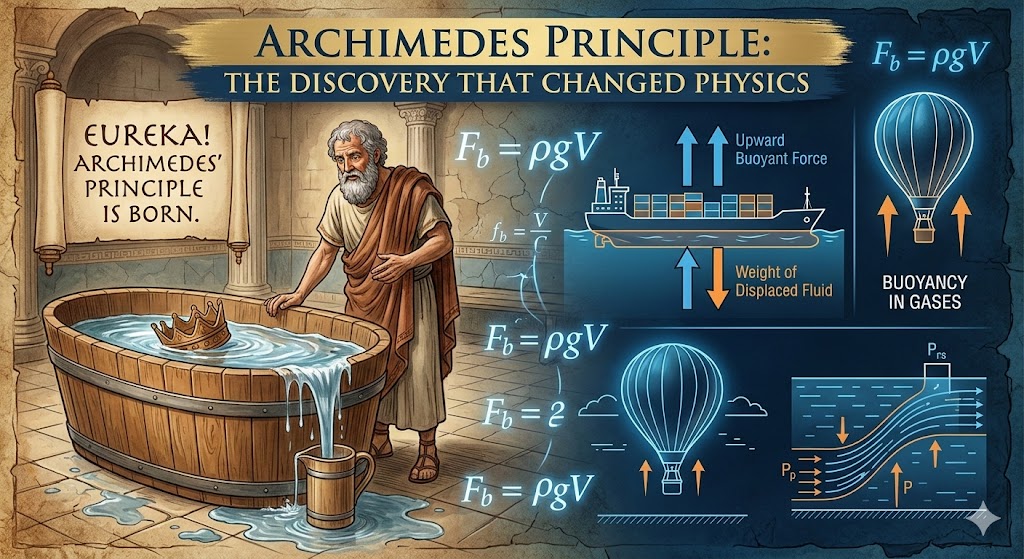
King Hiero II asked Archimedes to determine whether a royal crown was made of pure gold without damaging it. While thinking about the problem, Archimedes stepped into a bathtub and noticed that water overflowed as his body entered the tub.
At that moment, he realized that the amount of displaced water was related to the volume of the object placed in the liquid. This observation led him to the discovery now known as the Archimedes Principle.
Excited by this realization, he reportedly ran through the streets shouting “Eureka!”, meaning “I have found it.”
What Is the Archimedes Principle?
The Archimedes Principle states:
An object submerged in a fluid experiences an upward force equal to the weight of the fluid it displaces.
This upward force is called buoyant force.
In simple terms, when an object is placed in water or any liquid, the liquid pushes upward on the object. If the upward force is strong enough, the object floats. If the object is heavier than the displaced liquid, it sinks.
This idea explains many everyday phenomena related to floating and sinking.
Real-World Applications of the Archimedes Principle
Even though the Archimedes Principle was discovered in ancient times, it remains extremely important in modern science and technology.
Some major applications include:
Ship Design
Ships are designed using buoyancy principles so that even massive vessels can float safely on water.
Submarines
Submarines control their depth by adjusting their density relative to the surrounding water.
Hydrometers
These instruments measure the density of liquids using buoyancy.
Engineering and Fluid Mechanics
Many scientific calculations involving fluids depend on this principle.
Because of these applications, the Archimedes Principle remains a key concept in physics and engineering education.
Why the Discovery Was Revolutionary
The discovery of the Archimedes Principle was revolutionary because it introduced a scientific explanation for buoyancy.
Before Archimedes, people could observe floating objects but did not fully understand the reason behind it. Archimedes transformed simple observation into a scientific law.
His discovery also demonstrated the power of scientific observation and logical reasoning, two methods that later became central to modern scientific research.
Influence on Modern Science
The work of Archimedes influenced many future scientists and engineers.
His discoveries helped develop fields such as:
- Physics
- Engineering
- Fluid mechanics
- Naval architecture
Even today, scientists and engineers rely on the same principle discovered in ancient Greece.
Many historians consider Archimedes one of the greatest scientific minds in history because his discoveries continue to shape modern technology.
Readers interested in the life and achievements of the scientist behind this discovery can explore the life and discoveries of Archimedes.
Conclusion
The Archimedes Principle remains one of the most important discoveries in the history of science. By explaining why objects float or sink, Archimedes helped humanity understand the behavior of fluids.
More than two thousand years later, his discovery continues to influence engineering, physics, and technology around the world.
The story of the Archimedes Principle shows how careful observation and curiosity can lead to discoveries that change the course of scientific history.