Introduction
Before the era of Newton and Einstein, the Western world’s understanding of the physical realm was governed by Aristotle ideas about physics. For Aristotle, physics was not just a matter of mathematical formulas; it was the “philosophy of nature.” He sought to explain why things move, what they are made of, and how the cosmos is structured. His theories were so comprehensive and logically sound for their time that they remained the undisputed standard of scientific truth for nearly two thousand years. To understand the history of human thought, one must first understand how Aristotle perceived the mechanics of our world.
Aristotle’s View of the Physical World
Aristotle viewed the physical world as a place of constant change and purpose. Unlike modern physicists who often view the universe as a series of random mechanical events, Aristotle believed in teleology—the idea that everything in nature has a specific goal or “end.”
He categorized the world into two distinct realms: the Sublunary (the Earth and everything up to the Moon) and the Superlunary (the Heavens). In the sublunary realm, things were subject to decay, change, and death. In the superlunary realm, things were perfect, unchanging, and moved in eternal circles. This division allowed him to explain why a rock falls to the ground while the stars remain fixed in the sky. His work here was an essential part of the broader Aristotle contributions to science, as it attempted to provide a unified theory for all physical phenomena.
The Four Elements Theory
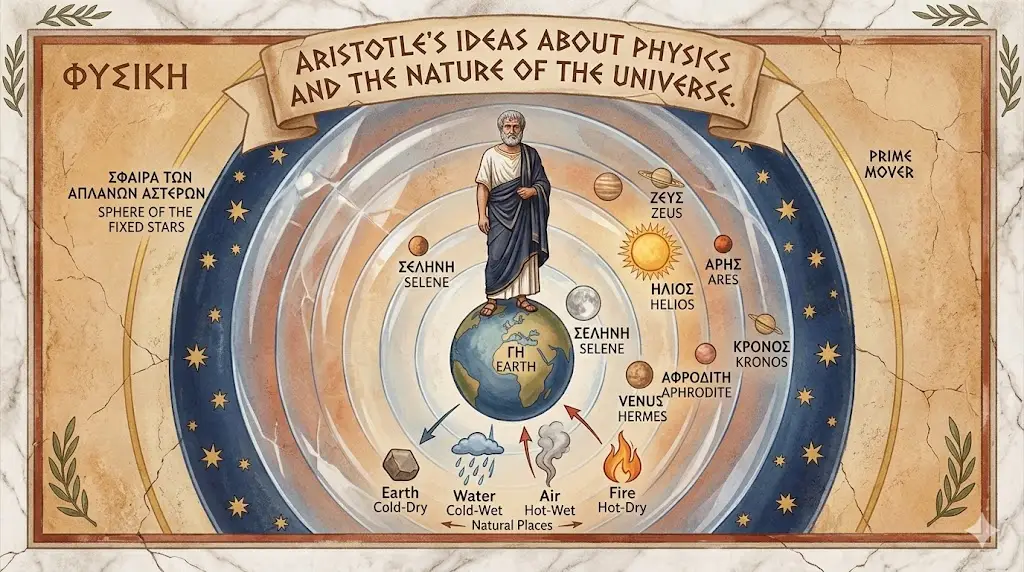
Aristotle’s chemistry and physics were built upon the theory of the four elements. He believed that everything in the terrestrial world was composed of varying proportions of four basic substances:
- Earth: Cold and Dry
- Water: Cold and Wet
- Air: Hot and Wet
- Fire: Hot and Dry
Each element had a “natural place” in the universe. Earth sat at the very center, followed by Water, then Air, and finally Fire at the top. This was not just a chemical observation but a physical law. If you held a stone (Earth) and let it go, it would fall because it was trying to return to its natural home at the center of the world. Smoke (Air/Fire) rose because its natural place was above the ground.
Natural Motion and Violent Motion
One of the most famous Aristotle ideas about physics was his distinction between two types of motion.
- Natural Motion: This occurred when an object moved toward its natural place without being forced. A leaf falling or a flame flickering upward were examples of natural motion. This required no external push; it was simply the object’s “nature” asserting itself.
- Violent Motion: This occurred when an external force was applied to an object to move it away from its natural place. For example, if you throw a stone upward, you are imposing “violent motion” on it.+1
Aristotle famously argued that “nature abhors a vacuum” and that an object requires a constant force to stay in motion. While we now know this to be incorrect (thanks to the law of inertia), his logic was based on everyday observations where friction and air resistance eventually stop any moving object.
Aristotle’s Model of the Universe
Aristotle’s cosmos was a Geocentric (Earth-centered) model. He envisioned the Earth as a stationary sphere at the center of a series of nesting crystalline spheres.
In this model:
- The Moon, Sun, and known planets each occupied their own revolving sphere.
- The outermost sphere contained the “fixed stars.”
- Beyond the stars lay the “Prime Mover,” the original source of all motion in the universe that kept the spheres turning.
Because the heavens were perfect, Aristotle argued they must be made of a fifth element: Aether (or Quintessence). Unlike the four earthly elements, aether was weightless, incorruptible, and moved only in perfect circles. This celestial mechanics was deeply tied to the Aristotle theory of logic, as he used deductive reasoning to conclude that since the heavens appear unchanging, they must be made of a substance fundamentally different from the “corruptible” earth.
The Influence of Aristotle’s Physics
The influence of Aristotle’s physics cannot be overstated. His ideas were adopted by the Catholic Church and Islamic scholars alike because they provided a stable, orderly view of the universe that aligned with theological concepts of a purposeful creator.
For centuries, to question Aristotle was to question the very fabric of reality. It wasn’t until the 16th and 17th centuries that thinkers like Galileo and Newton used the telescope and advanced mathematics to prove that the Earth moves and that the same laws of physics apply to both the heavens and the Earth. However, even in their opposition, these later scientists were responding to the framework Aristotle had built.
Frequently Asked Questions (FAQs)
What was Aristotle’s fifth element?
It was called Aether (or Quintessence). He believed it was the divine substance that made up the stars and planets, allowing them to move eternally in circles without decaying.
Why did Aristotle believe the Earth was the center of the universe?
His observation showed that heavy objects (Earth) fall toward a central point. He logically concluded that the Earth must be the gathering point for all heavy matter, making it the stationary center of the cosmos.
How did Aristotle’s physics differ from modern physics?
Aristotle relied on qualitative observation and purpose (teleology), whereas modern physics relies on quantitative measurement (math) and mechanical cause-and-effect.
Conclusion
While many of Aristotle ideas about physics have been replaced by modern science, his contribution remains a monumental chapter in the history of human thought. He was the first to create a cohesive, logical system that explained everything from a falling drop of rain to the movement of the distant stars. By attempting to categorize the nature of the universe, he set the stage for all future inquiry. Even though his “natural places” and “crystalline spheres” have faded, his belief that the universe is an understandable, orderly place remains the driving force behind all scientific discovery today.