Introduction
The Aristotle scientific method serves as the historical bridge between ancient mysticism and modern empirical science. While the “Scientific Revolution” is often associated with the 17th century, the foundational pulse of systematic inquiry began in the 4th century BCE with Aristotle. He was the first to suggest that the universe was not governed by the whims of gods, but by observable, natural laws. By prioritizing the evidence of the senses over pure abstract speculation, he provided a blueprint for how humans could interrogate the natural world and arrive at reliable truths.
The Need for a Systematic Approach to Knowledge
Before Aristotle, knowledge was often a fragmented collection of oral traditions, myths, and “armchair philosophy.” His predecessor, Plato, believed that the physical world was a mere shadow of a higher reality and that true knowledge could only be found through internal reflection.
Aristotle disagreed. He recognized a desperate need for a systematic approach to knowledge—a way to organize the overwhelming amount of information provided by the world around us. He sought a method that was not only consistent but also reproducible by others. This desire for order led to the development of the Aristotle scientific method, which transitioned Western thought from “why things should be” to “how things actually are.”
Observation as the First Step
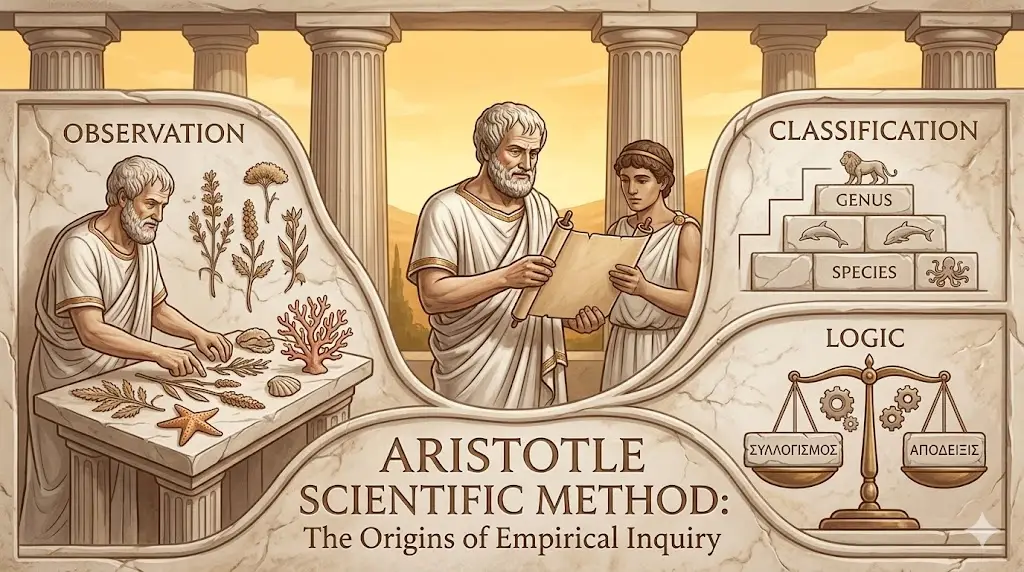
In the Aristotelian view, all knowledge begins with aisthesis (perception). While modern science uses high-tech sensors, the Aristotle scientific method relied on the keen use of the five senses. He believed that to understand a bird, one must watch it fly, eat, and nest.
This “bottom-up” approach is known as inductive reasoning. He would collect vast amounts of specific data points through direct contact with nature. During his time on the island of Lesbos, he spent years documenting the life cycles of marine creatures. This rigorous commitment to observation is the primary reason why Aristotle contributions to biology are still celebrated today; he was the first to prove that you cannot understand life by sitting in a room and thinking about it—you must go outside and look at it.
Classification and Organization of Knowledge
Once observations were collected, the next step in his method was classification. Aristotle believed that nature was inherently organized into hierarchies. To make sense of a specimen, a scientist had to identify its “essence” and its “accidents” (temporary or non-essential traits).
He introduced the concept of Genus and Species, which remains a cornerstone of biological taxonomy. By grouping organisms based on shared physical characteristics, he created a “Map of Nature.” This was not just a list; it was a structural database that allowed future scholars to see the relationships between different forms of life. Without this organizational breakthrough, the massive scale of Aristotle contributions to science would have been a chaotic jumble of notes rather than a coherent discipline.
The Role of Logic in Scientific Reasoning
Observation provides the data, but logic provides the “proof.” Aristotle developed a formal system of deduction to ensure that the conclusions drawn from observations were valid. This is where the Aristotle theory of logic becomes inseparable from his scientific method.
He utilized the Syllogism to test hypotheses. If a scientist observes that “all whales breathe air” (Major Premise) and that “this specific creature is a whale” (Minor Premise), then it logically follows that “this creature breathes air” (Conclusion). By applying these logical filters to his observations, he ensured that his scientific theories were internally consistent. He turned science into a “demonstrative” field where one could prove why a certain phenomenon occurred based on its first principles.
Influence on Later Scientific Thinking
The Aristotle scientific method dominated the intellectual landscape for nearly two millennia. From the Great Library of Alexandria to the medieval universities of Europe, his “Organon” (his works on logic and method) was the primary textbook for anyone seeking to understand the natural world.
Islamic scholars like Ibn Sina (Avicenna) and Al-Biruni expanded upon his methods, refining the process of experimentation. Later, during the Renaissance, even as thinkers like Galileo and Francis Bacon began to challenge his specific conclusions, they still operated within the framework of systematic observation that Aristotle had established. He taught the world that nature was a book that could be read, provided one knew the language of logic.
Limitations of Aristotle’s Method
Despite its brilliance, the Aristotle scientific method had significant limitations compared to modern standards:
- Lack of Experimentation: Aristotle was a master observer, but he rarely performed controlled experiments. He watched nature as it happened but did not often manipulate variables to see what changed.
- Teleological Bias: He believed everything in nature had a “purpose” (telos). For example, he believed rain fell because plants needed to grow, rather than because of atmospheric physics.
- The “Weight” of Authority: Because his system was so complete, later scholars became hesitant to challenge his errors, which occasionally slowed scientific progress in areas like physics and astronomy.
Lasting Legacy of Aristotle’s Scientific Approach
The true legacy of Aristotle lies in his spirit of inquiry. He gave us the vocabulary of science—terms like faculty, mean, category, energy, and principle all stem from his work. He established the first research library and the first systematic collection of zoological data.
Most importantly, he instilled the idea that the human mind is capable of understanding the universe through reason. Every time a student looks through a microscope to draw what they see, or a researcher categorizes data into a spreadsheet, they are following the path first cleared by the Aristotle scientific method.
Frequently Asked Questions (FAQs)
Did Aristotle use the modern scientific method?
Not exactly. While he used observation and logic (induction and deduction), he did not use the modern “hypothetico-deductive” model, which requires controlled experimentation and mathematical modeling.
How did Aristotle contribute to biology?
He classified over 500 species of animals and was the first to use comparative anatomy to show relationships between different organisms, such as identifying dolphins as mammals.
What is the difference between Aristotle’s induction and deduction?
Induction is the process of gathering specific observations to form a general rule (bottom-up). Deduction is using a general rule to reach a specific, necessary conclusion (top-down).
Conclusion
The Aristotle scientific method was the spark that ignited the flame of organized human knowledge. By combining the raw power of observation with the structural integrity of the Aristotle theory of logic, he transformed a world of myths into a world of facts. Although science has evolved to include complex math and lab testing, the core principle remains the same: we must look at the world, organize what we see, and reason our way toward the truth.