Introduction
The Aristotle Theory of Logic stands as one of the most significant intellectual achievements in human history. Before Aristotle, arguments were often judged by their persuasiveness or poetic flair rather than their structural integrity. Aristotle changed this by treating logic as a formal instrument of the mind—a “toolbox” for identifying truth and exposing fallacy. By developing a systematic way to analyze how we reason, he provided the framework that would guide Western philosophy, law, and science for over two millennia.+1
The Origin of Logical Thinking
Aristotle did not invent the act of thinking, but he was the first to invent the “science” of thinking. While his teacher, Plato, focused on the world of ideal forms, Aristotle was deeply concerned with the tangible world and how we categorize it. He realized that for any branch of knowledge to be valid, it must be built upon a foundation of consistent rules.
The origin of his logical thinking was rooted in the need for clarity. In the rowdy debates of Ancient Greece, “Sophists” often used clever but deceptive wordplay to win arguments. Aristotle sought to create a rigorous system that could distinguish a valid argument from a mere trick of language. This led to the birth of formal logic, where the focus shifted from what someone was saying to how the conclusion was derived from the premises.+1
The Concept of Syllogism
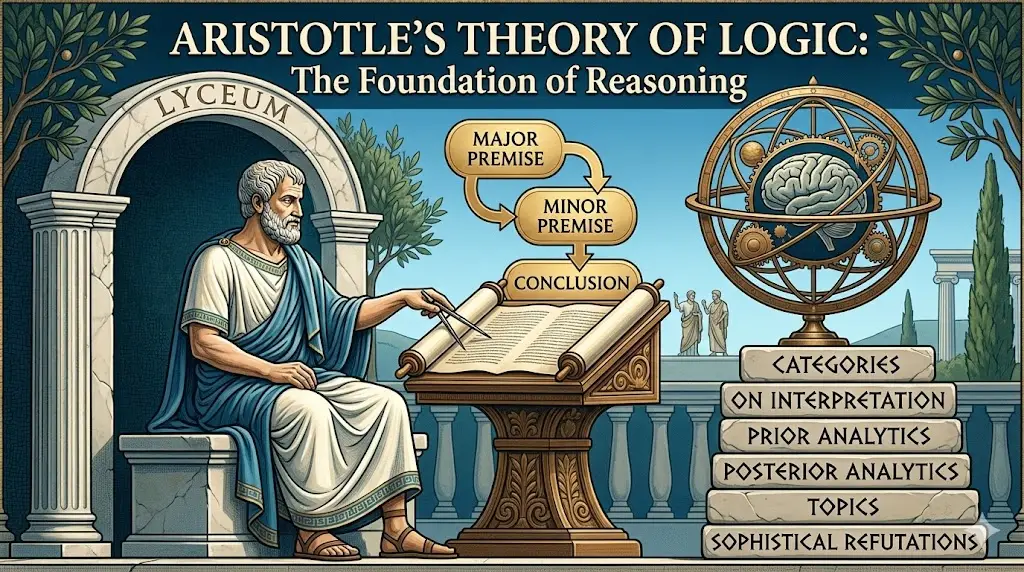
At the heart of the Aristotle Theory of Logic is the Syllogism. This is a three-part deductive argument consisting of a major premise, a minor premise, and a conclusion. Aristotle believed that if the premises are true and the structure is valid, the conclusion must inevitably be true.
The classic example of an Aristotelian syllogism is:
- Major Premise: All humans are mortal.
- Minor Premise: Socrates is a human.
- Conclusion: Therefore, Socrates is mortal.
Through the syllogism, Aristotle introduced the concept of deductive reasoning. He categorized these arguments into various “moods” and “figures,” identifying which structures led to certain truths and which led to logical fallacies. This was the first time in history that the “form” of an argument was separated from its “content.”
Aristotle’s Logical Works
Aristotle’s writings on logic are collectively known as the Organon, which means “instrument” or “tool.” He did not view logic as a science in itself, but rather as the essential tool that must be mastered before studying any other science. The Organon consists of six key books:+1
- Categories: Discusses the ten ways we describe things (substance, quantity, quality, relation, etc.).
- On Interpretation: Analyzes nouns, verbs, and how we form propositions.
- Prior Analytics: Introduces the formal theory of the syllogism.
- Posterior Analytics: Deals with demonstration and how we acquire “scientific” knowledge.
- Topics: Focuses on dialectical arguments and how to debate effectively.
- Sophistical Refutations: A guide to identifying and debunking logical fallacies.
These works established a vocabulary for logic—terms like “premise,” “conclusion,” and “proposition”—that we still use in modern philosophy classrooms today.
Influence on Science and Philosophy
It is impossible to separate the Aristotle Theory of Logic from the broader history of intellectual progress. His logic provided the “grammar” for medieval scholasticism and the Renaissance. When we look at Aristotle contributions to science, we see that his logical framework allowed researchers to move beyond random observations toward structured proof.+1
For centuries, a scientist’s work was judged by how well it adhered to Aristotelian logic. His insistence that every claim must be backed by a demonstration became the gold standard for academic rigor. While modern symbolic logic has expanded upon his work, the core idea that an argument must be internally consistent remains the bedrock of philosophical inquiry.
Logic and Scientific Thinking
Aristotle believed that logic was the bridge between raw sensory data and universal truths. This is where his work in logic intersects with his work in biology. When exploring Aristotle contributions to biology, we see him applying his logical categories to the natural world. He didn’t just look at animals; he categorized them by their “differentiae”—the logical characteristics that set one species apart from another.
Logic allowed Aristotle to:
- Classify Species: Using “genus” and “species” (logical terms) to organize life.
- Predict Outcomes: Using deductive reasoning to understand biological functions.
- Validate Observations: Ensuring that a biological theory didn’t contradict its own premises.
By applying the Aristotle Theory of Logic to the physical world, he transformed biology from a collection of “traveler’s tales” into a structured, verifiable science.
Lasting Legacy of Aristotelian Logic
The legacy of Aristotelian logic is visible every time we use a computer or a search engine. Modern computer programming and “if-then” statements are the digital descendants of the Aristotelian syllogism. While the 19th-century development of mathematical logic (by figures like George Boole and Gottlob Frege) moved beyond Aristotle’s linguistic focus, they still built upon the foundation he laid.
His work on fallacies is perhaps his most practical legacy. In an age of “fake news” and digital misinformation, Aristotle’s guides on how to spot a “sophistical refutation” (a logical trick) are more relevant than ever. He taught us that a loud argument is not necessarily a true one, and that truth is something that must be demonstrated through clear, valid steps.
Frequently Asked Questions (FAQs)
What is the main goal of Aristotle’s logic?
The main goal was to create a reliable method for determining the truth of an argument based on its structure, ensuring that conclusions follow necessarily from their premises.
What is a “fallacy” in Aristotelian terms?
A fallacy is an argument that appears to be valid but contains a flaw in its logical structure, leading to an incorrect or unsupported conclusion.
Is Aristotelian logic still used today?
Yes. While modern logic is more complex and uses mathematical symbols, the basic principles of deduction, the syllogism, and the laws of non-contradiction are still foundational to philosophy and law.
What is the “Law of Non-Contradiction”?
One of Aristotle’s most famous logical axioms, it states that something cannot be both true and false at the same time in the same sense.
Conclusion
The Aristotle Theory of Logic did more than just teach people how to win debates; it taught humanity how to think clearly. By identifying the syllogism and codifying the rules of deduction in the Organon, Aristotle provided the essential “instrument” for all future human discovery. Whether in the halls of a modern university, the coding of a software program, or the classification of a new biological species, the ghost of Aristotle’s logic continues to guide our search for truth.